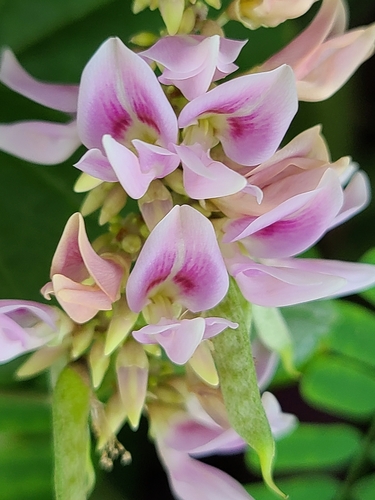
Entada africana
Guill. & Perr.

(c) Marco Schmidt http://www.senckenberg.de/root/index.php?page_id=1750&preview=true, some rights reserved (CC BY-SA)

(c) Marco Schmidt, some rights reserved (CC BY-NC-SA)

(c) Stefan Dressler, some rights reserved (CC BY-NC-SA)
What to Eat
Edible parts: Leaves - flavouring, Root
The leaves are used as a flavouring, and the root is edible.
Known Hazards
Where to Find It
A tropical plant. It grows in the savannah in West Africa. In Nigeria it is common at about 1,000 m above sea level. It grows in the Sahel. It grows on lower slopes or banks of swamps. It grows in areas with a rainfall between 600-1,200 mm each year. It is damaged by bush fires. It can grow in arid places.
Africa, Benin, Burkina Faso, Cameroon, Central Africa, Congo, East Africa, Ghana, Guinea, Guinée, Guinea-Bissau, Niger, Nigeria, Sahel, Senegal, Sudan, Uganda, West Africa, Zambia,
How to Identify
A small tree. It grows 8 m tall. It has low branches and a wide crown. It loses its leaves during the year. The bark is grey-brown and has stripes across it. It is scaly. The leaves are alternate and twice divided. The stalk is 25-30 cm long with 2-9 pair of side stalks which have 10-20 pairs of leaflets. The base of the leaflets is unequal. They are 2-3 cm long by 1 cm wide. The flowers are white to yellow and have a slight scent. They are in spikes 15 cm long in the axils of leaves. The fruit is a pod. It is 10-22 cm long and flat. The seeds have 2 wings.
How to Grow
A plant of drier areas in the tropics, where it can be found at elevations from 450 - 1,100 metres. It is found in areas with a mean annual rainfall in the range 600 - 1,200mm and mean annual temperatures of 20 - 32°c. The plant is found in the wild in deep sandy soils and more or less rocky soils. The tree is very tolerant of bush fires. The plant is very sensitive to bush fires and is often found wild in a fire-mutilated state.
Propagation: Seed - it has a hard seedcoat and may benefit from scarification before sowing to speed up germination. This can usually be done by pouring a small amount of nearly boiling water on the seeds (being careful not to cook them!) and then soaking them for 12 - 24 hours in warm water. By this time they should have imbibed moisture and swollen - if they have not, then carefully make a nick in the seedcoat (being careful not to damage the embryo) and soak for a further 12 hours before sowing.
Medicinal Uses
The plant is commonly used as a traditional medicine within its native range. The leaves have been shown to contain rotenol. The leaves are stomachic. They are used to make a tonic tea. Applied externally, the leaves are used for healing wounds. They make a good wound dressing, preventing suppuration. The bark is abortifacient. The roots are stimulant and tonic. Because of their emetic properties, they are said to have antidotal effects against various toxic agents and fish poison.
Other Uses
A fibre obtained from the inner bark is used for making ropes, bands, storage bins etc. The bark is a source of tannins. A low quality gum is obtained from the tree. It comprises around 10% gum tragacanth and 90% gum arabic. The bark contains low levels of rotenone, which has insecticidal properties. Rotenone is widely used as an insecticide, and is effective against a range of horticultural pests, such as aphids and caterpillars, and also against external body parasites like ticks, lice, fleas and flies. It is reported to be ineffective against bedbugs, cockroaches, scale insects and red spiders.. The rotenone can be found in various parts of the plant, but is generally most abundant in the bark, especially of the roots. The bark can be dried and powdered for use as an insecticidal dust. The wood is light red, rather soft and easy to work. It is used for small carpentry.
Wikipedia
Source ↗Entada africana is a species of flowering plant in the family Fabaceae. It is native to tropical Africa. It is listed as Least Concern on the IUCN Red List Of Threatened Species.
Notes
There are about 30 Entada species. They occur in the tropics. Also as Mimosaceae. The leaves contain rotenol.
Names & Synonyms
Batiare, Bonome, Bu salel, Pade-pade, Papadar, Samatino, Tawarsa, Wondon
References (9)
- A. Guillemin et al., Fl. Seneg. tent. 1:233. 1832
- Achigan-Dako, E, et al (Eds), 2009, Catalogue of Traditional Vegetables in Benin. International Foundation for Science.
- Bonou, A., et al, 2013, Valeur economique des Produits Forestiers Non Ligneux (PFNL) au Benin. Editions Universitaires Europeennes p 90
- Burkill, H. M., 1985, The useful plants of west tropical Africa, Vol. 3. Kew.
- Chapman, J. D. & Chapman, H. M., 2001, The Forest Flora of Taraba and Andamawa States, Nigeria. WWF & University of Canterbury. p 184
- Codjia, J. T. C., et al, 2003, Diversity and local valorisation of vegetal edible products in Benin. Cahiers Agricultures 12:1-12
- Fowler, D. G., 2007, Zambian Plants: Their Vernacular Names and Uses. Kew. p 80
- Maydell, H. von, 1990, Trees and shrubs of the Sahel: their characteristics and uses. Margraf. p 259
- Vanderjagt, D. J. et al, 2000, The trypsin inhibitor content of 61 wild edible foods of Niger. Plant Foods for Human Nutrition. 55:335-346