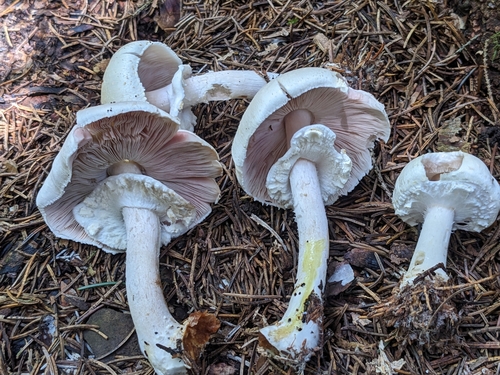
Agaricus augustus
Fr.
The Prince, mushroom
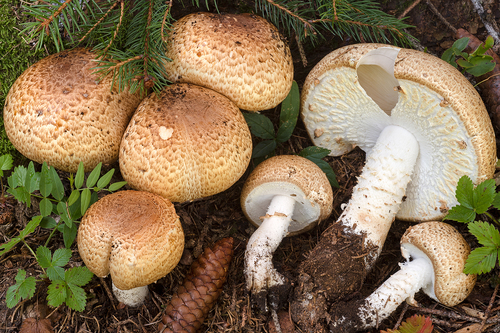
iNaturalist · cc-by-nc
(c) Federico Calledda, some rights reserved (CC BY-NC), uploaded by Federico Calledda
(c) Federico Calledda, some rights reserved (CC BY-NC), uploaded by Federico Calledda
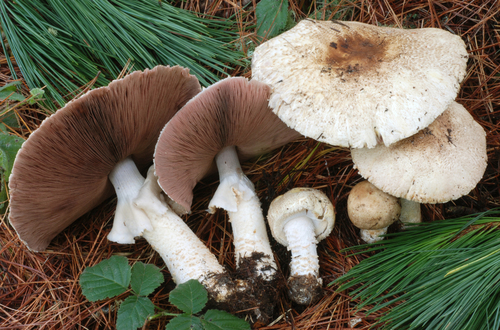
iNaturalist · cc-by-nc
(c) Christian Schwarz, some rights reserved (CC BY-NC), uploaded by Christian Schwarz
(c) Christian Schwarz, some rights reserved (CC BY-NC), uploaded by Christian Schwarz
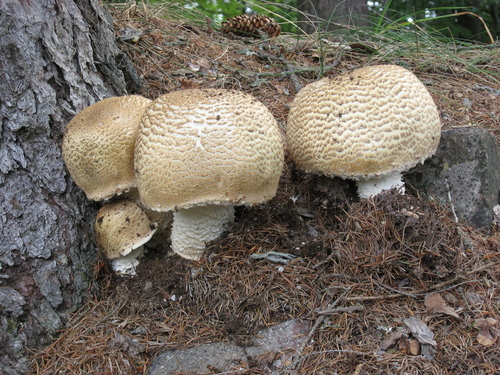
iNaturalist · cc-by-nc
(c) Andrea Peterlongo, some rights reserved (CC BY-NC), uploaded by Andrea Peterlongo
(c) Andrea Peterlongo, some rights reserved (CC BY-NC), uploaded by Andrea Peterlongo
What to Eat
Edible parts: Mushroom, Fungus
This mushroom is a choice edible for most people. It is collected widely for consumption in Eurasia, Canada, the United States, and some parts of Mexico.
Known Hazards
Where to Find It
It is a temperate plant.
Asia, Australia, Britain, Caucasus, China, Europe, Georgia, Hungary, Mexico, North America, Pakistan, USA,
Countries: Andorra, United Arab Emirates, Afghanistan, Antigua & Barbuda, Albania, Armenia, Austria, Australia, Azerbaijan, Bosnia & Herzegovina, Barbados, Bangladesh, Belgium, Bulgaria, Bahrain, Brunei, Bahamas, Bhutan, Belarus, Belize, Canada, Switzerland, China, Costa Rica, Cuba, Cyprus, Czechia, Germany, Denmark, Dominica, Dominican Republic, Estonia, Spain, Finland, France, United Kingdom, Grenada, Georgia, Greece, Guatemala, Honduras, Croatia, Haiti, Hungary, Indonesia, Ireland, Israel, India, Iraq, Iran, Iceland, Italy, Jamaica, Jordan, Japan, Kyrgyzstan, Cambodia, St Kitts & Nevis, North Korea, South Korea, Kuwait, Kazakhstan, Laos, Lebanon, St Lucia, Liechtenstein, Sri Lanka, Lithuania, Luxembourg, Latvia, Monaco, Moldova, Montenegro, North Macedonia, Myanmar, Mongolia, Malta, Maldives, Mexico, Malaysia, Nicaragua, Netherlands, Norway, Nepal, Oman, Panama, Philippines, Pakistan, Poland, Puerto Rico, Portugal, Qatar, Romania, Serbia, Russia, Saudi Arabia, Sweden, Singapore, Slovenia, Slovakia, San Marino, El Salvador, Syria, Thailand, Tajikistan, Timor-Leste, Turkmenistan, Turkey, Trinidad & Tobago, Taiwan, Ukraine, United States, Uzbekistan, St Vincent, Vietnam, Yemen
How to Identify
A mushroom. The fruiting bodies have thick flesh and are firm and white. The caps can be 25 cm across.
Wikipedia
Source ↗Agaricus augustus, known commonly as the prince, is a basidiomycete fungus of the genus Agaricus. It is generally edible, but bioaccumulates the metal cadmium.
Notes
There are about 300 Agaricus species.
Names & Synonyms
Dazigu, Sanjuanero del oyamel, Tskhvario
Psalliota augusta (Fr.) Quel.
References (12)
- Boa, E. R., 2004, Wild edible fungi and their importance to people. FAO Non Wood Forest Products Booklet 17
- Bussman, R. W., et al, 2016, A comparative ethnobotany of Khevsureti, Samtskhe-Javakheti, Tusheti, Svaneti, and Racha-Lechkhumi, Republic of Georgia (Sakartvelo), Caucasus. Journal of Ethnobiology and Ethnomedicine (2016) 12:43
- Bussman, R. W. et al, 2017, Ethnobotany of Samtskhe-Javakheti, Sakartvelo (Republic of Georgia), (Caucasus). Indian Journal of Traditional Knowledge Vol. 16(1) pp 7-24
- Estrada-Martinez, E., et al, 2009, Contribucion al conocimiento etnomicologico de los Hongos Comestibles Silvestres de Mercados Regionales y Comunidades de la Sierra Nevada (Mexico). Intercienca Jan 2009 Vol. 34 No. 1 Facciola, S., 1998, Cornucopia 2: a Source Book of Edible Plants. Kampong Publications, p 249
- Fuhrer, B., 2005, A field guide to Australian Fungi. Bloomings Books. p 18
- http://www.mykoweb.com/CAF/edible.html
- Jordan, P., 2000, The Mushroom Guide and Identifier, Hermes House, p 28
- Kaufmann, B. et al, 1999, The Great Encyclopedia of Mushrooms. Konemann. p 161
- Montoya, A., et al, 2014, Availability of Wild Edible Fungi in La Malinche National park, Mexico. Journal of Mycology. Article ID 241896, 15 pages
- Pace, G., 1998, Mushrooms of the world. Firefly books. p 48 (As Psalliota augusta)
- Vetner, J., 2004, Arsenic content of some edible mushroom species. Eur. Food Res. Technol. 219: 71-74
- www.plantnames.unimelb.edu.au