Microsorum punctatum
(L.) Copel.
Fragrant fern, Climbing bird's nest fern
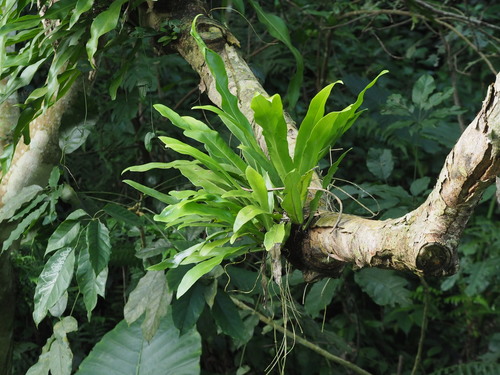
(c) Hong, some rights reserved (CC BY-NC), uploaded by Hong

(c) Lorraine Phelan, some rights reserved (CC BY-NC), uploaded by Lorraine Phelan
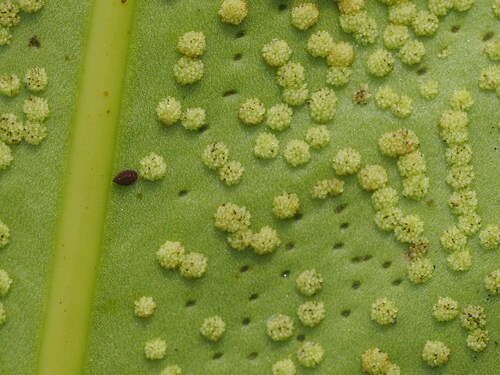
(c) Hong, some rights reserved (CC BY-NC), uploaded by Hong
What to Eat
Edible parts: Leaves, Fronds
The leaves and fronds are eaten.
Where to Find It
It is a tropical plant. It suits warm climates. It grows on boulders and amongst rocks in dry forest. It suits hardiness zones 11-12.
Africa, Asia, Australia, China, East Africa, Guam, Hawaii, India, Indochina, Indonesia, Madagascar, Malawi, Malaysia, Marquesas, Mozambique, Myanmar, Nigeria, Pacific, Papua New Guinea, PNG, Philippines, Polynesia, SE Asia, Sierra Leone, Singapore, Solomon Islands, Sri Lanka, Taiwan, Thailand, USA, Vietnam, West Africa, Zimbabwe,
How to Identify
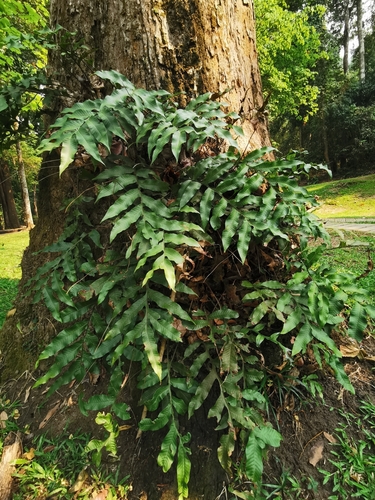
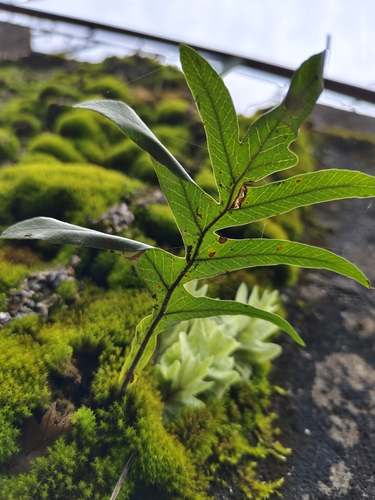
A leafy fern. It has a slender creeping rhizome. It is fleshy. It is covered with a dense mass of black roots. The fern grows 0.3-1.2 m high. It can grow in soil or on rocks. The fronds are narrow and pale green. They are 30-120 cm long by 4-10 cm wide. They are leathery and undivided. They grow erect. Some varieties have lobed leaves. There are a range of cultivated varieties. The spore bodies are 0.1 cm across. They grow on the upper half of the fronds.
How to Grow
Plants can be grown from spores or by division.
Medicinal Uses
Juice extracted from the fronds (leaves) of the fern is used as purgative, diuretic, and wound healing agents in traditional medicine in Assam.
Wikipedia
Source ↗Microsorum punctatum is a fern from the subfamily Microsoroideae commonly called the fish-tail fern, climbing bird's nest fern, dwarf elkhorn fern, or wart fern. It has been used in traditional medicine.
Notes
There are about 60 Microsorum species. They grow in the tropics.
Names & Synonyms
References (15)
- Andrews, S.B., 1990, Ferns of Queensland. A handbook to the ferns and fern allies. Queensland DPI p 281 (Also as Polypodium punctatum)
- Chaffey, C.H., 1999, Australian Ferns. Growing them successfully. Kangaroo Press. p 11, 182, 197
- Chai, T., et al, 2015, Cytotoxicity and Antiglucosidase Potential of Six Selected Edible and Medicinal ferns. Acta Poloniae Pharmaceutica ñ Drug Research, Vol. 72 No. 2 pp. 297- 401.
- Chin, W.Y., 1998, Ferns in the Tropics. Kangaroo. p 142
- Croft, J., 1982, Ferns and Man in New Guinea
- Cronin, L., 1989, The Concise Australian Flora. Reed. p 264
- Cundall, P., (ed.), 2004, Gardening Australia: flora: the gardener's bible. ABC Books. p 895
- Elliot, W.R., & Jones, D.L., 1993, Encyclopedia of Australian Plants suitable for cultivation. Vol 6. Lothian. p 412 (Drawing)
- Flora of Solomon Islands
- Goudey, C.J., 1988, A Handbook of Ferns for Australia and New Zealand. Lothian. p 124
- Hibbert, M., 2002, The Aussie Plant Finder 2002, Florilegium. p 197
- Powell, J.M., Ethnobotany. In Paijmans, K., 1976, New Guinea Vegetation. Australian National University Press. p 111 (As Polypodium irioides)
- Ratcliffe D & P., 1987, Australian Native Plants for Indoors. Little Hills press. p 106 (As Microsorium)
- Staples, G.W. and Herbst, D.R., 2005, A tropical Garden Flora. Bishop Museum Press, Honolulu, Hawaii. p 43
- Univ. Calif. Publ. Bot. 16:111. 1929