Senegalia catechu
(L. f.) P.J. H. Hurter & Mabb.
Catechu acacia, Cutch tree

(c) SONU KUMAR, some rights reserved (CC BY-NC)
(c) Rujuta Vinod, some rights reserved (CC BY-NC)

(c) Ramnarayan K, some rights reserved (CC BY)
What to Eat
Edible parts: Wood resin, Bark- tea , Gum
Catechu, extracted from the heartwood, is an essential ingredient in paan — a mildly narcotic chewing mixture made with betel leaf (Piper betle) and betel palm seed (Areca spp.). The seeds contain water-soluble mucilage (6.8%) and are a useful protein source, though they are nutritionally incomplete with respect to essential amino acids.
Known Hazards
Where to Find It
It is a tropical plant. It grows in dry open forest in the west of Thailand. They grow in the drier plains of India. In Nepal it grows between 200-1,400 m above sea level. It suits hardiness zones 10-12.
Asia, Bangladesh, Bhutan, China, Hawaii, Himalayas, India, Indochina, Indonesia, Mauritius, Myanmar, Nepal, Pacific, Pakistan, SE Asia, Sri Lanka, Taiwan, Thailand, USA, Vietnam,
How to Identify
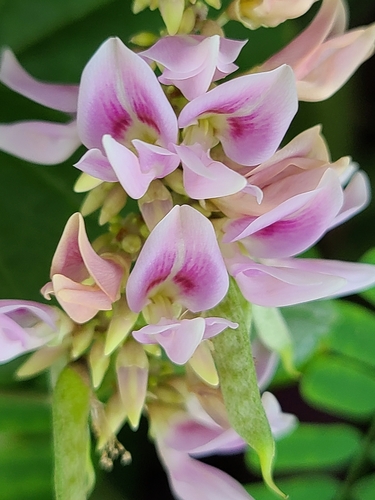
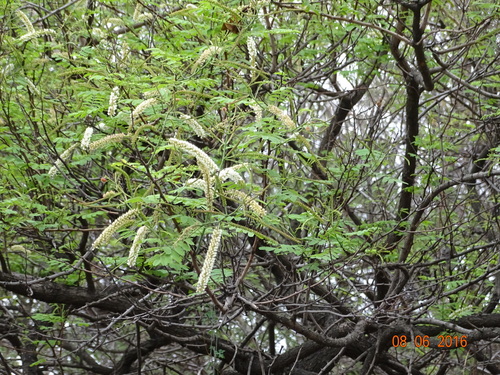
A tree. It grows 5-15 m high. The branches are spiny. The trunk is dark brown with cracks along its length. The leaves are compound with 9-30 pairs of leaflet stalks and 20-50 leaflets along them. These are oblong and have a sharp end. They are 3-4 cm long. The flower spike is 2.5-10 cm long in the axils of leaves. The flowers are 5 mm long. They are white have have a slight smell. The fruit are pods which are thin and have a short beak. They are flat and 5-7.5 cm long by 1-1.5 cm wide. The seeds are shiny brown and 3-10 occur in each pod.
How to Grow
The tree is grown from seeds. It can be grown from cuttings.
Propagation: Seeds of this genus typically have a hard seedcoat and benefit from scarification before sowing. Pour a small amount of nearly boiling water over the seeds (do not cook them), then soak in warm water for 12–24 hours. Seeds should swell and absorb moisture; if not, carefully nick the seedcoat without damaging the embryo and soak for a further 12 hours before sowing. Seed germinates best at around 21°C, with sprouting beginning around 5–7 days after sowing treated seed. Plants quickly develop a deep taproot and resent disturbance, so should be moved to their permanent positions as soon as possible. Can also be propagated by semi-ripe cuttings of lateral shoots.
Medicinal Uses
Black catechu is a bitter-sweet antiseptic and astringent herb. The leaves, young shoots, and bark are commonly used to check bleeding and discharges. The plant is strongly astringent, promoting blood clotting and reducing excess mucus in the nose, large bowel, or vagina. Internally, it treats dysentery, chronic diarrhoea, and chronic catarrh. Externally, it is applied as a wash to treat nosebleeds, haemorrhoids, skin eruptions, bed sores, mouth ulcers, sore throats, and dental infections. Boiling the wood and foliage produces a dark brown sticky substance known as catechu, cutch, or cachou. This solidifies on cooling and has been a significant medicinal trade item since at least the 16th century, reaching Europe in the 17th century. It contains 25–60% tannins, flavonoids, and resins, and is valued chiefly for its astringent qualities, used both internally and externally to check bleeding and excessive mucous membrane secretions. In this form, the herb is subject to legal restrictions in some countries. The seeds have also been reported to have antibacterial activity.
Other Uses
The bark is rich in tannins. A khaki dye can be obtained from the bark. The bark also exudes a high-quality light gum, considered one of the best substitutes for gum arabic — itself obtained from Senegalia senegal and used as a food additive, medicine, and mucilage in inks. A solid tannin-rich extract called catechu or cutch, usually containing 55–60% tannins, is obtained from the heartwood and processed into several distinct products. In India and Myanmar, dark catechu or Pegu cutch is used for tanning (often mixed with other tan materials), preserving fishing nets and ropes, and dyeing cotton, silk, canvas, paper, and leather a dark brownish colour; it also serves as a viscosity modifier in on-shore oil wells. For dyeing cotton, material is steeped for about one hour in a boiling cutch solution to which copper sulphate has been added, then transferred to a sodium bichromate bath; the resulting dye is very fast to light, acids, and alkalis. The crystalline portion of a concentrated wood decoction, called katha or kath, is widely used in betel chewing with Piper betle leaf and for astringent medicinal purposes. A third form, called khersal, is the crystalline deposit found in cavities of the wood and is also used medicinally. To produce these extracts, heartwood chips are extracted with water in copper, wood, aluminium, or stainless steel vessels, heated for about two hours, then re-extracted in a fresh water bath. The extract is evaporated and cooled for crystallization to yield katha, which is separated by filtering. Further concentration produces cutch, which solidifies on cooling — this separation works because cutch is soluble in both hot and cold water, while katha is only sparingly soluble in cold water. The heartwood is light red to reddish-brown, darkening on exposure, and is sharply distinct from the yellow to yellowish-white sapwood. The wood is very strong, hard, durable, and resistant to white ants and teredos. It requires long seasoning and is fairly difficult to saw. Used locally for poles, agricultural implements, wheels, and household items. It is also an excellent fuel and ideal for charcoal production. The plant is traditionally grown in living fences in the northwestern Himalayas to exclude livestock, mark land boundaries, and provide medicinal and other resources.
Wikipedia
Source ↗Senegalia catechu, previously known as Acacia catechu, is a deciduous, thorny tree which grows up to 15 m (50 ft) in height. The plant is called kachu in Malay; the Malay name was Latinized to "catechu" in Linnaean taxonomy, as the species from which the extracts cutch and catechu are derived. Other common names for it include kher, catechu, cachou, cutchtree, black cutch, and black catechu. Senegalia catechu is native to South Asia and Southeast Asia, including the Indian subcontinent, Myanmar, Cambodia and China (Yunnan). Through derivatives of the flavanols in its extracts, the species has lent its name to the important catechins, catechols and catecholamines of chemistry and biology.
Production
It is fast growing.
Other Information
It is sold in markets.
Notes
There are about 1,350 Acacia species. Over 1,000 occur in Australia. This one yields catechu used in dyeing. It has anticancer properties. Also as Mimosaceae.
Names & Synonyms
Black catechu, Black cutch, Kachu, Karangalli, Katha, Keo cau, Khadira, Khaia, Khair, Khayar, Khayer, Mung-ting, Nya, Pohon akasia katecu, Sandra, See-siad, Seesiat nuea, Sha, Shaji, Tun-sa-se, Wadalee-Gum tree
References (29)
- Acharya K. P. and Acharya, R., 2010, Eating from the Wild: Indigenous knowledge on wild edible plants in Parroha VDC of Rupandehi District, Central Nepal. International Journal of Social Forestry. 3(1):28-48 (As Acacia catechu)
- Ambasta S.P. (Ed.), 2000, The Useful Plants of India. CSIR India. p 4 (As Acacia catechu)
- Bandyopadhyay, S. et al, 2009, Wild edible plants of Koch Bihar district, West Bengal. Natural Products Radiance 8(1) 64-72 (As Acacia catechu)
- Bhatia, H., et al, 2018, Traditionally used wild edible plants of district Udhampur, J&K, India. Journal of Ethnobiology and Ethnomedicine (2018) 14:73 (As Acacia catechu)
- Biocyclopedia Edible Plant Species (As Acacia catechu)
- Bole, P.V., & Yaghani, Y., 1985, Field Guide to the Common Trees of India. OUP p 33 (As Acacia catechu)
- Brown, D., 2002, The Royal Horticultural Society encyclopedia of Herbs and their uses. DK Books. p 98 (As Acacia catechu)
- Burkill, I.H., 1966, A Dictionary of the Economic Products of the Malay Peninsula. Ministry of Agriculture and Cooperatives, Kuala Lumpur, Malaysia. Vol 1 (A-H) p (As Acacia catechu)
- Dangol, D. R. et al, 2017, Wild Edible Plants in Nepal. Proceedings of 2nd National Workshop on CUAOGR, 2017.(As Acacia catechu)
- Dunlop, C.R., Leach, G.J. & Cowie, I.D., 1995, Flora of the Darwin Region. Vol 2. Northern Territory Botanical Bulletin No 20. p 8 (As Acacia catechu)
- Facciola, S., 1998, Cornucopia 2: a Source Book of Edible Plants. Kampong Publications, p 151 (As Acacia catechu)
- Flora of Pakistan. www.eFloras.org (As Acacia catechu)
- Hedrick, U.P., 1919, (Ed.), Sturtevant's edible plants of the world. p 18 (As Acacia catechu)
- ILDIS Legumes of the World http:www;ildis.org/Legume/Web (As Acacia catechu)
- Jacquat, C., 1990, Plants from the Markets of Thailand. D.K. Book House p 39 (As Acacia catechu)
- Kintzios, S. E., 2006, Terrestrial Plant-Derived Anticancer Agents and Plant Species Used in Anticancer research Critical Reviews in Plant Sciences. 25: pp 79-113 (As Acacia catechu)
- Krishen P., 2006, Trees of Delhi, A Field Guide. DK Books. p 274 (As Acacia catechu)
- Maisuthisakul, P., 2012, Phenolic Constituents and Antioxidant Properties of some Thai Plants. Chp. 9 in Book Phytochemicals - A Global Perspective of Their Role in Nutrition and Health (As Acacia catechu)
- Manandhar, N.P., 2002, Plants and People of Nepal. Timber Press. Portland, Oregon. p 66 (As Acacia catechu)
- McMakin, P.D., 2000, Flowering Plants of Thailand. A Field Guide. White Lotus. p 51 (As Acacia catechu)
- Rashid, H. E., 1977, Geography of Bangladesh. Westview. p 322 (As Acacia catechu)
- Shrestha, S., 2021, Wild Edible Plants of Dhankuta, Eastern Nepal. Rupantaran : A Multidisciplinary Journal Vol. V : pp 100-109, September, 2021 p 102 (As Acacia catechu)
- Sp. pl. 4(2):1079. 1806 (As Acacia catechu)
- Staples, G.W. and Herbst, D.R., 2005, A tropical Garden Flora. Bishop Museum Press, Honolulu, Hawaii. p 302 (As Acacia catechu)
- Sukarya, D. G., (Ed.) 2013, 3,500 Plant Species of the Botanic Gardens of Indonesia. LIPI p 98 (As Acacia catechu)
- Swaminathan, M.S., and Kochnar, S.L., 2007, An Atlas of Major Flowering Trees in India. Macmillan. p 131 (As Acacia catechu)
- Thapa, L. B., et al, 2014, Wild Edible Plants used by endangered and Indigenous Raji Tribe in Western Nepal. International Journal of Applied Sciences and Biotechnology. Vol 2(3):243-252 (As Acacia catechu)
- Wiersema, J. H. & Leon, B., 2013, World Economic Plants. A Standard Reference CRC Press. 2nd Ed. p 629
- World Checklist of Useful Plant Species 2020. Royal Botanic Gardens, Kew