Zanthoxylum limonella
(Dennst.) Alston
Indian pepper

(c) V.Arun, some rights reserved (CC BY-NC)

(c) Rock Outcrops Network VBR test, some rights reserved (CC BY-NC)
(c) Pramod Appaso Kumbhar, some rights reserved (CC BY-NC)
What to Eat
Edible parts: Fruit, Leaves, Spice, Bark, Seed coat
The people of Goa, the Konkan and Kanara coasts, and Coorg use the woody pericarp of the tiny fruits as a spice, particularly with seafood dishes. The spice is known as "teppal" in Konkani. In the Northwest region of Vietnam, the spice is known as "mắc khén" and is used particularly by people of the Muong ethnic minority on grilled meats and in dipping sauces. The spice contains a chemical ingredient, sanshool, a local anesthetic that causes a tingling sensation on the tongue. Sanshool is also the main principle of Sichuan Pepper, which comes from the related species Zanthoxylum bungeanum and the Japanese/Korean pepper Zanthoxylum piperitum. Many butterflies, including Papilio buddha and Papilio helenus, use this as a host plant.
Where to Find It
A tropical plant. It grows in limestone areas.
Asia, Cambodia, India, Indochina, Indonesia, Laos, Malaysia, Myanmar, Northeastern India, Papua New Guinea, PNG, Philippines, SE Asia, Sri Lanka, Thailand, Vietnam,
How to Identify
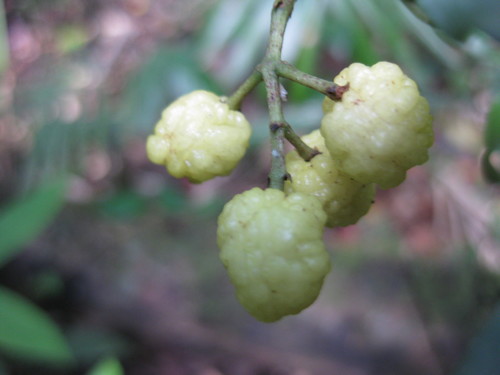
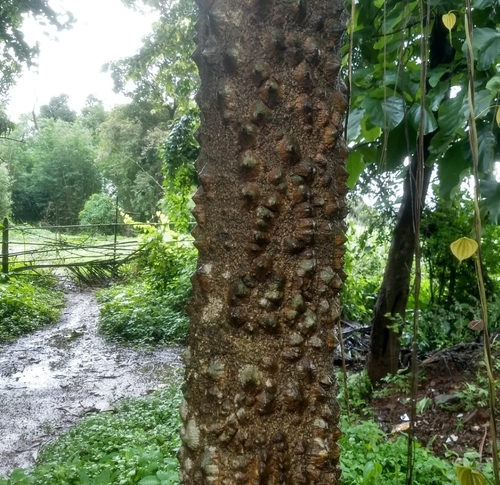
A medium sized tree. It grows 35 m tall. It loses its leaves during the year. The young bark has spines. The mature bark has prickles 2-3 cm long. All parts have a lemon like smell. The leaves have leaflets along the stalk and can have one at the end. The leaves are 30-40 cm long. The leaflets are almost opposite and are narrowly oval and 7-13 cm long by 3-5 cm wide. The flowering groups are 8-14 cm long in the axils of leaves or at the ends of branches. The flowers are white or pale yellow. The fruit is a flattened follicle 6-7 mm across with one seed in each section. The fruit are green and turn red when ripe. The seeds are hard and black. They are 5 mm across.
Notes
There are about 200 Zanthoxylum species.
Names & Synonyms
Kamchatton, Kamjad ton, Ma kwaen, Mwiching bwlai, Pepuli
References (17)
- Ambasta, S.P. (Ed.), 2000, The Useful Plants of India. CSIR India. p 698
- Anderson, E. F., 1993, Plants and people of the Golden Triangle. Dioscorides Press. p 224
- Burkill, I.H., 1966, A Dictionary of the Economic Products of the Malay Peninsula. Ministry of Agriculture and Cooperatives, Kuala Lumpur, Malaysia. Vol 2 (I-Z) p 2326 (As Zanthoxylum budrunga)
- Deb, D., et al, 2013, Wild Edible Plants and Their Utilization in Traditional Recipes of Tripura, Northeast India. Advances in Biological Research 7(5):203-211
- Eiadthong, W., et al, 2010, Management of the Emerald Triangle Protected Forests Complex. Botanical Consultant Technical Report. p 23
- Facciola, S., 1998, Cornucopia 2: a Source Book of Edible Plants. Kampong Publications, p 220 (As Fagara rhetsa)
- Hedrick, U.P., 1919, (Ed.), Sturtevant's edible plants of the world. p 692 (? As Zanthoxylum budrunga Wall.)
- Hedrick, U.P., 1919, (Ed.), Sturtevant's edible plants of the world. p 692 (As Zanthoxylum rhetsa)
- Jacquat, C., 1990, Plants from the Markets of Thailand. D.K. Book House p 74
- Jiwajinda, S., et al, 2002, Suppressive Effects of Edible Thai Plants on Superoxide and Nitric Oxide Generation. Asian Pacific Journal of Cancer Prevention, Vol 3, 2002
- Morton,
- Nakahara, K. et al, 2002, Antimutagenicity of Some Edible Thai Plants, and a Bioactive Carbazole Alkaloid, Mahanine, Isolated from Micromelum minutum. Journal of Agricultural and Food Chemistry. 50: 4796-4892
- PROSEA handbook Volume 13 Spices. p 280 (Zanthoxylum rhetsa)
- Suksri, S., et al, 2005, Ethnobotany in Bung Khong Long Non-Hunting Area, Northeast Thailand. Kasetsart J., (Nat. Sci) 39: 519-533
- Thitiprasert, W., et al, 2007, Country report on the State of Plant Genetic Resources for Food and Agriculture in Thailand (1997-2004). FAO p 95
- Tyagi, R. K., et al, 2004, Conservation of Spices Germplasm in India. Indian J. Plant Genet. Resour. 17(3): 163-174
- Wild edible plants of Himachal Pradesh (As Fagara limonella)