Micropholis egensis
(A. de Candolle) Pierre
Caimitillo, Caimito

(c) Nils Servientis - Bivouac Naturaliste, some rights reserved (CC BY-NC), uploaded by Nils Servientis - Bivouac Naturaliste

(c) Nils Servientis - Bivouac Naturaliste, some rights reserved (CC BY-NC)
What to Eat
Edible parts: Fruit
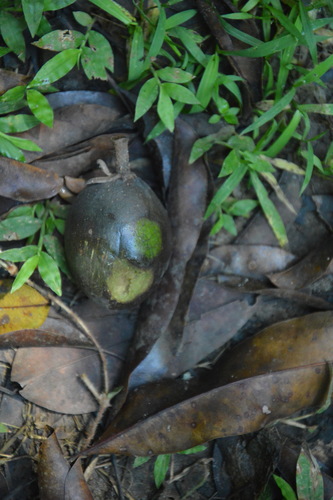
Fruit - raw. The yellow pulp has a sweet, plum-like flavour. The fruit is a green to yellow berry around 2 - 3cm in diameter.
Where to Find It
A tropical plant. It is normally in flooded forest. It is usually below 500 m altitude.
Amazon, Bolivia, Brazil, Central America, Colombia, Ecuador, French Guiana, Guianas, Guyana, Panama, Peru, South America*, Suriname, Venezuela,
How to Identify
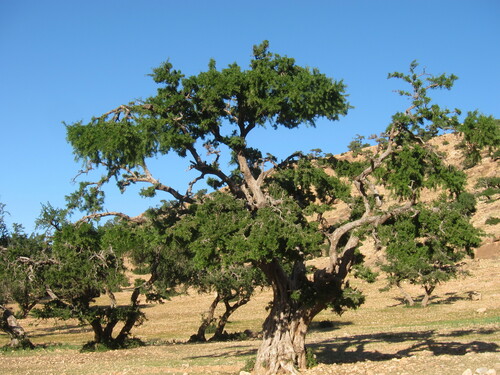
A tree. It grows 40 m high. The trunk is 60 cm across. Large trees can have buttresses. The young shoots have a few fine hairs. The bark becomes pale, cracked and scaly. The leaves are spaced and mostly alternate. They are 9-20 cm long by 3-9 cm wide. They are oval. The leaf stalk is 0.3-1.5 cm long. The flowers are of one sex with both flowers on one tree. They occur in tufts of 3-15 flowers in the axils of leaves. The flowers are yellowish-green. The fruit is 2.5-3 cm long. The fruit matures reddish, purple or black. It is narrowly oval. The fruit are edible. There is one seed. It is 2-2.7 cm long.
Names & Synonyms
Abiurana, Aicutimiuswjw, Bakoeman, Cajou, Kiemboto, Kimboto, Lagarto moona, Manigowe, Quinilla, Sapote yacu, Shakashak yaas
References (9)
- Bendezu, Y. F., 2018, Arboles nativos de lad Region Ucayali. Instituto Nacional de Innovacion Agraria. p 299
- Grandtner, M. M. & Chevrette, J., 2013, Dictionary of Trees, Volume 2: South America: Nomenclature, Taxonomy and Ecology. Academic Press p 413
- Lopez-Diago, D. & Garcia, N., 2021, Wild edible fruits of Colombia. Biota ColomBiana 22 (2) p 51
- Pennington, T.D., 1990, Sapotaceae in Flora Neotropica Monograph 52. New York Botanical Gardens. p 187
- Roa, J. A. G. & Boada, D. S. G., 2018, Fundación para el Fortalecimiento de la Fruticultura y Plantas Alimenticias no Convencionales en Colombia.
- Torre, de la, L., et al, 2008, Enciclopedia de las Plantas Útiles del Ecuador. Herbario QCA. Pontificia Universidad Católica del Ecuador. p 570
- van Roosmalen, M.G.M., 1985, Fruits of the Guianan Flora. Utrecht Univ. & Wageningen Univ. p 406
- Van Roosmalen, M.G.M., & Garcia, O. M., 2000, Fruits of the Amazonian Forest. Part 2: Sapotaceae. Acta Amazonica 30(2): 187-290
- Vasquez, R. and Gentry, A. H., 1989, Use and Misuse of Forest-harvested Fruits in the Iquitos Area. Conservation Biology 3(4): 350f