Pouteria ramiflora
(Martius) Radlkofer
Macaranduba, Abiu

(c) Mauricio Mercadante, some rights reserved (CC BY-NC-SA)

(c) Ulf Mehlig, some rights reserved (CC BY-NC-SA)

(c) Lucas Lima (Lima, L.M.), some rights reserved (CC BY-NC), uploaded by Lucas Lima (Lima, L.M.)
What to Eat
Edible parts: Fruit
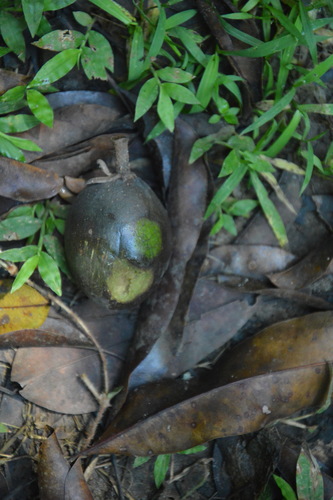
Fruit - raw. The fruit contains 1 - 2 large seeds surrounded by a soft, white, fleshy pulp with a slightly sweet flavour. The pear-shaped fruit is about 6cm long and 4cm wide.
Where to Find It
A tropical plant. It grows well on sandy soil. It grows naturally in the Amazon in Brazil. It grows in the tropical savannah. It grows between 200-1300 m altitude.
Amazon, Bolivia, Brazil, Central America, Costa Rica, Paraguay, Peru, South America,
How to Identify
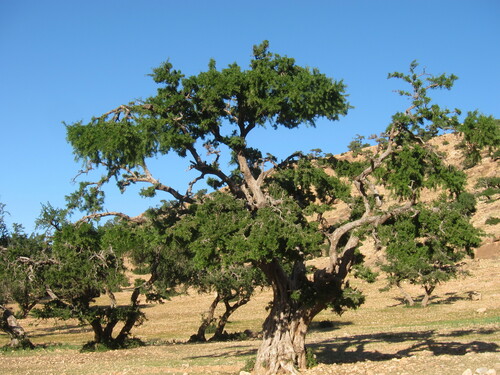
It is a large tree. It grows 10-25 m high. Often the trunk is short and gnarled. The young shoots have golden-brown hairs. The branches contain a milky latex like sap. The bark is cracked and scaly. The leaves are spaced and arranged in spirals. The leaves are 5-18.4 cm long by 2.5-8.4 cm wide. They are oval. There are 8-16 pairs of secondary veins. The leaf stalk is 0.6-1.8 cm long. The flowers occur in tufts of 5-15 flowers. The flowers are of one sex. The separate sexes occur on separate plants. The flowers are greenish-white. The fruit are green and egg shaped. It is 2.5-5 cm long. The fruit are edible. There is one seed. The seed is 1.6-3.2 cm long. The pulp is soft and white.
How to Grow
Plants are grown from seed. The seed are removed from ripe fruit. Seeds only remian viable for a short time. Seeds germinate in 20-40 days.
Propagation: Seed - best sown as soon as it is ripe in individual pots. Germination usually occurs in 3 - 6 weeks, although the germination rate is normally low.
Other Uses
The branches contain a milky, latex-like sap. No uses are recorded. The sapwood is almost indistinct from the heartwood. The wood is heavy, hard, of medium texture. It has little resistance to rot. The wood is used for boards, internal finishing in buildings, construction and the manufacture of toys, boxes etc.
Production
Plants grow at a moderate rate. The fruit mature 5-7 months after flowering.
Other Information
The fruit are not very popular.
Notes
There are about 150-320 Pouteria species. They grow in the tropics.
Names & Synonyms
Abiu carriola, Abiu do campo, Bacumixa, Curriola, Fruta-de-veado, Fruteira, Grao-de-galo, Graos de gallo, Guajara, Gunjara, Ibacoixa, Mandapuca, Vermelha, Pitomba de leira, Leiteiro-preto
References (12)
- Bortolotto, I. M., et al, 2018, Lista preliminar das plantas alimenticias nativas de Mato Grosso do Sul, Brasil. Iheringia, Serie Botanica, Porto Alegre, 73 (supl.):101-116
- Grandtner, M. M. & Chevrette, J., 2013, Dictionary of Trees, Volume 2: South America: Nomenclature, Taxonomy and Ecology. Academic Press p 529
- Kermath, B. M., et al, 2014, Food Plants in the Americas: A survey of the domesticated, cultivated and wild plants used for Human food in North, Central and South America and the Caribbean. On line draft. p 695
- Lorenzi, H., 2002, Brazilian Trees. A Guide to the Identification and Cultivation of Brazilian Native Trees. Vol. 01 Nova Odessa, SP, Instituto Plantarum p 340
- Lorenzi, H., Bacher, L., Lacerda, M. & Sartori, S., 2006, Brazilian Fruits & Cultivated Exotics. Sao Paulo, Instituto Plantarum de Estuados da Flora Ltda. p 306
- Paz, F. S., et al, 2021, Edible Fruit Plant Species in the Amazon Forest Rely Mostly on Bees and Beetles as Pollinators. Journal of Economic Entomology, XX(XX), 2021, 1–13
- Pennington, T.D., 1990, Sapotaceae in Flora Neotropica Monograph 52. New York Botanical Gardens. p 279
- Peres, M. K., 2011, Diasporos do Cerrado Atrativos para Fauna: Chave Interativa Caracterizacao Visual e Relacoes Ecologicas. Masters thesis. Universidade de Brasilia.
- Van Roosmalen, M.G.M., & Garcia, O. M., 2000, Fruits of the Amazonian Forest. Part 2: Sapotaceae. Acta Amazonica 30(2): 187-290
- Silva, S. y Tassara, H., 1996, Frutas no Brasil. Empresa das Artes, Sao Paulo
- Sitzungsber. Math.-Phys. Cl. Koenigl. Bayer. Akad. Wiss. Munchen 12:333. 1882
- www.colecionandofrutas.org