Pouteria laevigata
(Martius) Radlkofer
Smooth pouteria
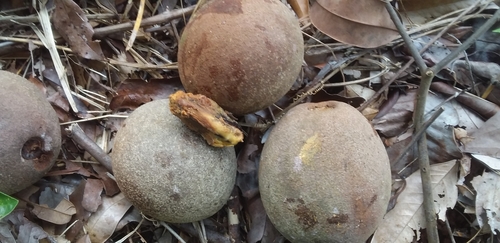
(c) raretreehunter, some rights reserved (CC BY-NC), uploaded by raretreehunter

(c) capepolly, some rights reserved (CC BY-NC)

(c) capepolly, some rights reserved (CC BY-NC)
What to Eat
Edible parts: Fruit
Many species, such as Pouteria sapota, have edible fruits and are important foods, seasonally. Some are being commercially collected and sold on local markets or packed in cans. Pouteria species yield hard, heavy, resilient woods used as firewood and timber, but particularly in outdoor and naval construction, such as dock pilings, deckings, etc. Some species, such as abiu (P. caimito), are considered to be shipworm resistant, but this depends on the silica content, which may vary from 0.0-0.9%. The weight by volume (at 12% moisture content) of Pouteria wood can be in excess of 1140 kg/m3 (71 lb/ft3; thus, the wood sinks in water. The wood of Pouteria species is prone to considerable movement and warping when it dries out, but in its main use, naval construction, this is not a problem, since the wood never gets really dry. The vessel elements are relatively small and usually di- to quadriseriate; the medullary rays are fine and close together. Pouteria woods are capable of attaining an excellent polish using fine-grained sandpaper and possibly some wax. They can sometimes show an attractive figure of dark stripes against a sandy to mid-brown background colour. However, the wood is hardly used for furniture because it is so dense that items made from it would be difficult to transport. Moreover, it is nearly impossible to work using hand tools. Even using power tools, working these woods presents some problems, as well, but given some patience and practical knowledge, these can easily be solved. For the silica to be effective against shipworms, it needs to dry to some degree to harden. When the wood is continually waterlogged, this process may take place very slowly or not at all, leaving the wood vulnerable. Pouteria foliage is used as food by some Lepidoptera caterpillars, including those of the dalcerid moth Dalcera abrasa, which has been recorded on P. ramiflora. The fruits are important food for various animals, such as the rock-haunting ringtail possum (Petropseudes dahli). Due to habitat loss and in some cases overexploitation, many species of Pouteria are threatened. At least 10 are close to extinction.
Where to Find It
A tropical plant. It grows in lowland forests on non flooded sites but also in places that are occasionally flooded. It grows between 100-400 m above sea level.
Amazon, Brazil, Central America, Colombia, Costa Rica, Ecuador, French Guiana, Guianas, Peru, South America*, Venezuela,
How to Identify
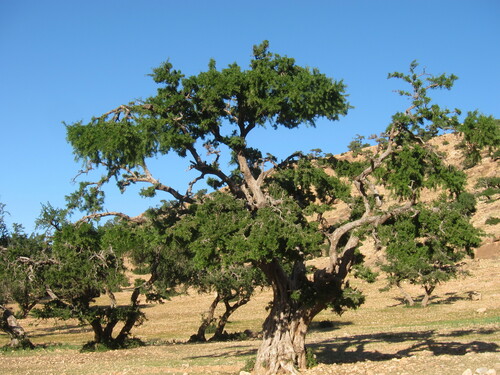
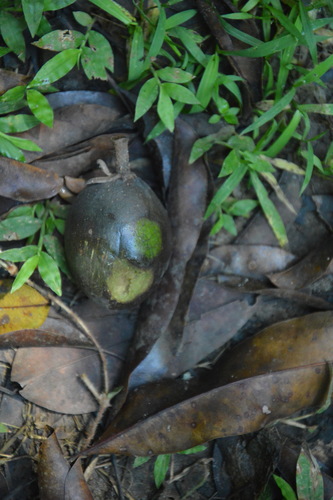
A tree. It grows 50 m tall. The trunk is 65 cm across. Young shoots have a few fine hairs. The bark is pale grey and finely cracked. The leaves are loosely clustered towards the tips and arranged in spirals. The leaves are 6-18 cm long by 4-7 cm wide. They are broadly sword shaped and there are 9-13 pairs of secondary veins. The flowers are in groups in the axils usually of fallen leaves. There are 2-15 flowers in a group. The flowers are cream to white. The fruit are 6-9 cm long and oval. They contain several seeds. These are about 4 cm long.
Production
Flowers occur February to June but can occur all year round.
Notes
There are about 150-320 Pouteria species. They grow in the tropics.
Names & Synonyms
Abiurana sapota, Arbol de churuco, Aviyu, Awe gomaradebe, Caimitillo, Caramury, Caucho, Dayahuetoa, Naso toa, Pendare rebalsero, Quinea wuina blanca, Sacha aviyu, Shiringa arana
References (8)
- Grandtner, M. M. & Chevrette, J., 2013, Dictionary of Trees, Volume 2: South America: Nomenclature, Taxonomy and Ecology. Academic Press p 527
- Kermath, B. M., et al, 2014, Food Plants in the Americas: A survey of the domesticated, cultivated and wild plants used for Human food in North, Central and South America and the Caribbean. On line draft. p 691
- Lopez-Diago, D. & Garcia, N., 2021, Wild edible fruits of Colombia. Biota ColomBiana 22 (2) p 51
- Pennington, T.D., 1990, Sapotaceae in Flora Neotropica Monograph 52. New York Botanical Gardens. p 374
- Roa, J. A. G. & Boada, D. S. G., 2018, Fundación para el Fortalecimiento de la Fruticultura y Plantas Alimenticias no Convencionales en Colombia.
- Torre, de la, L., et al, 2008, Enciclopedia de las Plantas Útiles del Ecuador. Herbario QCA. Pontificia Universidad Católica del Ecuador. p 572
- Van Roosmalen, M.G.M., & Garcia, O. M., 2000, Fruits of the Amazonian Forest. Part 2: Sapotaceae. Acta Amazonica 30(2): 187-290
- Vasquez, R. and Gentry, A. H., 1989, Use and Misuse of Forest-harvested Fruits in the Iquitos Area. Conservation Biology 3(4): 350f