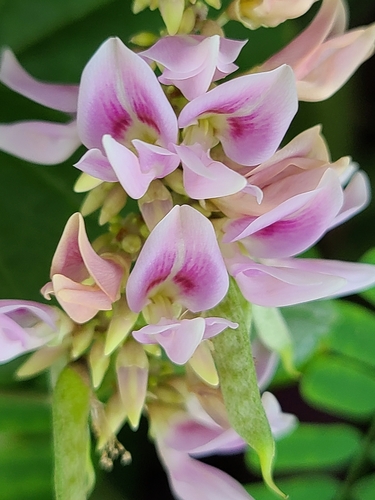
Astracantha gummifera
(Labill.) Podlech
Tragacanth, Gum tragacanth

Wikimedia Commons - Paul Taubert

Wikimedia Commons - Unknown authorUnknown author
What to Eat
Edible parts: Gum
The gum is used in confectionery and as a thickening agent and emulsifier in salad dressings, syrups, sauces, ice cream, drinks, and puddings.
Known Hazards
Where to Find It
It is a temperate plant.
Asia, Europe, India, Kuwait, Kurdistan, Mediterranean, Middle East, Syria,
How to Identify
A low shrub. It is evergreen and umbrella shaped. It grows 30 cm high. The leaves have spiny stalks. The leaves have leaflets along the stalk. There are 4-7 pairs of narrowly oval leaflets. They are 1 cm long. The flowers are small, white and downy. They are pea-like flowers. They are in the axils of leaves.
How to Grow
Plants are grown from seed.
Medicinal Uses
Astragalus has been used in traditional Chinese medicine over centuries to treat various disorders, but there is no high-quality evidence that it is effective or safe for any medical purpose.
Notes
There are 2,000 Astragalus species.
Names & Synonyms
References (9)
- Ambasta S.P. (Ed.), 2000, The Useful Plants of India. CSIR India. p 60 (As Astragalus gummifer)
- Bircher, A. G. & Bircher, W. H., 2000, Encyclopedia of Fruit Trees and Edible Flowering Plants in Egypt and the Subtropics. AUC Press. p 46 (As Astragalus gummifer)
- Brouk, B., 1975, Plants Consumed by Man. Academic Press, London. p 264 (As Astragalus gummifer)
- Brown, D., 2002, The Royal Horticultural Society encyclopedia of Herbs and their uses. DK Books. p 136 (As Astragalus gummifer)
- Facciola, S., 1998, Cornucopia 2: a Source Book of Edible Plants. Kampong Publications, p 102 (As Astragalus gummifer)
- Hedrick, U.P., 1919, (Ed.), Sturtevant's edible plants of the world. p 83 (As Astragalus gummifer)
- J. Phys. 46. 1790 (As Astragalus gummifer)
- Middleditch, B. S., 1991, Kuwaiti Plants: Distribution, Traditional Medicine, Phytochemistry, Pharmacology and Economic Value. Studies in Plant Science, 2. Elsevier p 13 (As Astragalus gummifer)
- World Checklist of Useful Plant Species 2020. Royal Botanic Gardens, Kew (As Astragalus gummifer)