Rubus glomeratus
Blume
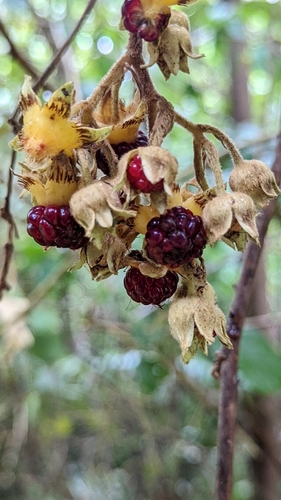
(c) Harsha Jayaramaiah, some rights reserved (CC BY), uploaded by Harsha Jayaramaiah
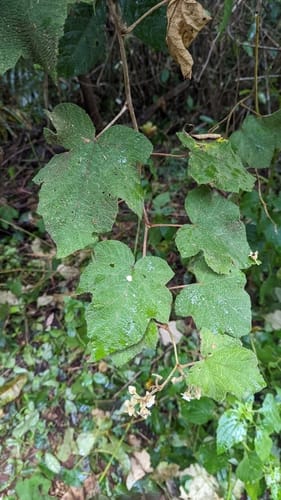
(c) Harsha Jayaramaiah, some rights reserved (CC BY)
What to Eat
Edible parts: Fruit
The fruit are eaten raw, though they are slightly sour.
Dangerous Lookalikes
This plant can be confused with the following toxic species. Always verify identification carefully before consuming any wild plant.


Red Baneberry: Short herbaceous plant (no thorns), berries on thick red stems, each berry has a single seed, compound sharply-toothed leaves.
Rubus glomeratus: Thorny woody canes (brambles), aggregate berry made of many drupelets, berries pull easily from receptacle.
Where to Find It
A tropical plant. It grows in the mountains. It grows in evergreen forests and grasslands.
Asia, India, Indochina, Indonesia, Malaysia, Myanmar, SE Asia, Singapore, Sumatra, Thailand,
How to Identify
A climbing shrub. The stems are reddish with cottony hairs. The leaves are alternate. They are 8 cm long by 8 cm wide. The leaves are oval or D shaped with 3-5 obscure lobes. The leaves have yellow hairs underneath. The flowers are in groups at the ends of the branches. The flower petals are white. The fruit is orange.
Notes
There are about 250 Rubus species.
Names & Synonyms
Akar kupur, Akar bulan mudu, Akar balek adap, Akar duri berumbet, Kattumunthiri, Mulluvettila
References (5)
- Altschul, S.V.R., 1973, Drugs and Foods from Little-known Plants. Notes in Harvard University Herbaria. Harvard Univ. Press. Massachusetts. no. 1430
- Bijdr. 1111. 1826
- Binu, S., 2010, Wild edible plants by the tribals in Pathanamthitta district, Kerala. Indian Journal of Traditional Knowledge. 9(2): 309-312
- Burkill, I.H., 1966, A Dictionary of the Economic Products of the Malay Peninsula. Ministry of Agriculture and Cooperatives, Kuala Lumpur, Malaysia. Vol 2 (I-Z) p 1952
- Jose, D. T. & Sasidharan, N., 2016, Checklist of wild edible plants of Aralam Wildlife sanctuary, Kerala, India. South Indian Journal Of Biological Sciences 2016; 2(1); 141‐144
More from Rosaceae


