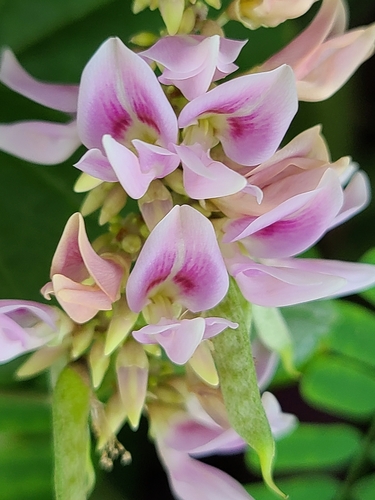
Inga vera subsp. spuria
(Humb. & Bonpl. ex Willd.) J. Leon
Guaba, Guama

bima

bima

bima
What to Eat
Edible parts: Pod pulp, Fruit - aril
The sweetish pulp of the fresh fruit is eaten, including the pod pulp and fruit aril.
Where to Find It
A tropical plant.
Belize, Caribbean, Central America, Colombia, Costa Rica, Ecuador, El Salvador, Guatemala, Haiti, Honduras, Mexico, Nicaragua, North America, Panama, South America, West Indies,
How to Identify
An evergreen tree. It grows 20 m tall. The flowers are white. The fruit pods are 50 cm long.
How to Grow
Plants grow easily from fresh seeds. Seeds germinate in 1-2 weeks given moisture and shade.
Wikipedia
Source ↗Inga vera is a species of tropical tree in the family Fabaceae. It occurs in Central and South America, where it is known as churimo, guamo churimo, guamo arroyero and guamo macho.
Production
It is fast growing.
Notes
There are 350 Inga species. Also as Mimosaceae.
Names & Synonyms
Churimo, Cuje, Guaba de mico, Pois Doux
References (11)
- Altschul, S.V.R., 1973, Drugs and Foods from Little-known Plants. Notes in Harvard University Herbaria. Harvard Univ. Press. Massachusetts. no. 1508
- Ann. Missouri Bot. Gard. 53:339. 1966
- Barwick, M., 2004, Tropical and Subtropical Trees. A Worldwide Encyclopedic Guide. Thames and Hudson p 226
- Blake, S. F., Native Names and Uses of some Plants of Eastern Guatemala and Honduras. Contributions from the National Herbarium. p 91 (As Inga spuria)
- Grandtner, M. M., 2008, World Dictionary of Trees. Wood and Forest Science Department. Laval University, Quebec, Qc Canada. (Internet database http://www.wdt.qc.ca) (As Inga vera)
- Hedrick, U.P., 1919, (Ed.), Sturtevant's edible plants of the world. p 356
- Lentz, D. L., 1993, Medicinal and Other Economic Plants of the Paya of Honduras. Economic Botany, Vol. 47, No. 4, pp. 358-370
- Martin, F. W., et al, 1987, Perennial Edible Fruits of the Tropics. USDA Handbook 642 p 99 (As Inga spuria)
- Plants of Haiti Smithsonian Institute http://botany.si.edu/antilles/West Indies (As Inga vera ssp. vera)
- Roa, J. A. G. & Boada, D. S. G., 2018, Fundación para el Fortalecimiento de la Fruticultura y Plantas Alimenticias no Convencionales en Colombia.
- Torre, de la, L., et al, 2008, Enciclopedia de las Plantas Útiles del Ecuador. Herbario QCA. Pontificia Universidad Católica del Ecuador. p 348