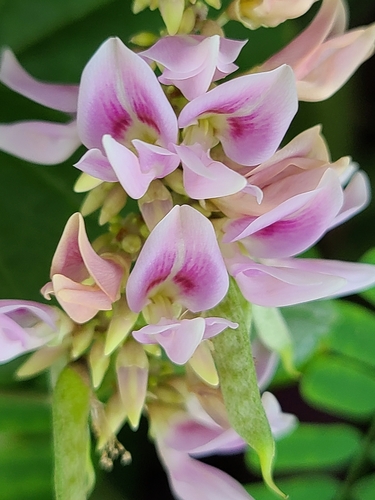
Lespedeza cuneata
(Dumon de Courset) G. Don
Perennial lespedeza

(c) Roberto R. Calderón, some rights reserved (CC BY-NC), uploaded by Roberto R. Calderón
(c) stella20009, some rights reserved (CC BY-NC)
(c) 洪阿愷, some rights reserved (CC BY-NC)
What to Eat
Edible parts: Leaves
Young leaves are edible after soaking and cooking.
Where to Find It
It is a subtropical plant. It grows on mountain slopes below 2500 m altitude in China. In Taiwan it grows on waste land up to 3,100 m altitude. In XTBG Yunnan. In Sichuan.
Afghanistan, Asia, Australia, Bhutan, China, Himalayas, India, Indochina, Indonesia, Japan, Korea, Laos, Malaysia, Nepal, North America, Pakistan, Philippines, SE Asia, Taiwan, Thailand, Vietnam,
How to Identify
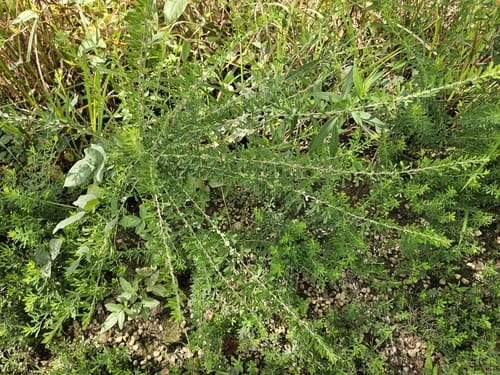
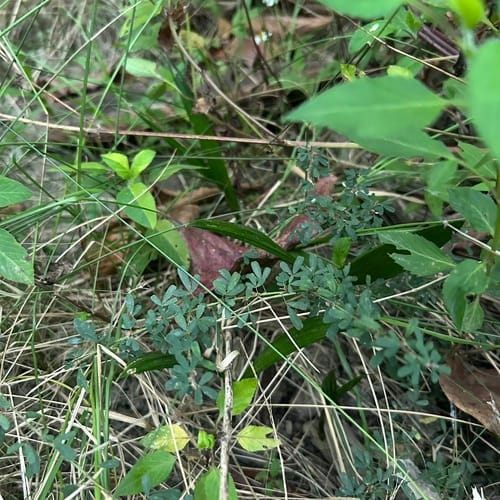
A small shrub up to 1 m tall. The leaves have 3 leaflets. These are narrow. They are 10-25 mm long by 2-4 mm wide. There are hairs on the lower side of the leaf. There are 2-4 flowers in the axils of the leaves. The flowers are whitish-yellow with violet stripes near the base. The fruit are oval pods 3 mm long.
How to Grow
A plant mainly of the subtropics to the tropics, it can survive milder winters in temperate areas (although top growth is usually killed back to the ground) but is more generally grown as a summer annual in temperate areas. It can be found at elevations up to 2,400 metres in the tropics. It grows best in areas where annual daytime temperatures are within the range 16 - 26°c, but can tolerate 6 - 36°c. It prefers a mean annual rainfall in the range 1,000 - 1,400mm, but tolerates 650 - 2,350mm. Easily grown in a well-drained, light to heavy loam in full sun. The roots can penetrate heavy clay subsoils. It can grow in shallow soils, but grows best in deep soils, such as deep sands with organic matter or sandy loams with clay loam subsoil. It will also grow on strongly acidic to neutral soils. The plant is tolerant of poor, acid soils with high aluminium and low phosphorus levels. Prefers a pH in the range 5.5 - 6.5, tolerating 4.5 - 7.1. Extensively planted for soil stabilization and improvement, the plant has often escaped from cultivation, invading local ecosystems and driving out native species. Seedlings are very slow to establish and generally require some weeding to reduce competition from other plants. After the first year, plants compete very successfully with weeds. When fertility of degraded soils has improved sufficiently, this species can be replaced by more productive crops. Eradication can be achieved by increasing the cutting intensity, followed by light disking and then sowing a fast-growing annual crop. The procedure often has to be repeated the following year. In addition to the normally pollinated sexual flowers, this species also produces clusters of cleistogamous flowers in the leaf axils. This species has a symbiotic relationship with certain soil bacteria, these bacteria form nodules on the roots and fix atmospheric nitrogen. Some of this nitrogen is utilized by the growing plant but some can also be used by other plants growing nearby.
Propagation: Pre-soak seed for 24 hours in warm water, then sow in spring in a greenhouse. Prick seedlings into individual pots when large enough to handle and grow on in the greenhouse for at least the first winter. Plant out into permanent positions in late spring or early summer after the last expected frosts. Take half-ripe cuttings of 7–10cm with a heel in July or August, rooting them in individual pots in a frame. Getting cuttings through their first winter can be difficult; plunging the pots in a bed of ashes in a sheltered outdoor border is recommended.
Medicinal Uses
The whole plant is anthelmintic, depurative, and tonic. A decoction is used to treat testicular tuberculosis, hernia, enuresis, dental caries, toothache, infantile marasmus/ascariasis, snake and dog bites, skin ulcers, dysentery, and enteritis.
Other Uses
The plant has an extensive root system and fixes atmospheric nitrogen through root bacteria. It is used in soil conservation schemes to renew worn-out soils.
Wikipedia
Source ↗Lespedeza cuneata is a species of flowering plant in the legume family known by the common names Chinese bushclover and sericea lespedeza, or just sericea. It is native to Asia and is present elsewhere as an introduced species and sometimes an invasive plant. Australian populations of Lespedeza juncea have sometimes been considered to belong to this species but are now considered to be distinct.
Notes
There are about 100 Lespedeza species.
Names & Synonyms
Chinese lespedeza, Jie ye tie sao zhou
References (7)
- Altschul, S.V.R., 1973, Drugs and Foods from Little-known Plants. Notes in Harvard University Herbaria. Harvard Univ. Press. Massachusetts. no. 1778
- Ambasta S.P. (Ed.), 2000, The Useful Plants of India. CSIR India. p 325
- Ann. Mus. Bot. Lugduno-Batavum 3:49. 1867 - an illegitimate, superfluous name (ICBN Art. 52) as Miquel cited L. argyraea Siebold & Zucc. (1845) (As Lespedeza sericea)
- Gen. hist. 2:307. 1832
- Huang Puhua; H. Ohashi, FABACEAE (Draft), Trib. Desmodieae (Bentham) Hutchinson. Flora of China.
- Plants for a Future database, The Field, Penpol, Lostwithiel, Cornwall, PL22 0NG, UK. http://www.scs.leeds.ac.uk/pfaf/ (As Lespedeza sericea)
- READ, (As Lespedeza sericea)