Erythrina stricta
Roxb.
Indian coral tree
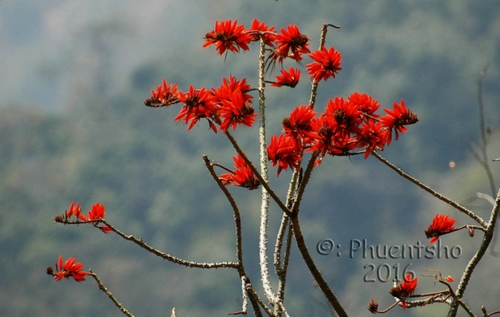
(c) Phuentsho, some rights reserved (CC BY-NC-SA), uploaded by Phuentsho

(c) Cheongweei Gan, some rights reserved (CC BY-NC)

(c) Cheongweei Gan, some rights reserved (CC BY-NC)
What to Eat
Edible parts: Leaves, Flowers
The young leaves are used as a vegetable, and the flowers are edible.
Known Hazards
Where to Find It
A tropical plant. It grows in both dry and moist forests. It grows in forests near rivers at about 1,400 m above sea level. In Yunnan.
Asia, Bhutan, China, Himalayas, India, Indochina, Laos, Myanmar, Nepal, SE Asia, Sikkim, Thailand, Tibet, Vietnam,
How to Identify
A large tree. It grows 35 m tall. It loses its leaves during the year. The branches grow steeply upwards and the crown is open. Young tree have sharp thorns. The leaves have 3 leaflets. The central leaflet is largest. They are 8-12 cm long and broadly oval. The young leaves have silky hairs. The flowers are about 4 cm across and bright red. They are in dense spike like clusters. The flowers are on one side. The fruit is a pod 5-10 cm long with 1-3 seeds.
How to Grow
Erythrina species are tolerant of a range of soils, often tolerating poor fertility, but generally grow best in a sunny position in a moderately fertile, well-drained soil. All species in this genus are believed to be self-compatible. Their flowers are adapted to pollination by birds, though various insects can also cause fertilization. The various species of Erythrina can all, as far as is known, be intercrossed to produce fertile hybrids. Those species most closely related to each other cross fairly readily, but even species that are quite distant can hybridize. This species has a symbiotic relationship with certain soil bacteria, these bacteria form nodules on the roots and fix atmospheric nitrogen. Some of this nitrogen is utilized by the growing plant but some can also be used by other plants growing nearby. A fast-growing tree.
Propagation: Like many species within the family Fabaceae, once they have been dried for storage the seeds of this species may benefit from scarification before sowing in order to speed up and improve germination. This can usually be done by pouring a small amount of nearly boiling water on the seeds (being careful not to cook them!) and then soaking them for 12 - 24 hours in warm water. By this time they should have imbibed moisture and swollen - if they have not, then carefully make a nick in the seedcoat (being careful not to damage the embryo) and soak for a further 12 hours before sowing. Species in this genus are generally easy to grow from cuttings. Many will strike well even from large cuttings placed in the open ground so long as they are kept moist but not too wet.
Medicinal Uses
The stem bark is crushed in water and applied locally to the body in order to destroy lice.
Other Uses
The bright red flowers yield a colour used in dyes. The wood is used to make household utensild. The wood of Erythrina species is generally greyish-white in colour, light in weight but strong, with a spongy texture and not very durable. The wood from the various species is used for purposes such as sieve frames, surfboards, dugout canoes, outrigger canoe floats, boxes and small art carvings. The tree is planted as a pioneer species in northern Thailand in reforestation projects to restore native woodland - it is planted in degraded woodland and open areas in a mix with various other species that all have the ability to grow fast; produce dense, weed-suppressing crowns; and attract seed-dispersing wildlife, particularly birds and bats. In India it is cultivated as a hedge plant, in living fences and for supporting pepper and vine. Most Erythrina species are very easy to grow from cuttings, with even quite large branches striking well. In addition, they generally fix atmospheric nitrogen, have nutrient-rich leaves that make an excellent soil-enriching mulch, often have open crowns that do not overly restrict light, and are also often quite thorny and can provide impenetrable barriers to protect from unwelcome intrusions. Many species are therefore used as living fences to provide boundaries and livestock-proof hedges.
Wikipedia
Source ↗Erythrina stricta is a species of trees in the family Fabaceae identified by William Roxburgh in 1832. It is now placed in the subfamily Faboideae and the tribe Phaseoleae. This species has been recorded from the Indian subcontinent, Indochina and China. There is one valid variety: E. stricta var. suberosa. It is called တောင်ကသစ် in Burmese, ทองเดือนห้า (RTGS: thongduean, IPA: [tʰɔːŋdɯːan]) in Thai and 勁直刺桐, Pinyin: jìn zhí cìtóng in Chinese and വെൺമുരിക്ക് in Malayalam. Erythrina stricta contains the indole alkaloid Hypaphorine
Notes
There are 108 Erythrina species.
Names & Synonyms
Chemroy, Choe co, Dok thong, Faledo, Hemmuruku, Kathit, Keechaga, Madar, Mai-ton, Mullumodugu, Mullumurukku, Mura, Murikkinchapu, Murikkusoppu, Phak thong, Phaledo, Tagek schein, Taung-kathit, Vong goa-hep
References (10)
- Altschul, S.V.R., 1973, Drugs and Foods from Little-known Plants. Notes in Harvard University Herbaria. Harvard Univ. Press. Massachusetts. no. 1812
- Ambasta, S.P. (Ed.), 2000, The Useful Plants of India. CSIR India. p 204
- Angami, A., et al, 2006, Status and potential of wild edible plants of Arunachal Pradesh. Indian Journal of Traditional Knowledge 5(4) October 2006, pp 541-550
- Fl. ind. ed. 1832, 3:251. 1832
- Gardner, S., et al, 2000, A Field Guide to Forest Trees of Northern Thailand, Kobfai Publishing Project. p 176
- Luczaj, L., et al, 2021, Wild food plants and fungi sold in the markets of Luang Prabang, Lao PDR. Journal of Ethnobiology and Ethnomedicine (2021) 17:6
- Murtem, G. & Chaudhrey, P., 2016, An ethnobotanical note on wild edible plants of Upper Eastern Himalaya, India. Brazilian Journal of Biological Sciences, 2016, v. 3, no. 5, p. 63-81.
- Narayanan Ratheesh, M. K. et al, 2011, Wild edible plants used by the Kattunaikka, Paniya and Kuruma tribes of Wayanad District, Kerala, India. Journal of Medicinal Plants Research Vol. 5(15), pp. 3520-3529
- Sutjaritjai, N., et al, 2019, Traditional Uses of Leguminosae among the Karen in Thailand. Plants 2019, 8, 600 p 7
- Xu, Z., Tao, G. & Tan, J., 1988, Tropical Wild Flowers and Plants in Xishuangbanna, Agricultural Publishing House. photo 10




