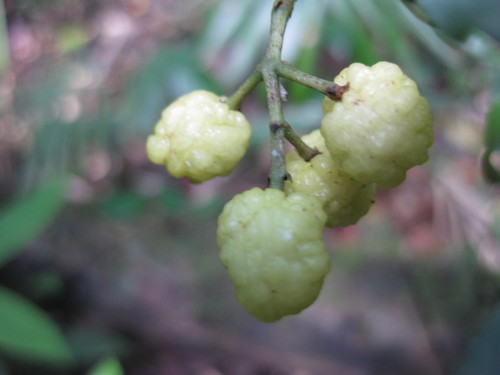
Atalantia malabarica
(Rafin) Tanaka
Chulemo, Wild lime

Lalithamba from India (via Wikimedia Commons)
What to Eat
Edible parts: Fruit
The fruits are pickled.
Where to Find It
A tropical plant. In southern India it grows up to 1,000 m above sea level.
Andamans, Asia, India, Malaysia, Myanmar, SE Asia, Sri Lanka,
How to Identify
A deciduous tree. It grows 5-10 m high. It is spiny. The bark is pale brown and smooth. The stems are deeply fluted. The leaves are smooth and 8 cm long. They are shiny. The tip has a notch. The leaves smell like a citrus. The flowers are white and have 4-5 petals. They are bundled into a tube. The flowers have a sweet smell. The fruit are like a small orange.
Production
In southern India it flowers are fruits throughout the year.
Names & Synonyms
Adavi-nimma, Atavi-jambira, Jangli nimbu, Kadu-nimbe, Kurunthamaram, Kattelunicchai, Kattunarenga, Makad-limbu
References (4)
- Ambasta S.P. (Ed.), 2000, The Useful Plants of India. CSIR India. p 61
- Awasthi, A.K., 1991, Ethnobotanical studies of the Negrito Islanders of Andaman Islands, India - The Great Andamanese. Economic Botany 45(2) pp274-280. (As Atalantia monophylla)
- Bircher, A. G. & Bircher, W. H., 2000, Encyclopedia of Fruit Trees and Edible Flowering Plants in Egypt and the Subtropics. AUC Press. p 47
- Krishen P., 2006, Trees of Delhi, A Field Guide. DK Books. p 85 (As Atalantia monophylla)