Atriplex angulata
Benth.
Fan saltbush, Angular Saltbush
(c) Bruce McLennan, some rights reserved (CC BY-NC), uploaded by Bruce McLennan

(c) Lachlan Copeland, some rights reserved (CC BY-SA)
What to Eat
Edible parts: Seeds
The seeds are eaten.
Where to Find It
It suits poorly drained soils. It can tolerate drought and frost. It suits semiarid areas.
Australia*,
How to Identify
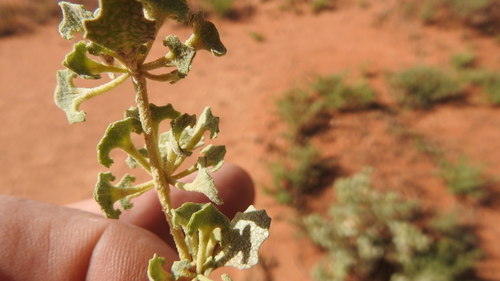
A small shrub. It grows 0.5-1.5 m high and spreads 1-2 m wide. It keeps growing from year to year. The branches are white. The leaves are 3 cm long and oval. The edges are wavy. The flowers are small and white. The male flowers occur in large clusters at the ends of small branches. The female flowers are in the axils of stems and leaves. The bracts around the fruit are 1 cm long and fan shaped.
How to Grow
Plants can be grown by seed or cuttings.
Wikipedia
Source ↗Atriplex angulata, commonly known as fan saltbush or angular saltbush, is a species of flowering plant in the family Amaranthaceae. It is an annual to short-lived perennial subshrub, native to Australia, distributed throughout drier parts of the mainland.
Notes
There are about 100-300 Atriplex species. They have also been put in the family Chenopodiaceae.
References (5)
- Cherikoff V. & Isaacs, J., The Bush Food Handbook. How to gather, grow, process and cook Australian Wild Foods. Ti Tree Press, Australia p 188
- Elliot, W.R., & Jones, D.L., 1982, Encyclopedia of Australian Plants suitable for cultivation. Vol 2. Lothian. p 255
- Fl. austral. 5:174. 1870
- Flora of Australia, Volume 4, Phytolaccaceae to Chenopodiaceae, Australian Government Publishing Service, Canberra (1984) p 105
- Lazarides, M. & Hince, B., 1993, Handbook of Economic Plants of Australia, CSIRO. p 28