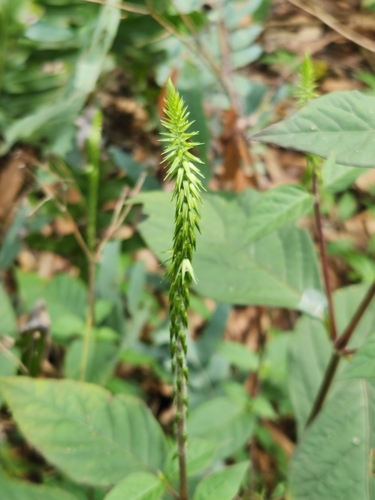
Atriplex cinerea
Poir.
Grey saltbush, Coast Saltbush
(c) plateauville, some rights reserved (CC BY-NC), uploaded by plateauville

(c) Tony Rebelo, some rights reserved (CC BY-SA), uploaded by Tony Rebelo
(c) Jane Gosden, some rights reserved (CC BY-NC-SA), uploaded by Jane Gosden
What to Eat
Edible parts: Leaves, Fruit, Seeds
The fruit and leaves are edible and are grazed by livestock. The fruit is popular with birds. The fruit is eaten as a snack or can be added to salads. The young leaves are eaten raw or steamed. They are often boiled to remove excess salt. Saltbush can be harvested for forage throughout the growing season, typically in late spring to early autumn. Saltbush leaves are available all year and can be eaten raw or cooked. Harvest lightly in winter when growth is slow. They make an exciting salad addition. When lightly steamed, the leaves retain their crispness and are a delicious spinach substitute. The salty flavour is present when growing inland in non-salty soils. The seed is edible but fiddly to use. Grind the seed into a powder, mix it with cereals, and use it in making cakes.
Known Hazards
Where to Find It
A temperate plant. It grows near beaches and salt marshes. These plants are closest to the sea. It can grow in semiarid regions. They can stand light frosts. Male plants often grow in a row on the seaward side of female plants. It is salt tolerant. It needs well drained soil. It suits hardiness zones 9-10. Tasmania Herbarium.
Australia*, Norfolk Island ?, Tasmania*,
How to Identify
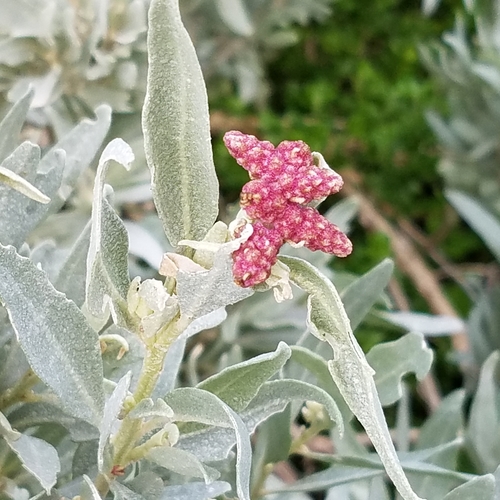
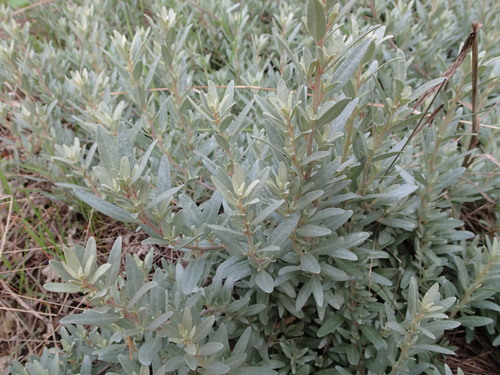
A dense small shrub. It grows 60-90 cm high. It can be 2 m high. It can spread 1.8-6 m wide. Stems can form roots at the nodes. The leaves are pale grey-blue. The leaves are 2.5-4 cm long and have a blunt tip. Male and female plants occur on separate plants. Male flowers are lumpy brown spikes at the tips of plants. Female flowers are single or in small clusters in the axils of leaves. Female plants produce clusters of small grey pods. The pods are 6-10 mm long. They are triangle shaped.
How to Grow
Soil Texture: Thrives in light (sandy), medium, and even heavy (clay) soils, provided they are well-drained. Soil Moisture: Prefers dry to moderately moist soils. Highly drought-tolerant and does not tolerate waterlogged conditions. Drainage: Requires well-drained soil for healthy growth. Soil pH: Tolerates various soil pH levels, including acidic, neutral, and alkaline soils. Saline Tolerance: Highly tolerant of saline conditions, ideal for coastal and salt-affected areas. Tolerance of Poor Soil: It thrives in poor, nutrient-deficient soils, particularly in arid and saline environments. Light Requirements: Requires full sun for optimal growth. It does not tolerate heavy shade. Height: Grows to about 1–3 meters (3–10 feet) tall, depending on conditions. Pollination: Primarily wind-pollinated, though some insects may visit its small, inconspicuous flowers. Temperature: Hardy in coastal regions and arid zones, suitable for USDA zones 9–11. Drought Tolerance: Exceptionally drought-tolerant, making it a key plant for xeriscaping and erosion control. Habitat: Native to coastal dunes and salt marshes in Australia, it is adapted to salty winds and poor, sandy soils. Pests and Diseases: Generally pest-free and highly resilient. However, it may experience some leaf drop in excessively wet conditions. The native range of this species is W. & S. Australia, Lord Howe Island. It is a shrub and grows primarily in the subtropical biome. Introduced into New Zealand North New Zealand South. While Atriplex cinerea can withstand mild frost, it may not survive prolonged or severe frosts, particularly if temperatures drop significantly below freezing.
Propagation: Grows easily from seeds or cuttings. Saltbush species are typically slow to moderate in growth but can establish well in poor soils.
Medicinal Uses
None Known
Other Uses
Agroforestry uses: Saltbush is often used for erosion control, as a windbreak, and for soil stabilisation. Its high salt tolerance makes it suitable for saline soils, and it can be used as forage for livestock. Commonly planted for erosion control, windbreaks, and revegetation of degraded or saline soils. Its silvery foliage makes it a popular ornamental in coastal landscapes. Nectary - Flowers rich in nectar and pollen: No – Saltbush is wind-pollinated, so it doesn’t produce nectar-rich flowers to attract pollinators. Wildlife - Food (Fruit, Seeds, Leaf litter, Shelter, Nesting, Roosting): Saltbush provides food for wildlife through its seeds and foliage. It is an important food source for herbivores like birds and small mammals. The dense, bushy form provides shelter and cover for nesting birds and other small animals. Invertebrate Shelter (Overwintering sites, Leaf litter, Groundcover): The dense, shrubby growth of Saltbush offers good ground cover for invertebrates, and the fallen leaves can serve as shelter and overwintering sites for beneficial insects. Pest Confuser (Smell): No – Saltbush does not have a strong aromatic smell that repels pests, so it is not typically used as a pest confuser. Saltbush generally flowers in late summer to early autumn, depending on the specific species and growing conditions. Special Uses
Wikipedia
Source ↗Atriplex cinerea, commonly known as grey saltbush, coast saltbush, barilla or truganini, is a plant species in the family Amaranthaceae. It occurs in sheltered coastal areas and around salt lakes in the Australian states of Western Australia, South Australia, Tasmania, Victoria and New South Wales. The species is also known to be present in the Waimea inlet in New Zealand, although has historically been found in Boulder Bank, D'Urville Island, and Palliser Bay. The Latin specific name cinerea means "ashy". Atriplex cinerea has a chromosome number 2n=54, indicating the species is hexaploid as the base number in Atriplex is 9.
Notes
There are about 100-300 Atriplex species. They have also been put in the family Chenopodiaceae.
Names & Synonyms
Coastal Saltbush. Barilla. Truganini.
References (28)
- Bodkin, F., 1991, Encyclopedia Botanica. Cornstalk publishing, p 118
- Bonney, N., 2012, Edible Wild Native Plants for Southern Australia. p 110
- Breidahl H., 1997, Australian Southern Shores. Lothian. p 60
- Cribb, A.B. & J.W., 1976, Wild Food in Australia, Fontana. p 105
- Cundall, P., (ed.), 2004, Gardening Australia: flora: the gardener's bible. ABC Books. p 206
- Curtis, W.M., 1993, The Student's Flora of Tasmania. Part 3 St David's Park Publishing, Tasmania, p 574
- Dashorst, G.R.M., and Jessop, J.P., 1998, Plants of the Adelaide Plains & Hills. Botanic Gardens of Adelaide and State Herbarium. p 58
- Elliot, W.R., & Jones, D.L., 1982, Encyclopedia of Australian Plants suitable for cultivation. Vol 2. Lothian. p 256
- Encycl. suppl. 1:471. 1811
- Etherington, K., & Imwold, D., (Eds), 2001, Botanica's Trees & Shrubs. The illustrated A-Z of over 8500 trees and shrubs. Random House, Australia. p 107
- Flora of Australia, Volume 4, Phytolaccaceae to Chenopodiaceae, Australian Government Publishing Service, Canberra (1984) p 129
- Flora of Australia Volume 49, Oceanic Islands 1, Australian Government Publishing Service, Canberra. (1994) p 81
- Hardwick, R.J., 2000, Nature's Larder. A Field Guide to the Native Food Plants of the NSW South Coast. Homosapien Books. p 33
- Harris, S., Buchanan, A., Connolly, A., 2001, One Hundred Islands: The Flora of the Outer Furneaux. Tas Govt. p 111
- Hastings Advance Community College, 2017, Uses for Native Plants of the Mornington Peninsula. 86pp. p 21
- Hibbert, M., 2002, The Aussie Plant Finder 2002, Florilegium. p 36
- Howells, C & Gulline, H., 2003, Coastal Plants of Tasmania. Plant Identikit. Australian Plant Society, Tasmania. p 53
- Lazarides, M. & Hince, B., 1993, Handbook of Economic Plants of Australia, CSIRO. p 28
- Lord, E.E., & Willis, J.H., 1999, Shrubs and Trees for Australian gardens. Lothian. p 149
- Low, T., 1991, Wild Food Plants of Australia. Australian Nature FieldGuide, Angus & Robertson. p 36
- Low, T., 1992, Bush Tucker. Australia’s Wild Food Harvest. Angus & Robertson. p 20, 21
- Maiden, J. H., 1889, The Useful Native Plants of Australia (including Tasmania). The Technology Museum of NSW, Sydney. p 9
- Paczkowska, G. & Chapman, A.R., 2000, The Western Australian Flora. A Descriptive Catalogue. Western Australian Herbarium. p 200
- Molyneux, B & Forrester, S., 1997, The Austraflora A-Z of Australian Plants. Reed. p 47
- Tasmanian Herbarium Vascular Plants list p 21
- Whiting, J. et al, 2004, Tasmania's Natural Flora. Tasmania's Natural Flora Editorial Committee PO Box 194, Ulverstone, Tasmania, Australia 7315 p 93
- Woolmore, E et al, 2002, King Island Flora: A Field Guide. p 37
- Young, J., (Ed.), 2001, Botanica's Pocket Trees and Shrubs. Random House. p 114