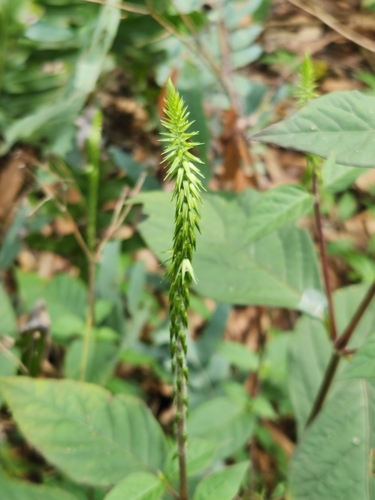
Atriplex halimus
L.
“Mallow”, Mediterranean Saltbush
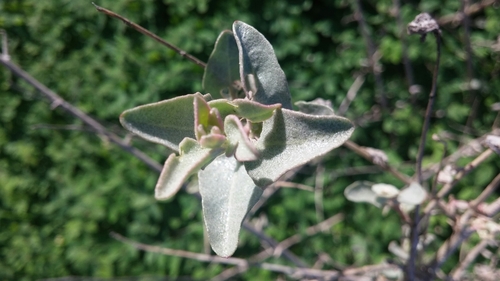
(c) keir, some rights reserved (CC BY-NC), uploaded by keir

(c) Valter Jacinto, some rights reserved (CC BY-NC-SA)
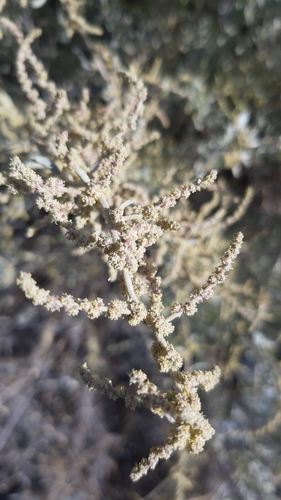
(c) Pedro Beja, some rights reserved (CC BY-NC), uploaded by Pedro Beja
What to Eat
Edible parts: Leaves, Seeds, Manna
Edible Parts: Leaves Manna Seed Edible Uses: Leaves - raw or cooked. Some forms are eaten raw. A famine food according to one report, but in our opinion it is far from being a famine food, in fact this is one of the more popular crops being grown at 'The Field' at present (1993). The leaves have a very nice rather salty flavour, they go well in salads or can be cooked like spinach. When lightly steamed, the leaves retain their crispness and are a delicious spinach substitute. The leaves retain their salty flavour even when grow inland in non-salty soils. The leaves can be used at any time of the year though winter harvesting must be light because the plant is not growing much at this time. Seed - cooked. It can be ground into a meal and used as a thickener in soups, or mixed with cereals in making bread. The seed is small and fiddly. The plant is said to yield an edible manna.
Known Hazards
Where to Find It
It is a subtropical plant. It grows on sandy soils by the sea. It can grow in salty soils. It needs a well drained soil. It does best in full sun but can grow in part shade. It can grow in salty or alkaline soils. It can tolerate wind. It does all right down to -5°C. Plants are damaged by frosts but recover. It grows in areas with an annual rainfall between 150-600 m altitude. Large plants are not easily transplanted. It grows between 910-1,220 m above sea level. It can grow in arid places and deserts. It grows in the Sahara. It suits hardiness zones 8-10.
Africa, Algeria, Angola, Australia, Balkans, Belgium, Britain, Bulgaria, Central Africa, Cyprus, East Africa, Egypt, Europe, France, Greece, India, Iran, Israel, Italy, Jordan, Kenya, Kuwait, Lebanon, Lesotho, Libya, Madagascar, Mauritius, Mediterranean, Middle East, Morocco, Mozambique, Niger, North Africa, Pakistan, Palestine, Portugal, Sahel, Saudi Arabia, Siberia, Sinai, South Africa, Southern Africa, Spain, Sudan, Syria, Tanzania, Tunisia, Turkey, Türkiye, USA, West Africa,
How to Identify
It is a shrub growing to 2 m high. The leaves are alternate and have leaf stalks. The leaves are silver green. The blade is 3 cm long. It narrows at the base. The flowers are greenish white. They are in irregular spikes.
How to Grow
An easily grown plant, it succeeds in full sun in any well-drained but not too fertile soil. Tolerates saline and very alkaline soils. Succeeds in dry soils including pure sands. Plants will grow in semi-shade, though they will soon become leggy in such a position, they are really best in full sun. A very wind hardy plant, it is resistant to salt-laden gales, and can be used as a hedge in maritime areas. Plants dislike very wet climates. This species is not hardy in the colder areas of the country, it tolerates temperatures down to between -5 and -10°c. This plant is hardier than the foregoing report suggests, it grows well at Hilliers Arboretum in Hampshire where temperatures can fall somewhat lower than -10°c. Plants can be damaged by severe frosts but they soon recover. Resents root disturbance when large. Plants are apt to succumb to winter wet when grown on heavy or rich soils. In garden design, as well as the above-ground architecture of a plant, root structure considerations help in choosing plants that work together for their optimal soil requirements including nutrients and water. Saltbush can be harvested for forage throughout the growing season, typically in late spring to early autumn. Saltbush generally flowers in late summer to early autumn, depending on the specific species and growing conditions.
Propagation: Seed - sow April/May in a cold frame in a compost of peat and sand. The seed usually germinates in 1 - 3 weeks at 13°c. Pot up the seedlings when still small into individual pots, grow on in a greenhouse for the first winter and plant out in late spring or early summer after the last expected frosts. The seed is seldom formed. Cuttings of half-ripe wood, July/August in a frame. Very easy. Pot up as soon as they start to root (about 3 weeks) and plant out in their permanent positions late in the following spring. Cuttings of mature wood of the current season's growth, November/December in a frame. Very easy. Pot up in early spring and plant out in their permanent position in early summer.
Medicinal Uses
Carminative The shoots are burnt to produce an antacid powder.
Other Uses
Hedge Hedge Soap making Soil reclamation Agroforestry uses: Saltbush is often used for erosion control, as a windbreak, and for soil stabilization. Its high salt tolerance makes it suitable for saline soils, and it can be used as forage for livestock. The ash from the burnt plant is used as the alkali in making soap. The plant makes a superb wind-resistant low-growing hedge that can be allowed to grow untrimmed or can be trimmed. It is especially valuable in maritime areas, succeeding right on the coast, though can also be used inland[75, 182, K]. The plant is extremely tolerant of pruning and can regrow even when cut back into old wood. The plant draws salt out of the soil and so has been used in soil-reclamation projects to de-salinate the soil. 1. Nectary - Flowers rich in nectar and pollen: No – Saltbush is wind-pollinated, so it doesn’t produce nectar-rich flowers to attract pollinators. 2. Wildlife - Food (Fruit, Seeds, Leaf litter, Shelter, Nesting, Roosting): Yes – Saltbush provides food for wildlife through its seeds and foliage. It is an important food source for herbivores like birds and small mammals. The dense, bushy form also provides shelter and cover for nesting birds and other small animals. 3. Invertebrate Shelter (Overwintering sites, Leaf litter, Groundcover): Yes – The dense, shrubby growth of Saltbush offers good ground cover for invertebrates, and the fallen leaves can serve as shelter and overwintering sites for beneficial insects. 4. Pest Confuser (Smell): No – Saltbush does not have a strong aromatic smell that repels pests, so it is not typically used as a pest confuser. Special Uses Food Forest Hedge Hedge
Wikipedia
Source ↗Atriplex halimus (known also by its common names: Mediterranean saltbush, sea orache, shrubby orache, silvery orache; ; also spelled orach) is a species of fodder shrub in the family Amaranthaceae.
Notes
There are about 100-300 Atriplex species. See Job 30:4 They have also been put in the family Chenopodiaceae.
Names & Synonyms
Gataf, G'taf, Guettaf, Hamth, Kataf, Legtaf, Sea Orache, Sea purslane, Seabeach sandwort, Shrubby orache, Tree purslane
References (29)
- Al-Qura'n, S. A., 2010, Ethnobotanical and Ecological Studies of Wild Edible Plants in Jordan. Libyan Agriculture Research Center Journal International 1(4):231-243
- Ambasta S.P. (Ed.), 2000, The Useful Plants of India. CSIR India. p 62
- Bailey, C. and Danin, A., 1981, Bedouin Plant Utilization in Sinai and the Negev. Economic Botany 35(2): 145-162
- Bidak, L. M., et al, 2015, Goods and services provided by native plants in desert ecosystems: Examples from the northwestern coastal desert of Egypt. Global Ecology and Conservation 3 (2015) 433–447
- Bircher, A. G. & Bircher, W. H., 2000, Encyclopedia of Fruit Trees and Edible Flowering Plants in Egypt and the Subtropics. AUC Press. p 47
- Blamey, M and Grey-Wilson, C., 2005, Wild flowers of the Mediterranean. A & C Black London. p 40
- Cundall, P., (ed.), 2004, Gardening Australia: flora: the gardener's bible. ABC Books. p 206
- Dop, M. C., et al, 2019, Identification and frequency of consumption of wild edible plants over a year in central Tunisia: a mixed-methods approach. Public Health Nutrition: 23(5), 782–794
- Etherington, K., & Imwold, D., (Eds), 2001, Botanica's Trees & Shrubs. The illustrated A-Z of over 8500 trees and shrubs. Random House, Australia. p 107
- Facciola, S., 1998, Cornucopia 2: a Source Book of Edible Plants. Kampong Publications, p 75
- Hedrick, U.P., 1919, (Ed.), Sturtevant's edible plants of the world. p 86
- INFOODSUpdatedFGU-list.xls
- Jackes, D. A., Edible Forest Gardens
- Joshi, A., et al, 2018, Halophytes of Thar Desert: Potential source of nutrition and feedstuff. International Journal of Bioassays 8.1 (2018) pp. 5674-5683
- Jardin, C., 1970, List of Foods Used In Africa, FAO Nutrition Information Document Series No 2.p 39, 58
- Kiple, K.F. & Ornelas, K.C., (eds), 2000, The Cambridge World History of Food. CUP p 1850
- Lord, E.E., & Willis, J.H., 1999, Shrubs and Trees for Australian gardens. Lothian. p 205
- Mahklouf, M. H., 2019, Ethnobotanical Study of Edible Wild Plants in Libya. European Journal of Ecology. 5(2): 30-40
- Martin, F.W. & Ruberte, R.M., 1979, Edible Leaves of the Tropics. Antillian College Press, Mayaguez, Puerto Rico. p 182
- Nassif, F., & Tanji, A., 2013, Gathered food plants in Morocco: The long forgotten species in Ethnobotanical Research. Life Science Leaflets 3:17-54
- Plants for a Future database, The Field, Penpol, Lostwithiel, Cornwall, PL22 0NG, UK. http://www.scs.leeds.ac.uk/pfaf/
- Rivera, D. et al, 2006, Gathered Mediterranean Food Plants - Ethnobotanical Investigations and Historical Development, in Heinrich M, Müller WE, Galli C (eds): Local Mediterranean Food Plants and Nutraceuticals. Forum Nutr. Basel, Karger, 2006, vol 59, pp 18–74
- Royal Botanic Gardens, Kew (1999). Survey of Economic Plants for Arid and Semi-Arid Lands (SEPASAL) database. Published on the Internet; http://www.rbgkew.org.uk/ceb/sepasal/internet [Accessed 7th April 2011]
- Sp. pl. 2:1052. 1753
- Terra, G.J.A., 1973, Tropical Vegetables. Communication 54e Royal Tropical Institute, Amsterdam, p 27
- USDA, ARS, National Genetic Resources Program. Germplasm Resources Information Network - (GRIN). [Online Database] National Germplasm Resources Laboratory, Beltsville, Maryland. Available: www.ars-grin.gov/cgi-bin/npgs/html/econ.pl (10 April 2000)
- van Wyk, B., 2005, Food Plants of the World. An illustrated guide. Timber press. p 79
- Wiersema, J. H. & Leon, B., 2013, World Economic Plants. A Standard Reference CRC Press. 2nd Ed. p 84
- World Checklist of Useful Plant Species 2020. Royal Botanic Gardens, Kew