Atriplex lentiformis
(Torr.) S. Watson
Quail bush
(c) Kenneth Bader, some rights reserved (CC BY-NC), uploaded by Kenneth Bader

(c) Scott Loarie, some rights reserved (CC BY)

(c) stonebird, some rights reserved (CC BY-NC-SA)
What to Eat
Edible parts: Leaves, Seeds, Stems
Edible Parts: Leaves Seed Shoots Edible Uses: Edible uses & rating: Seeds (after 2 changes of boiling water), leaves poor. Edibility rating: 2/5. Taste & processing notes: Utricles papery and easy to crush, but chaff includes stem shards; bugs often perforate seeds—cook. Raw seeds extremely bitter/alkaline/musty; after thorough boiling become passable. Season/harvest: Seeds late autumn–winter along desert watercourses [2-3]. Leaves and young shoots - cooked. Seed - cooked. It can be used as a piñole or be ground into a meal and used as a porridge, a thickener in soups or added to flour for making bread. The seed is rather small and fiddly to use.
Where to Find It
It is a Mediterranean plant. It grows in areas with a rainfall between 300-500 mm per year. It grows in dry, salty and alkaline soils. It cannot tolerate frost. It can grow in arid places.
Iran, Hawaii, Israel, Mediterranean, Mexico, Middle East, North America, Pacific, USA,
How to Identify
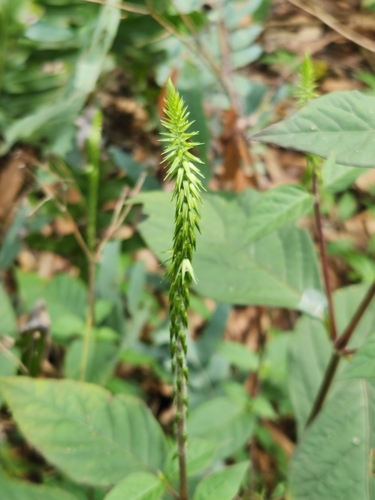
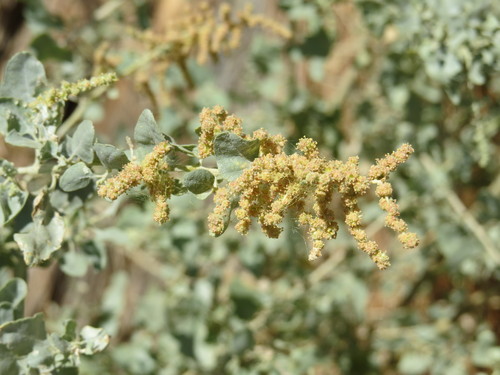
An evergreen dioecious shrub reaching 3 m tall at moderate growth rate, requiring both male and female plants for seed production. Remains leafy year-round, flowering May to September with seeds ripening July to October. Wind-pollinated. Prefers light sandy or medium loamy, well-drained soils tolerating poor fertility. Suitable for mildly acid to very alkaline and saline soils. Needs full sun, handles both dry and moist conditions with drought tolerance. Hardy to UK zone 8.
How to Grow
Plants can be grown by seed or cuttings.
Propagation: Seed - sow April/May in a cold frame in a compost of peat and sand. The seed usually germinates in 1 - 3 weeks at 13°c. Pot up the seedlings when still small into individual pots, grow on in a greenhouse for the first winter and plant out in late spring or early summer after the last expected frosts. Cuttings of half-ripe wood, July/August in a frame. Very easy. Pot up as soon as they start to root (about 3 weeks) and plant out in their permanent positions late in the following spring. Cuttings of mature wood of the current season's growth, November/December in a frame. Very easy. Pot up in early spring and plant out in their permanent position in early summer.
Medicinal Uses
Miscellany Poultice The fresh leaves can be chewed, or the dried leaves smoked, in the treatment of head colds. The crushed flowers, stems and leaves can be steamed and inhaled to treat nasal congestion. A poultice of the powdered roots has been applied to sores.
Other Uses
Miscellany Soap Agroforestry uses: Saltbush is often used for erosion control, as a windbreak, and for soil stabilization. Its high salt tolerance makes it suitable for saline soils, and it can be used as forage for livestock. The crushed leaves and roots have been used as a soap for washing clothes . 1. Nectary - Flowers rich in nectar and pollen: No – Saltbush is wind-pollinated, so it doesn’t produce nectar-rich flowers to attract pollinators. 2.Wildlife - Food (Fruit, Seeds, Leaf litter, Shelter, Nesting, Roosting): Yes – Saltbush provides food for wildlife through its seeds and foliage. It is an important food source for herbivores like birds and small mammals. The dense, bushy form also provides shelter and cover for nesting birds and other small animals. Outstanding cover/nest shrub; seeds for birds. 3.Invertebrate Shelter (Overwintering sites, Leaf litter, Groundcover): Yes – The dense, shrubby growth of Saltbush offers good ground cover for invertebrates, and the fallen leaves can serve as shelter and overwintering sites for beneficial insects. 4.Pest Confuser (Smell): No – Saltbush does not have a strong aromatic smell that repels pests, so it is not typically used as a pest confuser. Special Uses
Wikipedia
Source ↗Atriplex lentiformis (quail bush, big saltbrush, big saltbush, quailbrush, lenscale, len-scale saltbush and white thistle) is a species of saltbush.
Notes
There are about 100-300 Atriplex species. They have also been put in the family Chenopodiaceae.
Names & Synonyms
References (9)
- Beckstrom-Sternberg, Stephen M., and James A. Duke. "The Foodplant Database." http://probe.nalusda.gov:8300/cgi-bin/browse/foodplantdb.(ACEDB version 4.0 - data version July 1994)
- CURTIN,
- Kermath, B. M., et al, 2014, Food Plants in the Americas: A survey of the domesticated, cultivated and wild plants used for Human food in North, Central and South America and the Caribbean. On line draft. p 104
- MINNIS
- Plants for a Future database, The Field, Penpol, Lostwithiel, Cornwall, PL22 0NG, UK. http://www.scs.leeds.ac.uk/pfaf/
- Proc. Amer. Acad. Arts 9:118. 1874
- Royal Botanic Gardens, Kew (1999). Survey of Economic Plants for Arid and Semi-Arid Lands (SEPASAL) database. Published on the Internet; http://www.rbgkew.org.uk/ceb/sepasal/internet [Accessed 8th April 2011]
- Saunders, C.F., 1948, Edible and Useful Wild Plants. Dover. New York. p 54
- Tozer, F., 2007, The Uses of Wild Plants. Green Man Publishing. p 43