Vachellia reficiens
(Wawra) Kyal. & Boatwr.
False umbrella thorn
(c) jambobwana, some rights reserved (CC BY-NC)
(c) jambobwana, some rights reserved (CC BY-NC)
(c) jambobwana, some rights reserved (CC BY-NC)
What to Eat
Edible parts: Gum, Seeds
The gum is eaten as a snack, and the seeds are also edible.
Where to Find It
It is a tropical plant. It grows on sandy soils and occasionally brackish soils. It can be on mountain slopes, dry riverbeds of stony flats. In East Africa it grows between 50-1,450 m altitude. It grows in areas with an annual rainfall between 15-400 mm. It can tolerate drought. It can grow in arid places.
Africa, Angola, Botswana, Central Africa, East Africa, Ethiopia, Kenya, Namibia, Somalia, South Africa, Southern Africa, Uganda,
How to Identify
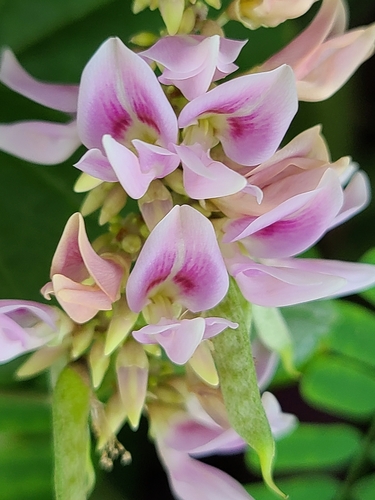
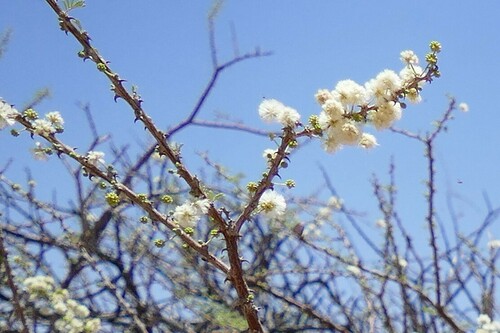
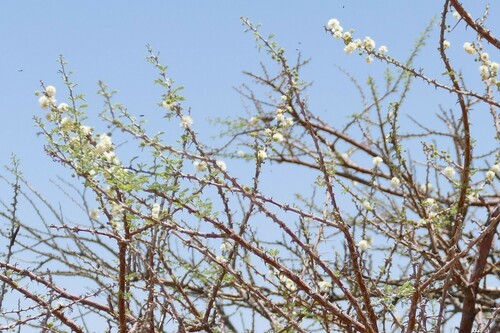
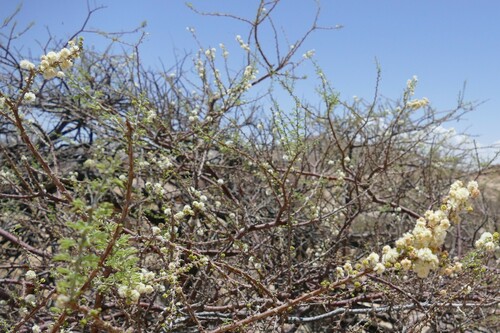
A bush or small tree. It can be 5 m high. It has spines which can be hooked or straight. They are in pairs in the axils of the leaves. They are 2-6 mm long. The bark is red brown and rough and becomes cracked when old. The leaves are compound. There are 2-9 pairs of stalks each bearing 5-11 pairs of very small leaflets. The flowers are white balls on slender stalks. They are 2-3 cm long. The fruit are short pods. They are red and 5-8 cm long by 0.6-1 cm wide. They are thinly woody and flat. There are 2 subspecies recognised.
Medicinal Uses
The bark is used to curdle milk.
Wikipedia
Source ↗Vachellia reficiens (Afrikaans: Rooihak, German: Rotrindenakazie), commonly known as red-bark acacia, red thorn, false umbrella tree, or false umbrella thorn, is a deciduous tree or shrub of the pea family (Fabaceae) native to southern Africa, often growing in an upside-down cone shape and with a relatively flat crown.
Notes
There are about 1,350 Acacia species. Over 1,000 occur in Australia. Also as Mimosaceae.
Names & Synonyms
Anywa, Eregae, Khansa, Panyarit, Qansax, Rooihaak
References (14)
- Dharani, N., 2002, Field Guide to common Trees & Shrubs of East Africa. Struik. p 193 (As Acacia reficiens)
- Dharani, N., 2006, Field Guide to Acacias in East Africa. Struik. p 141 (As Acacia reficiens)
- ILDIS Legumes of the World http:www;ildis.org/Legume/Web (As Acacia reficiens)
- Mutie, F. M., et al, 2023, Important Medicinal and Food Taxa (Orders and Families) in Kenya, Based on Three Quantitative Approaches. Plants 2023, 12, 1145
- Omer, M., 2011, Diversity of Woody Species, Local Knowledge and Management Practices in Different Land Use Systems of Awbare Wereda, Jig-Jiga Zone of Somali Region, Ethiopia. M. Sc. these Addis Abba University p 47 (As Acacia reficiens)
- Palgrave, K.C., 1996, Trees of Southern Africa. Struik Publishers. p 248 (As Acacia reficiens)
- Palmer, E and Pitman, N., 1972, Trees of Southern Africa. Vol. 2. A.A. Balkema, Cape Town p 700 (As Acacia reficiens)
- Peters, C. R., O'Brien, E. M., and Drummond, R.B., 1992, Edible Wild plants of Sub-saharan Africa. Kew. p 127 (As Acacia reficiens)
- Royal Botanic Gardens, Kew (1999). Survey of Economic Plants for Arid and Semi-Arid Lands (SEPASAL) database. Published on the Internet; http://www.rbgkew.org.uk/ceb/sepasal/internet [Accessed 27th April 2011] (As Acacia reficiens)
- Ruiters-Welcome, A. K., 2019, Food plants of southern Africa. Ph.D. thesis. Univ. of Johannesburg p 62
- Sitzungsber. Math.-Phys. Cl. Konigl. Bayer. Akad. Wiss. Munchen 38:555 (As Acacia reficiens)
- van Wyk, Ben-Erik, 2019, The diversity and multiple uses of southern African legumes. Australian Systematic Botany, 2019, 32, 519–546
- Welcome, A. K. & Van Wyk, B.-E., 2019, An inventory and analysis of the food plants of southern Africa. South African Journal of Botany 122 (2019) 136–179
- World Checklist of Useful Plant Species 2020. Royal Botanic Gardens, Kew