Atriplex muelleri
Benth.
Mueller’s saltbush
(c) Kym Nicolson, some rights reserved (CC BY), uploaded by Kym Nicolson

(c) Muriel Bendel, some rights reserved (CC BY-NC), uploaded by Muriel Bendel
(c) Kevin Faccenda, some rights reserved (CC BY), uploaded by Kevin Faccenda
What to Eat
Edible parts: Leaves
The favored species for human consumption is now usually garden orache (A. hortensis), but many species are edible and the use of Atriplex as food is known since at least the late Epipaleolithic (Mesolithic). Common orache (A. patula) is attested as an archaeophyte in northern Europe, and the Ertebølle culture is presumed to have used it as a food. Its seed has been found among apparent evidence of cereal preparation and cooking at Late Iron Age villages in Britain. Grey saltbush (A. cinerea) has been used as bushfood in Australia since prehistoric times. Chamiso (A. canescens) and shadscale (A. confertifolia) were eaten by Native Americans, and spearscale (A. hastata) was a food in rural Eurasia. Studies on Atriplex species demonstrated their potential use in agriculture. Meat from sheep which have grazed on saltbush has surprisingly high levels of vitamin E, is leaner and more hydrated than regular lamb and has consumer appeal equal to grain-fed lamb. The vitamin E levels could have animal health benefits while extending the shelf-life and maintaining the fresh red colour of saltbush lamb. This effect has been demonstrated for old man saltbush (A. nummularia) and river saltbush (A. amnicola). For reasons unknown, sheep seem to prefer the more fibrous, less nutritious river saltbush. A study on A. nummularia discovered the species have a nitrogen content of 2.5–3.5%, and could potentially be used as a protein supplement for grazing if palatable. A subsequent study allowed sheep and goats to voluntarily feed on Atriplex halimus and aimed to determine if the saltbush was palatable, and if so, did it provide enough nutrients to supplement the diet of these animals. In this study they determined when goats and sheep are given as much A. halimus as they like, they do obtain enough nutrients to supplement their diet – unless the animal requirements are higher during pregnancy and milk production. Saltbushes are also used as an ornamental plant in landscaping and can be used to prevent soil erosion in coastal areas. Old man saltbush (Atriplex nummularia) has also been successfully used to rehabilitate old mining sites in Australia.
Known Hazards
Where to Find It
It grows in temperate places. It grows in inland Australia. It is drought and frost tolerant. They need fairly well drained soils.
Australia*,
How to Identify
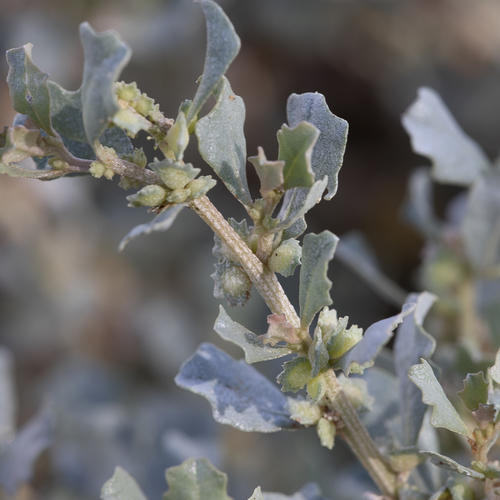
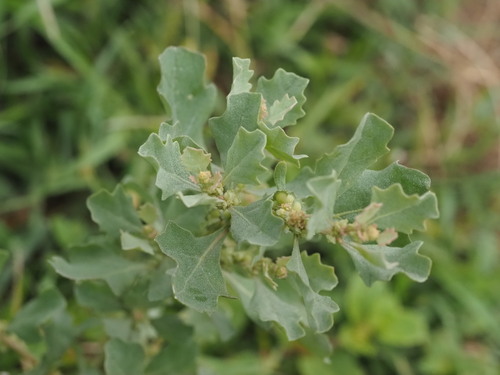
A spreading shrub. It grows 0.3-1 m high and spreads 1-2 m wide. It grows each year from seed. The branches are rigid. The leaves are 5 cm long and wedge shaped. They have lobes or irregular teeth along the edge. The upper surface is green and they are mealy white underneath. The flowers are small. Male flowers are round and in the upper axils of leaves. The female flowers occur in clusters in the lower axils. They are both on the same plant.
How to Grow
Plants can be grown by seed or cuttings.
Notes
There are about 100-300 Atriplex species. They have also been put in the family Chenopodiaceae.
References (7)
- Bodkin, F., 1991, Encyclopedia Botanica. Cornstalk publishing, p 118
- Elliot, W.R., & Jones, D.L., 1982, Encyclopedia of Australian Plants suitable for cultivation. Vol 2. Lothian. p 257
- Fl. austral. 5:175.1870
- Flora of Australia, Volume 4, Phytolaccaceae to Chenopodiaceae, Australian Government Publishing Service, Canberra (1984) p 113
- Lazarides, M. & Hince, B., 1993, Handbook of Economic Plants of Australia, CSIRO. p 28
- Low, T., 1992, Bush Tucker. Australia’s Wild Food Harvest. Angus & Robertson. p 129
- Paczkowska, G. & Chapman, A.R., 2000, The Western Australian Flora. A Descriptive Catalogue. Western Australian Herbarium. p 200