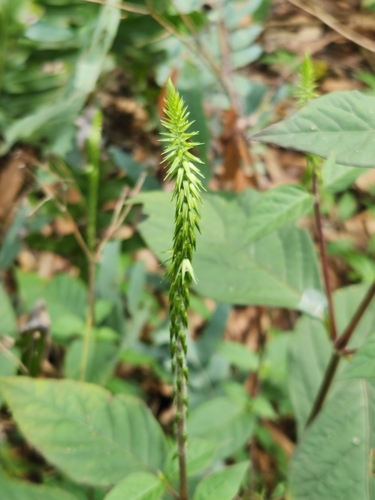
Atriplex sagittata
Borkh.
Fat Hen, Sjajna loboda
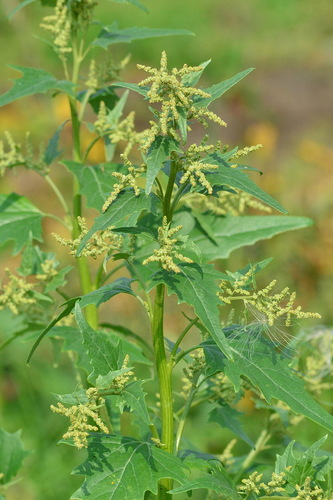
(c) Константин Самодуров, some rights reserved (CC BY-NC), uploaded by Константин Самодуров

(c) Иван Тисленко, some rights reserved (CC BY-NC), uploaded by Иван Тисленко
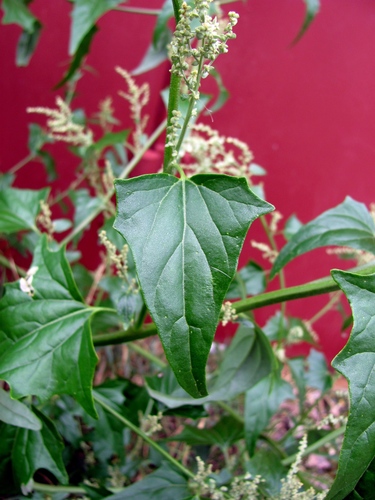
(c) eugenezakharov, some rights reserved (CC BY-NC), uploaded by eugenezakharov
What to Eat
Edible parts: Leaves, Vegetable
The leaves are cooked as a vegetable and used in pickles.
Where to Find It
It will grow in most soils. It is damaged by drought and frost.
Armenia, Australia, Balkans, Bosnia, Bulgaria, Caucasus, Central Asia, Europe*, Mediterranean, Slovenia, Tajikistan, Turkey, Türkiye,
How to Identify
A plant that keeps growing from year to year. It grows 2.5 m high and spreads 2 m wide. The stem is erect and branching. The leaves are triangle shaped and have lobes. The flowers are of on sex and are green. They are in long clusters that hang down.
How to Grow
Plants can be grown by seed or cuttings.
Wikipedia
Source ↗Atriplex sagittata is a species of flowering plant belonging to the family Amaranthaceae. Its native range is Central and Eastern Europe to Central Asia.
Other Information
It is sold in local markets.
Notes
There are about 100-300 Atriplex species. They have also been put in the family Chenopodiaceae.
Names & Synonyms
Kopjastolistna loboda, Laskava loboda
References (8)
- Bodkin, F., 1991, Encyclopedia Botanica. Cornstalk publishing, p 118 (As Atriplex nitens)
- Bot. Handb. 3:541. 1802 (As Atriplex nitens)
- Cerne, M., 1992, Wild Plants from Slovenia used as Vegetables. Acta Horticulturae 318 (As Atriplex nitens)
- Ertug, F, Yenen Bitkiler. Resimli Türkiye Florası -I- Flora of Turkey - Ethnobotany supplement (As Atriplex nitens)
- Hammer, K. & Spahillari, M., 1999, Crops of European origin. in Report of a networking group on minor crops. IPGRI p 41 (As Atriplex nitens)
- Nedelcheva A., 2013, An ethnobotanical study of wild edible plants in Bulgaria. EurAsian Journal of BioSciences 7, 77-94 (As Atriplex nitens)
- Redzic, S. J., 2006, Wild Edible Plants and their Traditional Use in the Human Nutrition in Bosnia-Herzegovina. Ecology of Food and Nutrition, 45:189-232 (As Atriplex nitens)
- Rivera, D. et al, 2006, Gathered Mediterranean Food Plants - Ethnobotanical Investigations and Historical Development, in Heinrich M, Müller WE, Galli C (eds): Local Mediterranean Food Plants and Nutraceuticals. Forum Nutr. Basel, Karger, 2006, vol 59, pp 18–74 (As Atriplex nitens)