Atriplex nummularia
Lindley
Old man saltbush
(c) Adam Yates, some rights reserved (CC BY-NC), uploaded by Adam Yates

(c) geoffbyrne, some rights reserved (CC BY-NC)

(c) Tony Rebelo, some rights reserved (CC BY-SA), uploaded by Tony Rebelo
What to Eat
Edible parts: Leaves, Seeds
Edible Parts: Leaves Shoots Edible Uses: Leaves and young shoots - cooked. Seed - cooked. It can be used as a piñole or be ground into a meal and used as a thickener in soups that are added to flour for making bread.
Known Hazards
Where to Find It
It can grow from temperate to subtropical climates and from semiarid to arid regions. It can tolerate heavy frost. It suits alkaline soils. It can tolerate salty soils. It is drought resistant.
Africa, Argentina, Asia, Australia*, China, Eswatini, India, North America, South Africa, Southern Africa, Southern America, St Helena, Swaziland, Taiwan, USA,
How to Identify
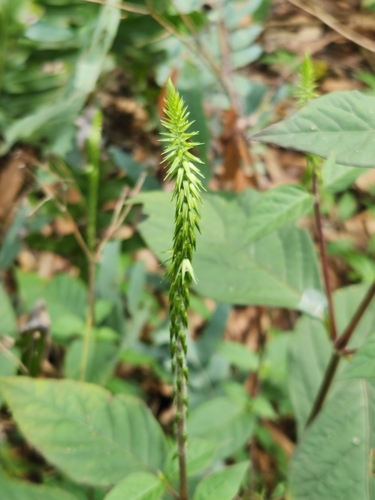
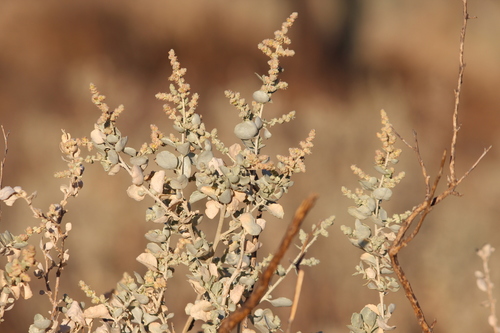
A perennial herb. It grows 1-3 m tall. It spreads 2-4 m wide. The branches are whitish. The leaves are furry and silvery white. They are 4 cm long by 4 cm wide. They are flat with teeth along the edge. The flowers are small. The flowers are yellowish-brown. The male flowers are round and in clusters at the end of the plant. The female flowers are in long dense clusters at the ends of plants. Male and female flowers are on separate plants.
How to Grow
Requires a position in full sun in any well-drained but not too fertile soil. Tolerates saline and very alkaline soils. Succeeds in a hot dry position. This species is not hardy in the colder areas of the UK, it tolerates temperatures down to between -5 and -10°c. Plants are usually monoecious but can be dioecious. Prefers an average annual rainfall between 300 - 600 mm. It is unlikely to do well in humid regions. Saltbush can be harvested for forage throughout the growing season, typically in late spring to early autumn. Saltbush generally flowers in late summer to early autumn, depending on the specific species and growing conditions. Saltbush species are typically slow to moderate in growth, depending on the environmental conditions, but can establish well in poor soils.
Propagation: Seed - sow April/May in a cold frame in a compost of peat and sand. The seed usually germinates in 1 - 3 weeks at 13°c. Pot up the seedlings when still small into individual pots, grow on in a greenhouse for the first winter and plant out in late spring or early summer after the last expected frosts. Cuttings of half-ripe wood, July/August in a frame. Very easy. Pot up as soon as they start to root (about 3 weeks) and plant out in their permanent positions late in the following spring. Cuttings of mature wood of the current season's growth, November/December in a frame. Very easy. Pot up in early spring and plant out in their permanent position in early summer.
Medicinal Uses
The plant has been used for the treatment of scurvy and blood diseases.
Other Uses
Fire retardant Fodder Hedge Soil stabilization Fodder for sheep and cattle. A fire-retardant hedge in arid, inland areas. Agroforestry Uses: The plant has excellent potential for use as a windbreak. It provides a useful windbreak which, along with readily visible leaves in the lights of cars at night, makes it suitable for roadside plantings. Saltbush is often used for erosion control, as a windbreak, and for soil stabilization. Its high salt tolerance makes it suitable for saline soils, and it can be used as forage for livestock. Ornamental. The ornamental foliage can be pruned to make hedges and provides an attractive silvery contrast against darker plants in the garden. With its deep root system, the plant has good potential for use to prevent soil erosion. Other Uses: The wood is a high-quality fuel. 1. Nectary - Flowers rich in nectar and pollen: No – Saltbush is wind-pollinated, so it doesn’t produce nectar-rich flowers to attract pollinators. 2. Wildlife - Food (Fruit, Seeds, Leaf litter, Shelter, Nesting, Roosting): Yes – Saltbush provides food for wildlife through its seeds and foliage. It is an important food source for herbivores like birds and small mammals. The dense, bushy form also provides shelter and cover for nesting birds and other small animals. 3. Invertebrate Shelter (Overwintering sites, Leaf litter, Groundcover): Yes – The dense, shrubby growth of Saltbush offers good ground cover for invertebrates, and the fallen leaves can serve as shelter and overwintering sites for beneficial insects. 4. Pest Confuser (Smell): No – Saltbush does not have a strong aromatic smell that repels pests, so it is not typically used as a pest confuser. Special Uses Carbon Farming Hedge
Wikipedia
Source ↗Atriplex nummularia is a species of saltbush from the family Amaranthaceae and is a large woody shrub known commonly as oldman saltbush. A. nummularia is native to Australia and occurs in each of the mainland states, thriving in arid and semi-arid inland regions.
Notes
There are about 100-300 Atriplex species. They have also been put in the family Chenopodiaceae.
References (27)
- Alice, L. & O'Quinn, T., Australian Bush Superfoods. Explore Australia p 142
- Ambasta S.P. (Ed.), 2000, The Useful Plants of India. CSIR India. p 62
- Bindon, P., 1996, Useful Bush Plants. Western Australian Museum. p 45
- Bodkin, F., 1991, Encyclopedia Botanica. Cornstalk publishing, p 118
- Bonney, N., 1997, Economic Native Trees and Shrubs for South Australia. Greening Australia (SA) inc. Campbelltown SA 5074 p 33
- Bonney, N., 2012, Edible Wild Native Plants for Southern Australia. p 110
- Brown, D., 2002, The Royal Horticultural Society encyclopedia of Herbs and their uses. DK Books. p 137
- Cherikoff V. & Isaacs, J., The Bush Food Handbook. How to gather, grow, process and cook Australian Wild Foods. Ti Tree Press, Australia p 188
- Elliot, W.R., & Jones, D.L., 1982, Encyclopedia of Australian Plants suitable for cultivation. Vol 2. Lothian. p 257
- Flora of Australia, Volume 4, Phytolaccaceae to Chenopodiaceae, Australian Government Publishing Service, Canberra (1984) p 130
- Greig, D., 1996, Flowering Natives for Home Gardens. Angus & Robertson. p 59
- Hall, N. et al, 1972, The Use of Trees and Shrubs in the Dry Country of Australia, AGPS, Canberra. p 287, 354
- Hibbert, M., 2002, The Aussie Plant Finder 2002, Florilegium. p 36
- Isaacs, J., 1987, Bush Food, Aboriginal Food and Herbal Medicine. Weldons. p 115
- Lazarides, M. & Hince, B., 1993, Handbook of Economic Plants of Australia, CSIRO. p 28
- Leiper, G & Houser, J., Mutooroo. Plant Use by Australian Aboriginal People. Assembly press, Queensland.
- Lord, E.E., & Willis, J.H., 1999, Shrubs and Trees for Australian gardens. Lothian. p 149
- T. L. Mitchell, J. exped. trop. Australia 64. 1848
- Molyneux, B & Forrester, S., 1997, The Austraflora A-Z of Australian Plants. Reed. p 47
- Morley, B.D., & Toelken, H.R., (Eds), 1983, Flowering Plants in Australia. Rigby. p 83
- Paczkowska, G. & Chapman, A.R., 2000, The Western Australian Flora. A Descriptive Catalogue. Western Australian Herbarium. p 200
- Plants for a Future database, The Field, Penpol, Lostwithiel, Cornwall, PL22 0NG, UK. http://www.scs.leeds.ac.uk/pfaf/
- Swaziland's Flora Database http://www.sntc.org.sz/flora
- Williams A. & Sides, T., 2008, Wiradjuri Plant Use in the Murrumbidgee Catchment. Murrumbidgee Catchment Management Authority. Wagga Wagga, p 57
- World Checklist of Useful Plant Species 2020. Royal Botanic Gardens, Kew
- www.eFloras.org Flora of China
- Zhu Gelin (Chu Ge-ling); Steven E. Clemants, CHENOPODIACEAE [Draft], Flora of China