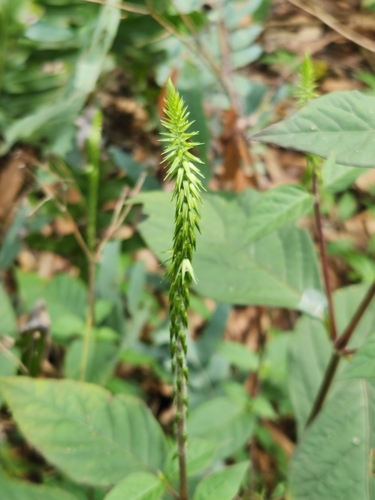
Atriplex patula
L.
Common Orache, Spreading orach
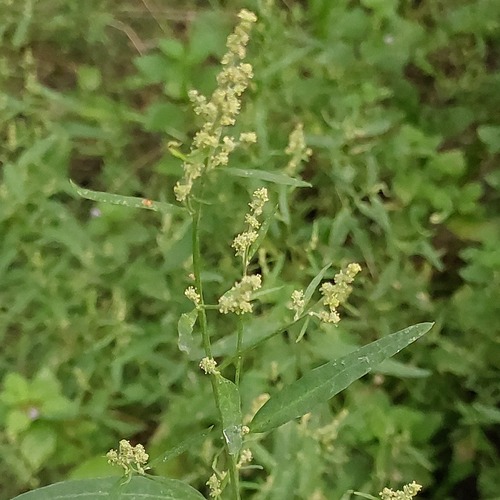
(c) Alexander Baransky, some rights reserved (CC BY-NC), uploaded by Alexander Baransky

(c) Jóna Zoltán, some rights reserved (CC BY-NC), uploaded by Jóna Zoltán
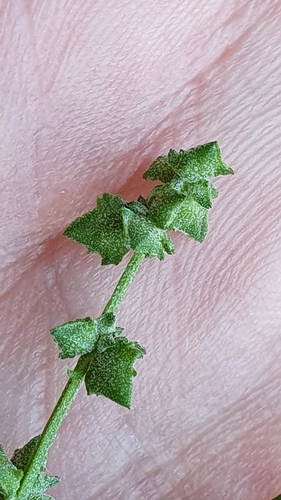
(c) Alexander Rumpel, some rights reserved (CC BY-NC), uploaded by Alexander Rumpel
What to Eat
Edible parts: Leaves, Seeds, Vegetable
Edible Parts: Leaves Seed Edible Uses: Edible uses & rating: Leaves historically boiled (Hopi), seeds used in scarcity years. Edibility rating: 1/5. Taste & processing notes: Leaves intensely acrid; require multiple water changes; foam persists; flavor remains poor. Seeds are salty/woody/acrid. Season/harvest: Desert; summer bloom, autumn seed [2-3]. Young leaves - raw or cooked as a spinach substitute. A fairly bland flavour, a few leaves of stronger-flavoured plants can be added to enhance the taste. Seed - ground and mixed with cornmeal or used to thicken soups etc. Small and very fiddly to harvest and use.
Known Hazards
Where to Find It
It is a temperate plant. In Argentina it grows between sea level and 500 m above sea level. Tasmania Herbarium.
Africa, Albania, Argentina, Australia, Britain, Canada, Central Asia, Chile, China, Czech Republic, Europe, Falklands, France, Germany, Hungary, Mediterranean, Moldova, Morocco, Netherlands, North Africa, North America, Russia, Slovenia, South America, Tajikistan, Tasmania, Turkey, Türkiye, Uruguay,
How to Identify
An annual herb. It grows 30 cm to 1.5 m tall. The leaves are alternate. The leaves are sword shaped and 3-14 cm long. The lower leaves can be more broad with a wedge shaped base that tapers into a short leaf stalk. The upper leaves do not have a leaf stalk. The seeds are 1.2-1.5 mm across.
How to Grow
Full sun; hyper-arid alkaline basins. Succeeds in full sun in any well-drained but not too fertile soil. Prefers a rich soil. Tolerates saline and very alkaline soils. Habitat & range: Sonoran/Mojave deserts.
Propagation: Seed - sow April/May in situ. Germination is usually rapid. Cuttings possible.
Medicinal Uses
Laxative The seeds, harvested when just ripe, are said to be as efficacious as ipecacuanha as a laxative.
Other Uses
Excellent nurse/hedge in severe deserts; minimal water. Wildlife/ecology: Browse (limited); cover; salinity tolerance for restoration. Special Uses
Wikipedia
Source ↗Atriplex patula (spear saltbush; common orache; spear orach; spreading orach; ) is a ruderal, circumboreal species of annual herbaceous plant in the genus Atriplex naturalized in many temperate regions.
Other Information
The leaves are rarely used.
Notes
There are about 100-300 Atriplex species. They have also been put in the family Chenopodiaceae.
Names & Synonyms
Halberd-leaved saltbush, Lebeda rozkladita, Loboda, Spearscale, Tibidas, Vad laboda
References (19)
- Bircher, A. G. & Bircher, W. H., 2000, Encyclopedia of Fruit Trees and Edible Flowering Plants in Egypt and the Subtropics. AUC Press. p 47
- Brown, D., 2002, The Royal Horticultural Society encyclopedia of Herbs and their uses. DK Books. p 137
- Brown, D., 2002, The Royal Horticultural Society encyclopedia of Herbs and their uses. DK Books. p 137
- Cerne, M., 1992, Wild Plants from Slovenia used as Vegetables. Acta Horticulturae 318
- Ciocarlan, N. & Ghendov, V., 2015, Ethnobotanical and Ecological Studies of Wild Edible Plants from Bugeac Steppe, Republic of Moldova. Journal of EcoAgriTourism. Cailta terra Vol. 11(2):
- Curtis, W.M., 1993, The Student's Flora of Tasmania. Part 3 St David's Park Publishing, Tasmania, p 575
- Denes, A., et al, 2012, Wild plants used for food by Hungarian ethnic groups living in the Carpathian Basin. Acta Societatis Botanicorum Poloniae 81 (4): 381-396
- Ertug, F, Yenen Bitkiler. Resimli Türkiye Florası -I- Flora of Turkey - Ethnobotany supplement
- Facciola, S., 1998, Cornucopia 2: a Source Book of Edible Plants. Kampong Publications, p 76
- Kermath, B. M., et al, 2014, Food Plants in the Americas: A survey of the domesticated, cultivated and wild plants used for Human food in North, Central and South America and the Caribbean. On line draft. p 104
- Kolosova, V., et al, 2020, Foraging in Boreal Forest: Wild Food Plants of the Republic of Karelia, NW Russia. Foods 2020, 9, 1015; p 8
- Mabey, R., 1973, Food for Free. A Guide to the edible wild plants of Britain, Collins. p 91
- MacKinnon, A., et al, 2009, Edible & Medicinal Plants of Canada. Lone Pine. p 307
- Plants for a Future database, The Field, Penpol, Lostwithiel, Cornwall, PL22 0NG, UK. http://www.scs.leeds.ac.uk/pfaf/
- Simkova, K. et al, 2014, Ethnobotanical review of wild edible plants used in the Czech Republic. Journal of Applied Botany and Food Quality 88, 49-67
- Sp. pl. 2:1053. 1753
- Tasmanian Herbarium Vascular Plants list p 21
- Upson, R., & Lewis R., 2014, Updated Vascular Plant Checklist and Atlas for the Falkland Islands. Falklands Conservation and Kew.
- www.eFloras.org Flora of China