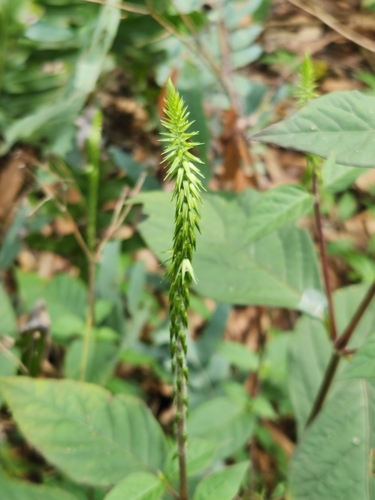
Atriplex serenana
A. Nelson ex Abrams
Bractscale

(c) Jordan Collins, some rights reserved (CC BY-NC), uploaded by Jordan Collins
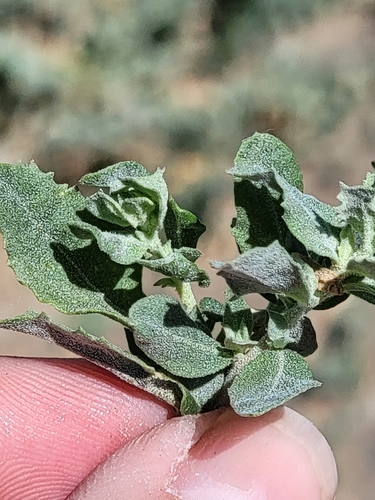
(c) Steph Ele Anderson, some rights reserved (CC BY-NC), uploaded by Steph Ele Anderson
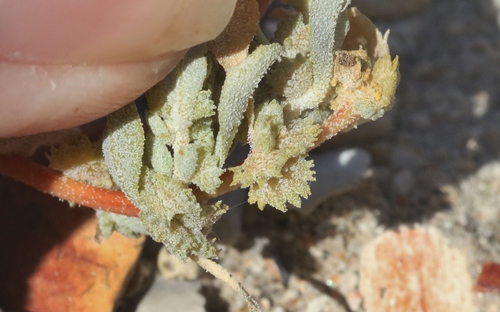
(c) James Bailey, some rights reserved (CC BY-NC), uploaded by James Bailey
What to Eat
Edible parts: Leaves, Seeds
Edible Parts: Leaves Seed Edible Uses: Condiment Edibility (summary & rating). Leaves used as a potherb by the Kawaiisu. Expect a salty or bitter taste; boil to tame it. Edibility rating: 3/5 (workable boiled green in small portions). Parts used & preparation. Leaves: Harvest tender growth; boil (one or more water changes if very salty); use as a side green. Seeds: Not documented in your notes; treat as with other Atriplex if attempted. Leaves and young plants - cooked. They are usually boiled with other foods as a salty flavouring. Seed - cooked. Used in piñole or ground into a meal and used as a thickener in making bread, or mixed with flour in making bread. Traditional uses. Kawaiisu boiled greens. Harvest tips. Favor pre-flowering leaves; if strongly briny, blanch and refresh in clean water before final cooking.
Known Hazards
Where to Find It
It is a temperate plant.
North America, USA,
How to Identify
Annual orache reaching 3 m tall. Flowers July to August; seeds ripen August to September. Monoecious (both male and female flowers on same plant); wind-pollinated. Tolerates light sandy and medium loamy soils, well-drained preferred, and survives in nutritionally poor, mildly acid, neutral, very alkaline, and saline soils. Requires full sun; handles drought and maritime exposure. Hardy to UK zone 8.
How to Grow
Season & phenology. Can bloom spring through autumn depending on moisture. Identification notes. Small annual, scurfy foliage; conspicuous, often broad bracts enclosing the utricles; stays low to the ground. Habitat & distribution. Coastal/inland saline flats, disturbed soils in southern California. Growing conditions & cultivation. Full sun; drought/salt tolerant; light, alkaline soils; minimal water. Hardiness. Warm-season annual; reseeds in USDA 8–11 (and warmer parts of 7). Size & habit. 10–30 cm tall, mounding patches. Weed potential. Low–moderate. Opportunistic in disturbed salt patches but not typically aggressive. Lookalikes & cautions. Other small oraches; apply oxalate/nitrate precautions.
Propagation: Propagation. By seed; surface-sow or cover very lightly; good drainage and warmth.
Medicinal Uses
None known
Other Uses
None known Special Uses
Wikipedia
Source ↗Atriplex serenana is a species of saltbush known by the common names bractscale and stinking orach. It is native to California and Baja California, where it grows in saline and alkaline soils such as those on alkali flats and beach bluffs. This is a mat-forming annual herb producing scaly stems up to a meter long. The toothed leaves are 1 to 4 centimeters long. The flowers are generally borne in hard clusters along the stem and there is sometimes a spikelike inflorescence of male flowers at the end of the stem. There are two varieties of this species. The rarer of the two, Davidson's saltscale (var. davidsonii), is limited to the coastline of southern California and Baja California.
Notes
There are about 100-300 Atriplex species. They have also been put in the family Chenopodiaceae.
Names & Synonyms
Atriplex serenana — Bractscale
References (4)
- Beckstrom-Sternberg, Stephen M., and James A. Duke. "The Foodplant Database." http://probe.nalusda.gov:8300/cgi-bin/browse/foodplantdb.(ACEDB version 4.0 - data version July 1994) (As Atriplex bracteosa)
- Plants for a Future database, The Field, Penpol, Lostwithiel, Cornwall, PL22 0NG, UK. http://www.scs.leeds.ac.uk/pfaf/
- Proc. Biol. Soc. Wash. 17:99. 1904 (Abrams, Fl. Los Angeles 128. 1904)
- Proc. Amer. Acad. Arts 9:116. 1874 (non Trautv. 1870) (As Atriplex bracteosa)