Atriplex stipitata
Benth.
Kidney or Mallee saltbush
(c) Kym Nicolson, some rights reserved (CC BY), uploaded by Kym Nicolson
(c) Bernadette Lingham, some rights reserved (CC BY-NC), uploaded by Bernadette Lingham
(c) tjane0708, some rights reserved (CC BY-NC), uploaded by tjane0708
What to Eat
Edible parts: Seeds
The seeds are eaten.
Where to Find It
It grows in warm temperate places. It grows in the arid interior. It suits salty areas. It will grow in most types of soils. It can tolerate frost.
Australia*,
How to Identify
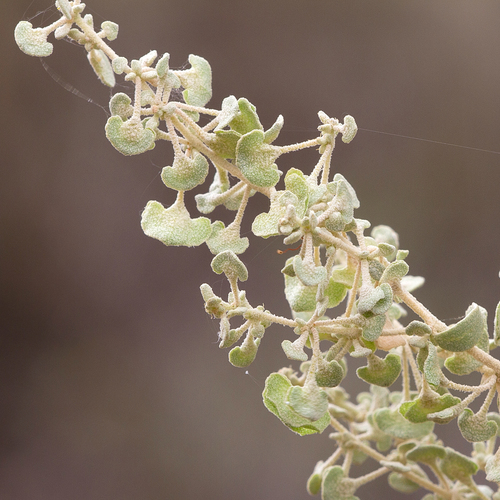
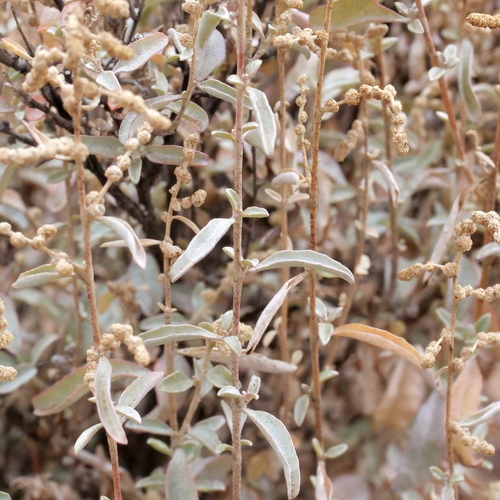
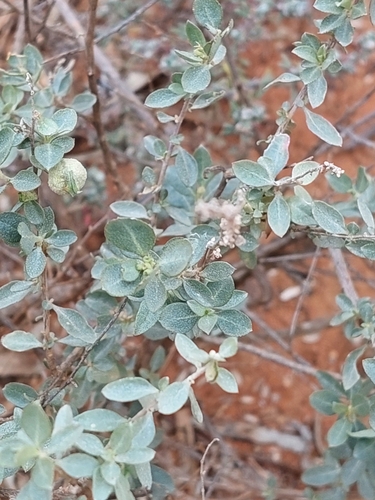
A small shrub. It grows 1-1.5 m high and spreads 1-1.5 m across. The small branches are slender. The leaves are 1-2 cm long and oval or oblong. The leaves curve inwards on the top surface. They are grey. The flowers are small and cream. The male flowers are in small clusters while the female flowers usually occur singly. The fruiting body is o.5 cm long by 1 cm wide and kidney shaped.
How to Grow
Plants can be grown by seed or cuttings.
Wikipedia
Source ↗Atriplex stipitata, commonly known as mallee saltbush, bitter saltbush and kidney saltbush, is a species of shrub in the family Amaranthaceae, found in all mainland states of Australia. In South Australia, it flowers all year round, however in other states generally flowers from spring through to autumn. A. stipitata is not considered a threatened species.
Notes
There are about 100-300 Atriplex species. They have also been put in the family Chenopodiaceae.
Names & Synonyms
References (6)
- Cherikoff V. & Isaacs, J., The Bush Food Handbook. How to gather, grow, process and cook Australian Wild Foods. Ti Tree Press, Australia p 188
- Elliot, W.R., & Jones, D.L., 1982, Encyclopedia of Australian Plants suitable for cultivation. Vol 2. Lothian. p 258
- Fl. austral. 5:168. 1870
- Flora of Australia, Volume 4, Phytolaccaceae to Chenopodiaceae, Australian Government Publishing Service, Canberra (1984) p 93, 121
- Lazarides, M. & Hince, B., 1993, Handbook of Economic Plants of Australia, CSIRO. p 29
- Paczkowska, G. & Chapman, A.R., 2000, The Western Australian Flora. A Descriptive Catalogue. Western Australian Herbarium. p 201