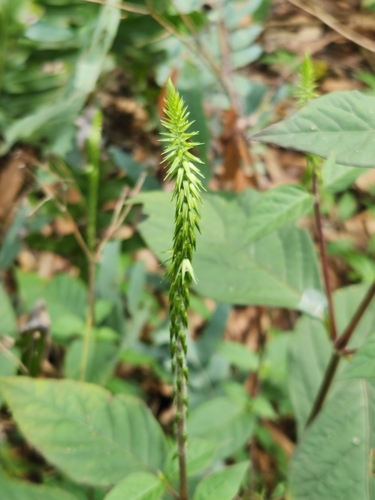
Atriplex vesicaria
Heward ex Benth.
Bladder saltbush

(c) Kym Nicolson, some rights reserved (CC BY), uploaded by Kym Nicolson

(c) David Spencer Muirhead, some rights reserved (CC BY-NC), uploaded by David Spencer Muirhead
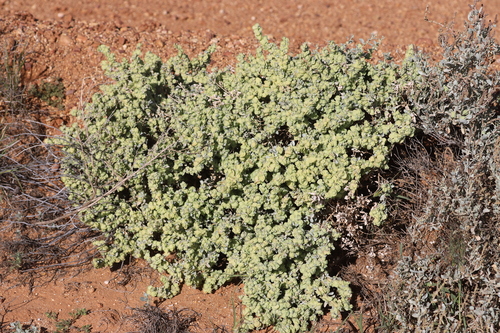
(c) Arthur Chapman, some rights reserved (CC BY-NC-SA), uploaded by Arthur Chapman
What to Eat
Edible parts: Seeds, Leaves
The seeds and leaves are eaten.
Known Hazards
Where to Find It
It grows in inland Australia. It will grow in heavy alkaline soils. It can tolerate frost and drought. It will grow in salty soils. It can grow in arid places.
Africa, Australia*, India, Israel, Mediterranean, Middle East, North Africa, Tunisia,
How to Identify
A small shrub. It grows 0.5-1 m high and spreads 1-2 m across. The branches are erect. The leaves are 1-3 cm long by 2 cm wide. The base tapers to the stalk. There are small teeth along the edge. The leaves are silvery grey. The flowers are small. The male flowers are in dense clusters 2.5 cm long. The female flowers are in clusters in the axils of the lower leaves. The fruit is bladder like. It is 1.5 cm wide. There is a hard nut inside.
How to Grow
Plants can be grown by seed or cuttings.
Wikipedia
Source ↗Atriplex vesicaria, commonly known as bladder saltbush, is a species of flowering plant of the family Amaranthaceae and is endemic to arid and semi-arid inland regions of Australia. It is an upright or sprawling shrub with scaly leaves and separate male and female plants, the fruit often with a bladder-like appendage.
Notes
There are about 100-300 Atriplex species. They have also been put in the family Chenopodiaceae.
Names & Synonyms
References (10)
- Cancilla, D., 2018, Ethnobotanical and Ethnozoological Values Desktop Assessment - Eliwana Project. p 38
- Bindon, P., 1996, Useful Bush Plants. Western Australian Museum. p 46
- Bodkin, F., 1991, Encyclopedia Botanica. Cornstalk publishing, p 119
- Elliot, W.R., & Jones, D.L., 1982, Encyclopedia of Australian Plants suitable for cultivation. Vol 2. Lothian. p 258
- Fl. austral. 5:172. 1870
- Flora of Australia, Volume 4, Phytolaccaceae to Chenopodiaceae, Australian Government Publishing Service, Canberra (1984) p 122, 93
- Hall, N. et al, 1972, The Use of Trees and Shrubs in the Dry Country of Australia, AGPS, Canberra. p 284
- Lazarides, M. & Hince, B., 1993, Handbook of Economic Plants of Australia, CSIRO. p 29
- Paczkowska, G. & Chapman, A.R., 2000, The Western Australian Flora. A Descriptive Catalogue. Western Australian Herbarium. p 201
- Royal Botanic Gardens, Kew (1999). Survey of Economic Plants for Arid and Semi-Arid Lands (SEPASAL) database. Published on the Internet; http://www.rbgkew.org.uk/ceb/sepasal/internet [Accessed 8th April 2011]