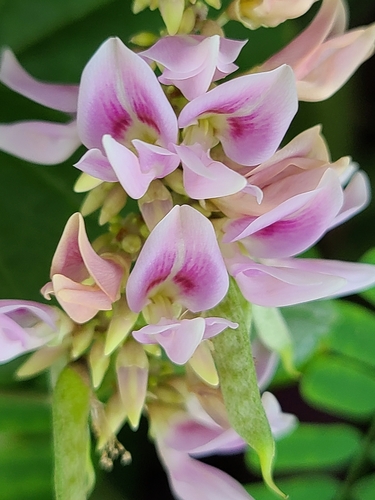
Acacia saligna
(Labill.) H. Wendl.
Golden wreath wattle

(c) wormsy, some rights reserved (CC BY-NC), uploaded by wormsy
(c) lamprisdimitris, some rights reserved (CC BY-NC)
(c) James Bailey, some rights reserved (CC BY-NC), uploaded by James Bailey
What to Eat
Edible parts: Seeds, Gum
The flowers are cooked and, being rich in pollen, are commonly used in fritters. When the bark is damaged, it exudes copious amounts of a very acidic gum that shows promise for use in pickles and other acidic foodstuffs.
Known Hazards
Where to Find It
It is a subtropical plant. It occurs in coastal areas of Western Australia. It will grow on calcareous or sandy soils. It prefers light to medium soils. It requires an open sunny position. It is drought resistant and frost tolerant. It can stand some salting. It grows well in subtropical regions. It grows in areas with an annual rainfall between 125-1,200 m above sea level. It grows below 300 m above sea level. It is wind resistant. It can grow in arid places. It suits hardiness zones 9-11. Wittunga Botanical Gardens.
Africa, Algeria, Argentina, Asia, Australia*, Cyprus, East Africa, Egypt, Ethiopia, Europe, France, Greece, India, Indochina, Iran, Iraq, Israel, Italy, Jordan, Kenya, Libya, Mauritius, Mediterranean, Mexico, Middle East, Morocco, Mozambique, Namibia, New Zealand, North Africa, North America, Pakistan, Portugal, Saudi Arabia, SE Asia, South Africa, Southern Africa, South America, Spain, St Helena, Syria, Tanzania, Tunisia, Uganda, Uruguay, USA, Vietnam, Zambia, Zimbabwe,
How to Identify
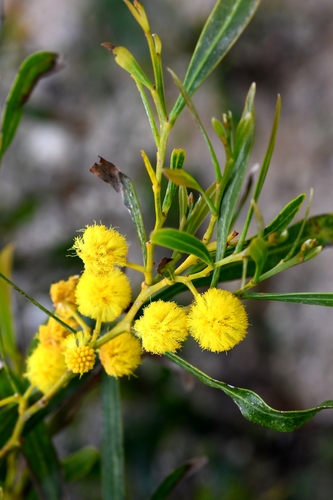
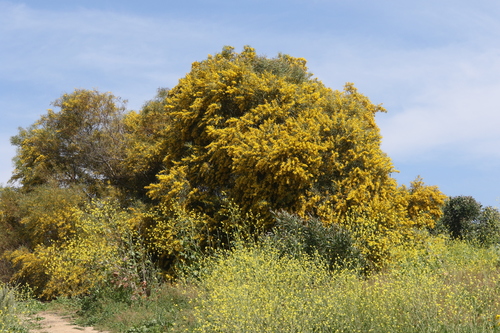
A shrub or small tree. It grows 5 m tall. There are prickles along the stem. The leaves are twice divided and there are 8-18 pairs of pinnae. There are up to 50 pairs of pinnules on each pinnae. The flowers are yellow. They are in large clusters at the ends of branches. The pods are flattened.
How to Grow
It is grown from seed. The seed need treatment to break the hard seed coat. Normally this is by putting the seeds in very hot water and letting the water cool down overnight then planting the seeds immediately. It can be grown from cuttings. Trees re-sprout from the base when cut down.
Propagation: Seed is best sown as soon as it is ripe in a sunny position in a warm greenhouse. Stored seed should be scarified, pre-soaked for 12 hours in warm water, then sown in a warm greenhouse in March; it germinates in 3–4 weeks at 25°C. Prick seedlings out into individual pots once large enough to handle and grow on in a sunny greenhouse position through their first winter. Plant out in late spring or early summer after the last expected frosts, with some cold protection recommended for the first winter outdoors. Cuttings of half-ripe wood with a heel can be taken in July or August, potted individually in a frame, overwintered in a greenhouse, and planted out the following late spring or early summer. Success rate is a fair percentage.
Medicinal Uses
None known
Other Uses
A yellow dye is obtained from the flowers and a green dye from the seed pods. On a 10% moisture basis, the bark contains 21.5% tannin. The plant is fast-growing and widely used for reclaiming eroded hillsides and wastelands, stabilizing drift sands, and as fuel — it is considered one of the best woody species for binding moving sand. It is also useful for windbreaks, amenity plantings, beautification projects, and roadside stabilization in semiarid regions. Heavily armed with thorns, it makes an effective screen or hedge in warm temperate areas. It is also used in carbon farming and as a nitrogen fixer.
Wikipedia
Source ↗Acacia saligna, commonly known by various names including coojong, golden wreath wattle, willow wattle, orange wattle, blue-leafed wattle, Western Australian golden wattle, and, in Africa, Port Jackson willow, is a small tree in the family Fabaceae. Native to Australia, it is widely distributed throughout the south west corner of Western Australia, extending north as far as the Murchison River, and east to Israelite Bay. The Noongar peoples know the tree as Cujong.
Production
It is usually fast growing.
Notes
There are about 1,350 Acacia species. Over 1,000 occur in Australia. It has become a weed in South Africa. Also as Mimosaceae.
Names & Synonyms
Blue-leaf wattle, Goudwilger, Keo lieu, Orange Wattle, Port Jackson wattle, Weeping wattle
References (35)
- Asfaw, Z. and Tadesse, M., 2001, Prospects for Sustainable Use and Development of Wild Food Plants in Ethiopia. Economic Botany, Vol. 55, No. 1, pp. 47-62
- Barwick, M., 2004, Tropical and Subtropical Trees. A Worldwide Encyclopedic Guide. Thames and Hudson p 4
- Bekele-Tesemma A., Birnie, A., & Tengnas, B., 1993, Useful Trees and Shrubs for Ethiopia. Regional Soil Conservation Unit. Technical Handbook No 5. p 60
- Bindon, P., 1996, Useful Bush Plants. Western Australian Museum. p 27
- Bodkin, F., 1991, Encyclopedia Botanica. Cornstalk publishing, p 32
- Bonney, N., 1997, Economic Native Trees and Shrubs for South Australia. Greening Australia (SA) inc. Campbelltown SA 5074 p 20
- Comm. Acac. aphyll. 26. 1820
- Cundall, P., (ed.), 2004, Gardening Australia: flora: the gardener's bible. ABC Books. p 79
- Doran, J.C., & Turnbull, J.W. (Eds), 1997, Australian Trees and Shrubs: species for land rehabilitation and farm plantings in the tropics. ACIAR Monograph No 24. p 210
- Elliot, W.R., & Jones, D.L., 1982, Encyclopedia of Australian Plants suitable for cultivation. Vol 2. Lothian. p 110
- Etherington, K., & Imwold, D., (Eds), 2001, Botanica's Trees & Shrubs. The illustrated A-Z of over 8500 trees and shrubs. Random House, Australia. p 56
- Flora of Pakistan. www.eFloras.org
- Greig, D., 1996, Flowering Natives for Home Gardens. Angus & Robertson. p 39
- Hall, N. et al, 1972, The Use of Trees and Shrubs in the Dry Country of Australia, AGPS, Canberra. p 195
- Hnatiuk, R. J. 1990. Census of Australian vascular plants. Australian Flora and Fauna Series No. 11.
- Holliday, I., 1989, A Field Guide to Australian Trees. Hamlyn. p 32
- ILDIS Legumes of the World http:www;ildis.org/Legume/Web
- Kew Plants of the World Online
- Lazarides, M. & Hince, B., 1993, Handbook of Economic Plants of Australia, CSIRO. p 6
- Lord, E.E., & Willis, J.H., 1999, Shrubs and Trees for Australian gardens. Lothian. p 42
- Marchant, N. G. et al. 1987. Flora of the Perth Region.
- Maslin, B. R., et al, 1998, Edible Wattle Seeds of Southern Australia. CSIRO p 49
- Mbuya, L.P., Msanga, H.P., Ruffo, C.K., Birnie, A & Tengnas, B., 1994, Useful Trees and Shrubs for Tanzania. Regional Soil Conservation Unit. Technical Handbook No 6. p 64
- National Academy of Sciences. 1980. Firewood crops. Shrub and tree species for energy production.
- National Academy of Sciences. 1979. Tropical legumes: resources for the future
- Paczkowska, G . & Chapman, A.R., 2000, The Western Australian Flora. A Descriptive Catalogue. Western Australian Herbarium. p 322
- Palgrave, K.C., 1996, Trees of Southern Africa. Struik Publishers. p 250
- Pham-Hoang Ho, 1999, An Illustrated Flora of Vietnam. Nha Xuat Ban Tre. p 821
- Plants and People in Mooro Country. Nyungar Plant use in Yellagonga Regional Park
- Plowes, N. J. & Taylor, F. W., 1997, The Processing of Indigenous Fruits and other Wildfoods of Southern Africa. in Smartt, L. & Haq. (Eds) Domestication, Production and Utilization of New Crops. ICUC p 184
- Royal Botanic Gardens, Kew (1999). Survey of Economic Plants for Arid and Semi-Arid Lands (SEPASAL) database. Published on the Internet; http://www.rbgkew.org.uk/ceb/sepasal/internet [Accessed 27th April 2011]
- van Wyk, B, van Wyk, P, and van Wyk B., 2000, Photographic guide to Trees of Southern Africa. Briza. p 41
- Wiersema, J. H. & Leon, B., 2013, World Economic Plants. A Standard Reference CRC Press. 2nd Ed. p 6
- Willis, J. H. 1970-1972. A handbook to plants in Victoria.
- World Checklist of Useful Plant Species 2020. Royal Botanic Gardens, Kew