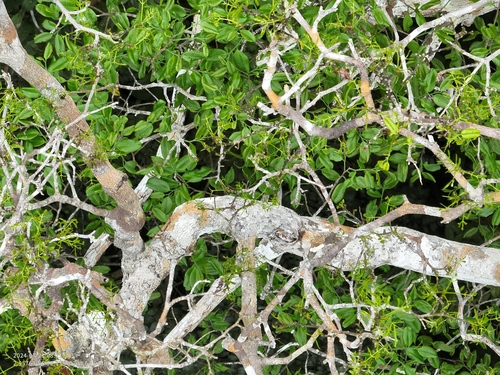
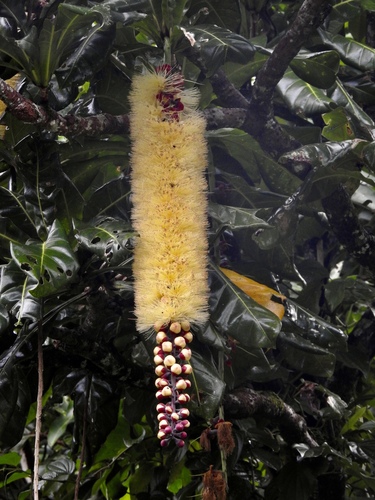
Barringtonia asiatica
(L.) Kurz.
Fish Killer tree, Beach Barringtonia
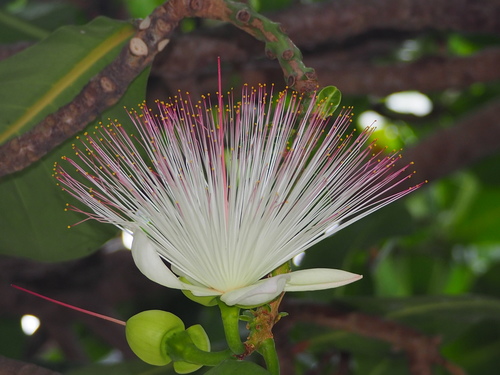
no rights reserved, uploaded by 葉子

(c) nawendy, some rights reserved (CC BY-NC), uploaded by nawendy
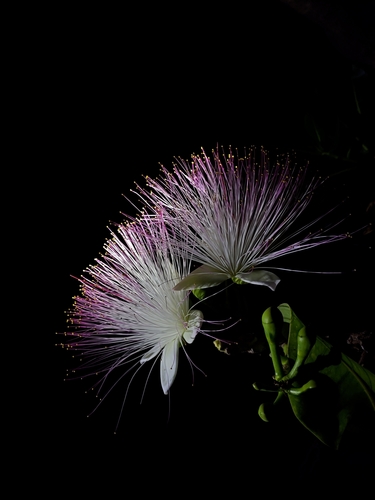
(c) Robin Liau, some rights reserved (CC BY-NC), uploaded by Robin Liau
What to Eat
Edible parts: Leaves, Pods, Seeds, Fruit, Flowers, Caution
The young leaf shoots, young flowers, and young fruit may be eaten fresh. Young fruit are eaten as a vegetable, and the seeds have been recorded as cooked and eaten in Indonesia and the Andaman Islands. Cooking destroys the saponins.
Known Hazards
Where to Find It
A tropical plant. They occur along the seashore throughout the islands of Asia and the Pacific. Trees often lean out over the sea. It prefers well-composted, moist, well-drained soil. It can grow easily in sandy soil. It can tolerate salty soils. It suits a protected sunny position. It is drought and frost tender. It suits hardiness zones 11-12.
Africa, American Samoa, Andamans, Asia, Australia, British Indian Ocean Terr., BIOT, Cambodia, Carolines, Chuuk, Comoros, Cook Islands, Dominican Republic, East Africa, East Timor, Fiji, French Polynesia, FSM, Hawaii, India, Indochina, Indonesia, Japan, Kiribati, Madagascar, Malaysia, Maldives, Mariana Islands, Marquesas, Mascarenes, Mauritius, Micronesia, Mozambique, Myanmar, New Caledonia, Pacific, Palau, Papua New Guinea, PNG, Philippines, Philippines, Rotuma, Samoa, SE Asia, Seychelles, Singapore, Solomon Islands, Sri Lanka, Taiwan, Tahiti, Thailand, Timor-Leste, Tokelau, Tonga, Tuvalu, USA, Vanuatu, Vietnam, Wallis and Futuna, West Indies,
How to Identify
A small tree. It is 5-9 m tall. It can grow up to 25 m. It spreads to 3-5 m wide. The trunk is short and erect and branches occur from near the base. The leaves are 20 to 40 cm long and 10-15 cm wide and without individual leaf stalks. They are shiny light green, and larger near the tip than the base. The tip is rounded and somewhat pointed. The flowers are large and pink and white. They are 3-5 cm across. The fruit is sharply 4 and rarely 5-angled. The fruit are 12 cm across, woody and broad at one end. They contain one large seed.
How to Grow
Plants can be grown from cuttings or seed. Seed need to be sown fresh. Seed germinate readily. Young trees need shade. Plants can be grown by layering.
Propagation: Seed - best sown as soon as it is ripe. About 70% of the seed germinates in 36 - 63 days. Cuttings.
Medicinal Uses
A decoction of the leaves is used to treat hernia. The leaves are heated and externally applied for stomach-ache. Fresh leaves are applied topically to bring relief from rheumatism and to treat sores. The fruits are applied externally as a treatment for sores. The toxic seeds are employed as a vermifuge. Although toxic, the dried nut is ground, mixed with water and drunk to treat coughs, influenza, sore throat and bronchitis. Used externally, the fresh nut is scraped and applied directly to wounds and sores. It is also applied to a swollen spleen after an attack of malaria. A decoction of the bark is used to treat constipation and epilepsy. The bark is used externally for treating sores. In tests, the leaf material of this species was active against some tumours.
Other Uses
The dried fruits are used as floats. The yellowish to red wood is light, soft and easy to split. It is used for making furniture, carving and turnery.
Wikipedia
Source ↗Barringtonia asiatica, known variously as fish poison tree, putat and beach Barringtonia among other names, is a species of plants in the brazil nut family Lecythidaceae. It is native to coastal habitats from Tanzania and Madagascar in the west to tropical Asia, northern Australia, and islands of the western Pacific Ocean. It was described by Wilhelm Sulpiz Kurz in 1875 and has a conservation status of least concern. It has been used by a number of traditional cultures as a fish poison.
Production
Seed take up to 2 months to germinate but seedlings grow very quickly.
Other Information
It is not known if it is used for food in Papua New Guinea. A very minor food.
Notes
The seeds are used as a fish poison due to a chemical saponin. There are about 40 Barringtonia species. The seeds contain Hydrocyanic acid and triterpene acids.
Names & Synonyms
Bitung, Botong, Butun, Fish Poison Tree, Futu, Hotu, Hutu, Keben, Keiengal, Kimbi, Kinbi, Kyi-gyi, Motong-botong, Navel, Pertun, Putat ayer, Putat gajah, Putat laut, Puteng, Queens of shores, Reang, Sea putat, Te baireati, Vutu, Waap, Waba, Waiep, Wan bibi
References (49)
- Ambasta S.P. (Ed.), 2000, The Useful Plants of India. CSIR India. p 68
- Barwick, M., 2004, Tropical and Subtropical Trees. A Worldwide Encyclopedic Guide. Thames and Hudson p 43
- Bhargava, N., 1983, Ethnobotanical Studies of the Tribes of Andaman and Nicobar Islands, India. 1. Onge. Economic Botany 37(1): 110-119
- Bircher, A. G. & Bircher, W. H., 2000, Encyclopedia of Fruit Trees and Edible Flowering Plants in Egypt and the Subtropics. AUC Press. p 54 (Also as Barringtonia butonica)
- Bodkin, F., 1991, Encyclopedia Botanica. Cornstalk publishing, p 133
- Burkill, I.H., 1966, A Dictionary of the Economic Products of the Malay Peninsula. Ministry of Agriculture and Cooperatives, Kuala Lumpur, Malaysia. Vol 1 (A-H) p 306
- Cabalion, P. and Morat, P., 1983, Introduction le vegetation, la flore et aux noms vernaculaires de l'ile de Pentcoste (Vanuatu), In: Journal d'agriculture traditionnelle et de botanique appliquee JATBA Vol. 30, 3-4
- Cooper, W. and Cooper, W., 2004, Fruits of the Australian Tropical Rainforest. Nokomis Editions, Victoria, Australia. p 266
- Cowie, I, 2006, A Survey of Flora and vegetation of the proposed Jaco-Tutuala-Lore National Park. Timor-Lests (East Timor) www.territorystories.nt/gov.au p 49
- Cundall, P., (ed.), 2004, Gardening Australia: flora: the gardener's bible. ABC Books. p 220
- Dobriyal, M. J. R. & Dobriyal, R., 2014, Non Wood Forest Produce an Option for Ethnic Food and Nutritional Security in India. Int. J. of Usuf. Mngt. 15(1):17-37
- Elliot, W.R., & Jones, D.L., 1982, Encyclopedia of Australian Plants suitable for cultivation. Vol 2. Lothian. p 306
- Engel, D.H., & Phummai, S., 2000, A Field Guide to Tropical Plants of Asia. Timber Press. p 73
- Etherington, K., & Imwold, D., (Eds), 2001, Botanica's Trees & Shrubs. The illustrated A-Z of over 8500 trees and shrubs. Random House, Australia. p 119
- Flora of Australia, Volume 8, Lecythidales to Batales, Australian Government Publishing Service, Canberra (1982) p 4
- Franklin, J., Keppel, G., & Whistler, W., 2008, The vegetation and flora of Lakeba, Nayau and Aiwa Islands, Central Lau Group, Fiji. Micronesica 40(1/2): 169–225, 2008
- Havel, J.J., 1975, Forest Botany, Volume 3 Part 2 Botanical taxonomy. Papua New Guinea Department of Forests, p 225
- Hearne, D.A., & Rance, S.J., 1975, Trees for Darwin and Northern Australia. AGPS, Canberra p 30
- Hedrick, U.P., 1919, (Ed.), Sturtevant's edible plants of the world. p 93 (As Barringtonia butonica)
- Henty, E.E., 1980, Harmful Plants in Papua New Guinea. Botany Bulletin No 12. Division Botany, Lae, Papua New Guinea. p 26
- Hinton, B & B., 1982, A Wilderness in Bloom. Wildflowers of tropical Australia. p 41
- Jackes, B. R., 2010, Plants of Magnetic Island. 3rd Edition. James Cook University, Australia. p 23
- Lazarides, M. & Hince, B., 1993, Handbook of Economic Plants of Australia, CSIRO. p 31
- Liefting, A., et al, Samoan plant names. http://en.wikipedia.org
- MARDI Malaysia
- Martin, F.W. & Ruberte, R.M., 1979, Edible Leaves of the Tropics. Antillian College Press, Mayaguez, Puerto Rico. p 197
- Menninger, E.A., 1977, Edible Nuts of the World. Horticultural Books. Florida p 38 (As Barringtonia butonica)
- Monsalud, M.R., Tongacan, A.L., Lopez, F.R., & Lagrimas, M.Q., 1966, Edible Wild Plants in Philippine Forests. Philippine Journal of Science. p 485
- Nicholson, N & H., 1994, Australian Rainforest Plants 4, Terania Rainforest Publishing. NSW. p 15
- Parham, B. E. V., 1971, The Vegetation of the Tokelau Islands with special reference to the Plants of Nukunonu Atoll. New Zealand Journal of Botany. 9:4, 576-609
- Phon, P., 2000, Plants used in Cambodia. © Pauline Dy Phon, Phnom Penh, Cambodia. p 88
- Prance. G. T., 2013, A revision of Barringtonia (Lecythidaceae). Allertonia 12:1-164
- Prance, G. T. & Jongkind, C. H., 2015, A Revision of African Lecythidaceae. Kew Bulletin. 70:1-68
- Prelim. rep. forest Pegu., App. A:lxv, App. B:65. 1875
- Schatz, G.E., 2001, Generic Tree Flora of Madagascar. Royal Botanical Gardens, Kew and Missouri Botanical Garden. p 230
- Selvam, V., 2007, Trees and shrubs of the Maldives. RAP Publication No. 2007/12 p 40
- Staples, G.W. and Herbst, D.R., 2005, A tropical Garden Flora. Bishop Museum Press, Honolulu, Hawaii. p 369.
- Stone, B.,
- Sujanapal, P., & Sankaran, K. V., 2016, Common Plants of Maldives. FAO & Kerala FRI, p 52
- Sukarya, D. G., (Ed.) 2013, 3,500 Plant Species of the Botanic Gardens of Indonesia. LIPI p 148
- Swaminathan, M.S., and Kochnar, S.L., 2007, An Atlas of major Flowering Trees in India. Macmillan. p 287
- Thaman, R. and W. Clarke, Paper on Agroforestry on Aneityum and Tanna, Vanuatu from Internet
- Thaman, R. R, 2016, The flora of Tuvalu. Atoll Research Bulletin No. 611. Smithsonian Institute p 71
- Thitiprasert, W., et al, 2007, Country report on the State of Plant Genetic Resources for Food and Agriculture in Thailand (1997-2004). FAO p 95
- Townsend, K., 1994, Across the Top. Gardening with Australian Plants in the tropics. Society for Growing Australian Plants, Townsville Branch Inc. p 98
- Wickens, G.E., 1995, Edible Nuts. FAO Non-wood forest products. FAO, Rome. p 139
- World Checklist of Useful Plant Species 2020. Royal Botanic Gardens, Kew
- Yuncker, T.G., 1959, Plants of Tonga, Bernice P. Bishop Museum, Hawaii, Bulletin 220. p 196
- Zawiah, N. & Othaman, H., 2012, 99 Spesies Buah di FRIM. Institut Penyelidikan Perhutanan Malaysia. p 64