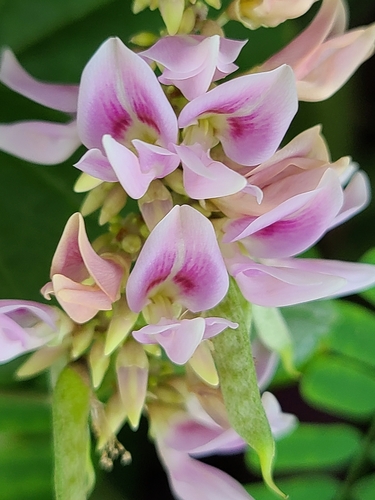
Pueraria mirifica
Airy Shaw & Suvat.

Conveyor Belt

Royal Botanic Garden Edinburgh

Royal Botanic Gardens, Kew
What to Eat
Edible parts: Roots, Tubers, Leaves - medicine
The roots and tubers are eaten, and leaves are used medicinally.
Known Hazards
Where to Find It
A tropical plant.
Asia, Indochina, SE Asia, Thailand,
How to Identify
A tropical climbing vine of the Fabaceae family with dark purple flowers.
Medicinal Uses
Some herbal supplements claim various health benefits of the extracts of Pueraria mirifica, although the claims are unsubstantiated and not backed by rigorous clinical evidence.
Wikipedia
Source ↗Pueraria mirifica, also known as กวาวเครือ kwao krua (among other names), is a plant found in northern and northeastern Thailand and Myanmar. In Thailand, the plant is known as "kwao krua kao", the 'kao' meaning white which distinguishes Pueraria mirifica from other plants with tuberous roots also sharing the 'kwao krua' designation, such as Butea superba, commonly called kwao krua deng (red) and the 'black' and 'dull grey' kwao krua plants. The species was definitively identified as Pueraria mirifica in 1952. Dried and powdered, the tuberous root of Pueraria mirifica has a history of domestic consumption in Thailand in traditional medicine.
Notes
It contains phytoestrogens.
Names & Synonyms
Kwao Krua, Thai kudzu
References (3)
- Egan, A. N. 2020, Economic and ethnobotanical uses of tubers in the genus Pueraria DC. Legume Perspectives. Issue 19. November 2020
- Kew Bull. 7:550. 1952
- PROSEA handbook Volume 9 Plants yielding non-seed carbohydrates. p 179