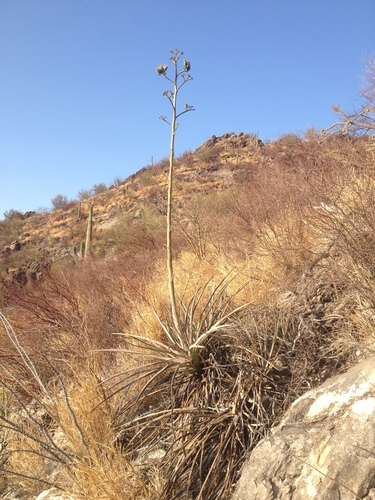
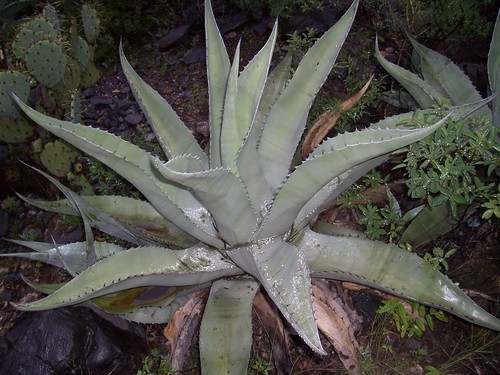
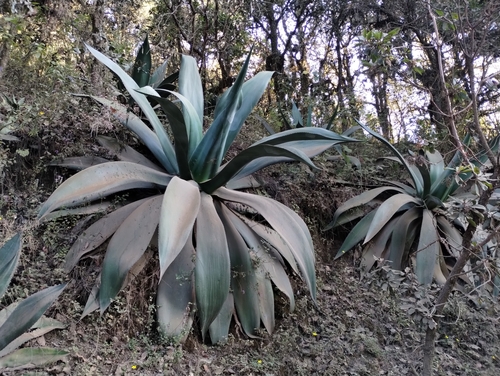
Furcraea foetida
(L.) Haw.
Mauritius hemp

(c) James Steamer, some rights reserved (CC BY-NC), uploaded by James Steamer

(c) Stephane Philizot, some rights reserved (CC BY-NC), uploaded by Stephane Philizot
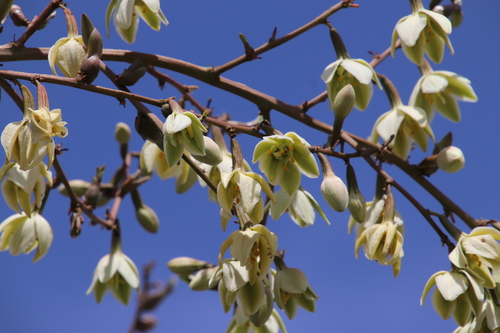
(c) Millie Basden, some rights reserved (CC BY), uploaded by Millie Basden
What to Eat
No edible uses are known.
Known Hazards
Where to Find It
A tropical plant. It grows naturally in tropical America. It can grow in warm temperate places. It grows easily on grey sand over limestone. It suits drier tropical regions. Mt Cootha Botanical Gardens.
Asia, Australia, Brazil, Central America*, East Africa, Fiji, French Guiana, Guianas, Guyana, Hawaii, Indonesia, Madagascar, Malaysia, Marquesas, Mauritius, Myanmar, Pacific, SE Asia, Singapore, South Africa, Southern Africa, South America, St Helena, Suriname, USA,
How to Identify
It is like an Agave. It is a herb that keeps growing from year to year. It grows 1.5-6 m high. Some forms have prickles and some do not. The leaves are sword shaped. They are green and in rings. The flowers are on long stalks. The flowers are drooping and bell shaped. They are white. Plants flower only once then die. The bruised leaves have a bad smell.
How to Grow
It is grown from offsets of the main plant. It can also be grown from seeds.
Propagation: Seed, though it is rarely produced. Plants typically generate large numbers of bulbils that root and grow into new plants when they fall to the ground. These bulbils can remain viable for several years, even in unfavourable conditions.
Medicinal Uses
The root is used as a blood-purifying remedy. An infusion with sweet oil is drunk as a treatment for syphilis, and the root mixed with gin is used for back pain. The leaves are febrifuge and are prepared with molasses or honey to treat children's persistent colds.
Other Uses
The plant is used as a hedge in desert gardens. A strong, good-quality fibre obtained from the leaves is thinner and softer than sisal and can be used for ropes, sacks, twine, hammocks, and similar products. It breaks down in salt water but withstands fresh water. Macerated young leaves are used as a hair shampoo and soap.
Wikipedia
Source ↗Furcraea foetida (Giant Cabuya, Green-aloe or Mauritius-hemp) is a species of flowering plant native to the Caribbean and northern South America. It is widely cultivated and reportedly naturalized in many places (India, parts of Africa, Portugal, Australia, Thailand, Florida, New Zealand, and many oceanic islands).
Production
Plants usually live for 12-15 years before flowering.
Notes
There are 20-25 Furcraea species. They grow in tropical America. Also put in the family Agavaceae.
Names & Synonyms
Aloe hijau, Giant cabuya, Green aloe, Thinbaw-nanat-gyi
References (9)
- Burkill, I.H., 1966, A Dictionary of the Economic Products of the Malay Peninsula. Ministry of Agriculture and Cooperatives, Kuala Lumpur, Malaysia. Vol 1 (A-H) p 1056
- Franklin, J., Keppel, G., & Whistler, W., 2008, The vegetation and flora of Lakeba, Nayau and Aiwa Islands, Central Lau Group, Fiji. Micronesica 40(1/2): 169–225, 2008
- Paczkowska, G. & Chapman, A.R., 2000, The Western Australian Flora. A Descriptive Calatogue. Western Australian Herbarium. p 29
- PROSEA handbook Volume 9 Plants yielding non-seed carbohydrates. p 188
- Purseglove,
- Smith, A.C., 1979, Flora Vitiensis Nova, Lawaii, Kuai, Hawaii, Volume 1 p 155
- Staples, G.W. and Herbst, D.R., 2005, A tropical Garden Flora. Bishop Museum Press, Honolulu, Hawaii. p 586
- Sukarya, D. G., (Ed.) 2013, 3,500 Plant Species of the Botanic Gardens of Indonesia. LIPI p 1018
- Syn. pl. succ. 73. 1812