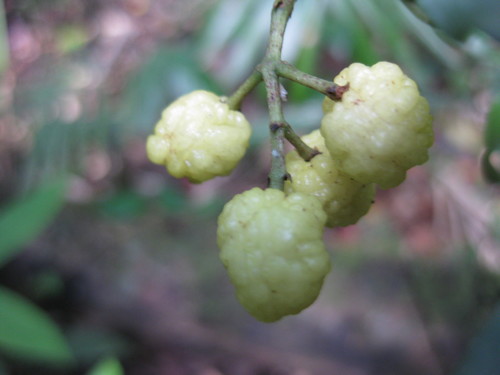
Zanthoxylum nitidum
(Roxb.) DC.

(c) 黃美滿, some rights reserved (CC BY), uploaded by 黃美滿
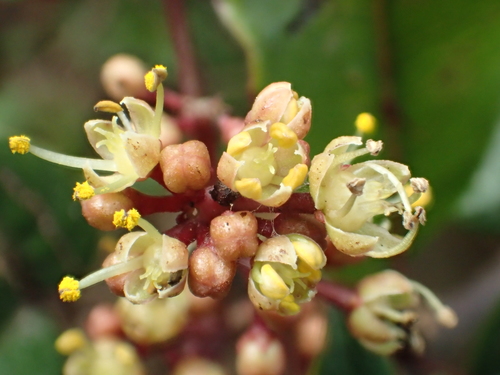
no rights reserved, uploaded by 葉子
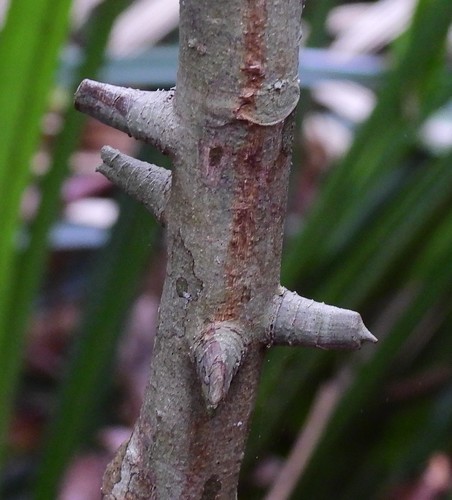
(c) Graham Bell, some rights reserved (CC BY-NC), uploaded by Graham Bell
What to Eat
Edible parts: Spice, Fruit, Leaves - flavouring
No edible uses are known for this plant.
Known Hazards
Where to Find It
A tropical plant. It grows in rainforest. It grows between sea level and 500 m altitude in tropical Queensland. In Sikkim it grows between 1,000-2,000 m above sea level. In XTBG Yunnan.
Asia, Australia, China, Himalayas, India, Indochina, Indonesia, Japan, Laos, Malaysia, Myanmar, Nepal, Northeastern India, Pacific, Papua New Guinea, PNG, Ryukyu, SE Asia, Sikkim, Taiwan, Thailand, Vietnam,
How to Identify
A shrub or scrambling vine. There are hooked thorns on the stems. Plants are separately male and female. The leaves are compound and alternate. Leaves are spiny underneath and also have small hairs. There are 5-9 leaflets and they are 5-10 cm long by 2-5 cm wide. A group of flowers occur in the axils of leaves or at the ends of branches. The flowers have 4 petals. They are cream, yellow or pink. They are 2 mm long. The fruit is a red follicle. It is 4-7 mm long and wide and has one seed. The seed is black and 4-5 mm long.
How to Grow
Zanthoxylum nitidum is a plant mainly of the tropics and subtropics and is unlikely to tolerate much, if any, frost. Its range extends to hardiness zone nine in southern China (from Yunnan to Zhejiang) and so it might also succeed outdoors in the warmest parts of the temperate zone. Prefers a good deep well-drained moisture retentive soil in full sun or semi-shade. Flowers are formed on the old wood. A dioecious species, both male and female forms must be grown if seed is required. Occasional plants have both male and female flowers (monoecious).
Propagation: Seed is best sown in a greenhouse as soon as it ripens in autumn. Stored seed may need up to 3 months of cold stratification, though scarification can also help. Sow stored seed in a cold frame as early in the year as possible; germination should occur in late spring, though it may take a further 12 months. Prick seedlings into individual pots when large enough to handle, grow on in a cold frame through their first winter, then plant out in early summer. Cuttings of half-ripe wood can be taken in July or August and rooted in a frame. Root cuttings 3cm long, planted horizontally in pots in a greenhouse, give a good success rate. Suckers can be removed in late winter and planted directly into their permanent positions.
Medicinal Uses
The root is anodyne, antiphlogistic, carminative, and depurative. The plant is also analgesic and antirheumatic. The resin in the bark — especially that of the roots — is powerfully stimulant and tonic.
Other Uses
The plant is used as an insecticide and is also toxic to fish.
Wikipedia
Source ↗Zanthoxylum nitidum, commonly known as shiny-leaf prickly-ash, is a species of flowering plant in the family Rutaceae. It is a woody climber with prickles on the branchlets, thick, cone-shaped spines on the trunk and older branches, pinnate leaves with five to nine leaflets, and panicles or racemes of white to pale yellow, male or female flowers in leaf axils and on the ends of branchlets.
Names & Synonyms
Baghanchora, Honyor, Leuer, Parpartimur, Purpuray timur, Rau sung, Ri'kom, Singite, Sung, Tejmoi, Tejmuri, Tezamul, Tezmuri, Timur, Trong
References (15)
- Ambasta, S.P. (Ed.), 2000, The Useful Plants of India. CSIR India. p 698
- Cooper, W. and Cooper, W., 2004, Fruits of the Australian Tropical Rainforest. Nokomis Editions, Victoria, Australia. p 472
- Gardner, S., et al, 2000, A Field Guide to Forest Trees of Northern Thailand, Kobfai Publishing Project. p 105
- Martin, F. W., et al, 1987, Perennial Edible Fruits of the Tropics. USDA Handbook 642 p 78
- Medhi, P., Sarma, A and Borthakur, S. K., 2014, Wild edible plants from the Dima Hasao district of Assam, India. Pleione 8(1): 133-148
- Pegu, R., et al, 2013, Ethnobotanical study of Wild Edible Plants in Poba Reserved Forest, Assam, India. Research Journal of Agriculture and Forestry Sciences 1(3):1-10
- Peter, K. V. (Ed.), 2004, Handbook of Herbs and Spices Vol. 2 Woodhead Publishing and CRC Press.
- Prodr. 1:727. 1824
- PROSEA handbook Volume 13 Spices. p 280
- Srivastava, R. C., 2010, Traditional knowledge of Nyishi (Daffla) tribe of Arunachal Pradesh. Indian Journal of Traditional Knowledge. 9(1):26-37 (As Zanthoxylum hamiltonianum)
- Sundriyal, M., et al, 1998, Wild edibles and other useful plants from the Sikkim Himalaya, India. Oecologia Montana 7:43-54 (As Zanthoxylum hamiltonianum Wall.)
- Sundriyal, M., et al, 2004, Dietary Use of Wild Plant Resources in the Sikkim Himalaya, India. Economic Botany 58(4) pp 626-638
- Thoa P. T. K., et al, 2013, Biodiversity indices and utilization of edible wild plants: a case study of the Cham Island in Quang Nam Province, Vietnam. Journal of Research in Environmental Science and Toxicology 2(9) :167-174
- Wild edible plants of Himachal Pradesh (As Fagara hamiltoniana)
- World Checklist of Useful Plant Species 2020. Royal Botanic Gardens, Kew