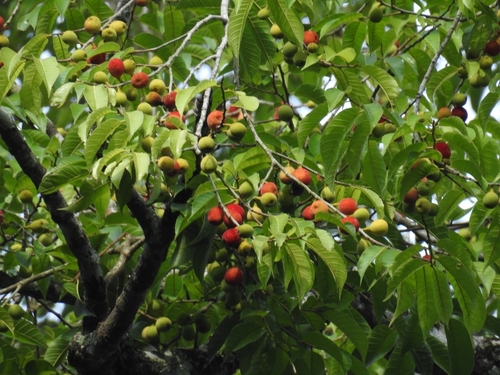
Artocarpus rigidus subsp. asperulus
(Gagnep.) Jarrett

The New York Botanical Garden

The Trustees of the Natural History Museum, London
What to Eat
Edible parts: Fruit
The pulp around the seeds is eaten.
Where to Find It
A tropical plant.
Asia, Cambodia, Indochina, Laos, Myanmar, SE Asia, Thailand, Vietnam,
How to Identify
The leaves have a rough upper surface. The base is rounded or is shallowly heart shaped. The fruiting head has rough bristly hairs.
Wikipedia
Source ↗Artocarpus rigidus is a tree species in the Moraceae that was described by Blume. A. rigidus is a wild species of the breadfruit/jackfruit genus (Artocarpus) and may be referred to as monkey jack. Its Vietnamese name is mít nài (sometimes da xóp). This 20–25 m trees species can be found in Indochina and Malesia. The subspecies A. rigidus subsp. asperulus (Gagnep.) F.M.Jarrett is accepted; synonyms for the latter are: Artocarpus asperulus Gagnep. and A. calophyllus Kurz.
Other Information
It is a cultivated food plant.
Notes
There are about 50 Artocarpus species. They are in the tropics and subtropics of Asia and the Pacific.
Names & Synonyms
Cay da xop, Cay mit nai, Dom knol prei, Kanun pan, Knor prey, Taung peing
References (1)
- PROSEA (Plant Resources of South East Asia) handbook, Volume 2, 1991, Edible fruits and nut. p 80