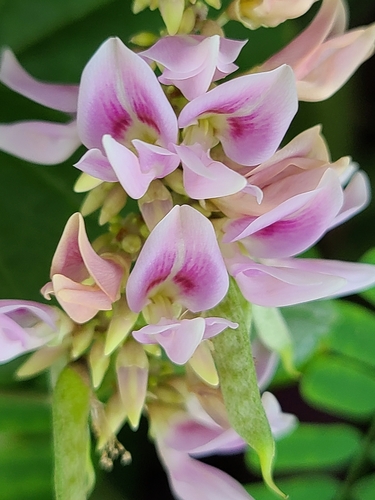
Acacia stricta
(Andr.) Willd.
Hop Wattle, Straight Wattle
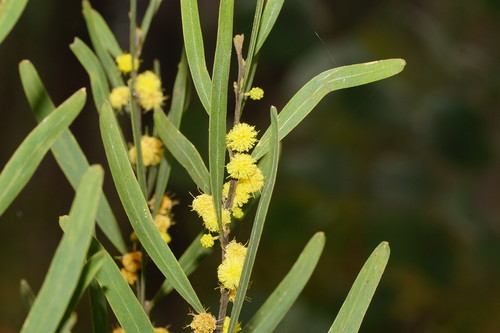
(c) Reiner Richter, some rights reserved (CC BY-NC-SA), uploaded by Reiner Richter
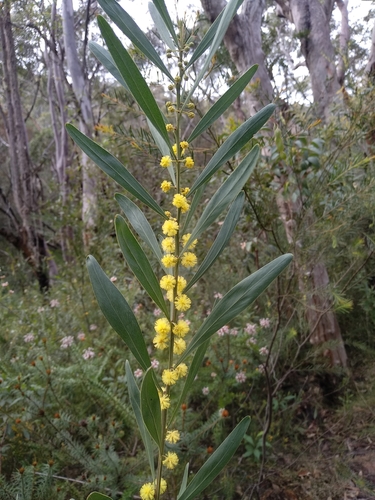
(c) David, some rights reserved (CC BY-NC), uploaded by David

(c) Chris Ecroyd, some rights reserved (CC BY-NC), uploaded by Chris Ecroyd
What to Eat
Edible parts: Seeds
The seeds are eaten green.
Where to Find It
It is a temperate plant. It grows naturally in south eastern parts of Australia. It prefers light to heavy soils. It requires an open sunny position. It needs reasonably good rainfall. It is frost resistant. It needs fairly well drained soils. In Tasmania it is common and widespread in pastures and dry places. Tasmania Herbarium. Arboretum Tasmania.
Australia*, New Zealand, Tasmania*,
How to Identify
A shrub or small tree. It grows 5 m tall. There are prickles along the stem. The leaves are twice divided and there are 8-18 pairs of pinnae. There are up to 50 pairs of pinnules on each pinnae. The flowers are yellow. They are in large clusters at the ends of branches. The pods are flattened.
How to Grow
It is grown from seed. The seed need treatment to break the hard seed coat. Normally this is by putting the seeds in very hot water and letting the water cool down overnight then planting the seeds immediately. It can also be grown from cuttings.
Wikipedia
Source ↗Acacia stricta (hop wattle, straight wattle) is a perennial tree. The plant is adaptable to most soils, tolerating full sun or partial to complete shade. Tolerates drought conditions and moderately salty winds. The shrub is useful in planting, as it is not too dense and can be used for screening other plants. The plant grows up to 2-4m depending on conditions.
Production
It grows quickly. Flowering is normally May to October.
Notes
There are about 1,350 Acacia species. Over 1,000 occur in Australia. Also as Mimosaceae.
References (10)
- Bodkin, F., 1991, Encyclopedia Botanica. Cornstalk publishing, p 34
- Cherikoff V. & Isaacs, J., The Bush Food Handbook. How to gather, grow, process and cook Australian Wild Foods. Ti Tree Press, Australia p 47
- Cronin, L., 1989, The Concise Australian Flora. Reed. p 48
- Curtis, W.M., 1956, The Students Flora of Tasmania Vol 1 p 123
- Elliot, W.R., & Jones, D.L., 1982, Encyclopedia of Australian Plants suitable for cultivation. Vol 2. Lothian. p 118
- Grieg, D., 2002, A photographic guide to Wildflowers of South-eastern Australia. New Holland. p 67
- ILDIS Legumes of the World http:www;ildis.org/Legume/Web
- Lord, E.E., & Willis, J.H., 1999, Shrubs and Trees for Australian gardens. Lothian. p 42
- Sp. pl. 4(2):1052. 1806
- Whiting, J. et al, 2004, Tasmania's Natural Flora. Tasmania's Natural Flora Editorial Committee PO Box 194, Ulverstone, Tasmania, Australia 7315 p 214