Amalocalyx microlobus
Pierre ex Spire
Maxinha, Xiyai
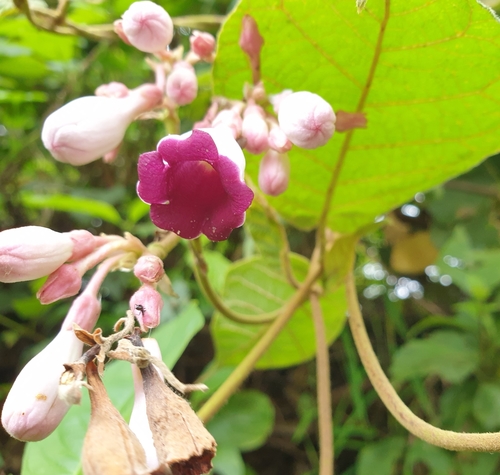
(c) LannaMountainsCharlie, some rights reserved (CC BY-NC-SA), uploaded by LannaMountainsCharlie

(c) onidiras-iNaturalist, some rights reserved (CC BY-NC), uploaded by onidiras-iNaturalist

(c) 虫虫, some rights reserved (CC BY-NC), uploaded by 虫虫
What to Eat
Edible parts: Fruit
The fruit are eaten mixed with seasoning or salt and sold in local markets.
Where to Find It
A tropical plant. It grows in forests, often clinging to trees between 600-1400 m altitude. In Yunnan.
Asia, China, Indochina, Laos, Myanmar, SE Asia, Thailand, Vietnam,
How to Identify
A herbaceous climber. It is an evergreen vine. It has a grey covering. The leaves are narrowly oval and 5-15 cm long by 2-11 cm wide. They taper to a sharp tip. The leaf stalk is 1-2 cm long. The flowers are light purple-red. There are 15-20 flowers in a group 6-12 cm long. The fruit are follicles 11 cm long and 1 cm wide. The seeds are round with yellowish-brown hairs.
Other Information
It is sold in local markets.
Notes
There is only one Amalocalyx species.
Names & Synonyms
Long rui biu, Mak sim, Mao che teng, Mu nuo qi cha, Xin ha
References (11)
- Cao, Y., et al, 2020, Ethnobotanical study on wild edible plants used by three trans-boundary ethnic groups in Jiangcheng County, Pu’er, Southwest China. Journal of Ethnobiology and Ethnomedicine (2020) 16:66
- Delang, C. O., 2007, Ecological Succession of Usable Plants in an Eleven-Year Fallow Cycle in North Lao P.D.R., Ethnobotany Research and Applications. Vol. 5:331-350
- Ghorbani, A., et al, 2012, A comparison of the wild food plant use knowledge of ethnic minorities in Naban River Watershed Nature Reserve, Yunnan, SW China. Journal of Ethnobiology and Ethnomedicine; 8:17
- Hu, Shiu-ying, 2005, Food Plants of China. The Chinese University Press. p 629 (As Amalocalyx yunnanensis)
- Jin, Chen et al, 1999, Ethnobotanical studies on Wild Edible Fruits in Southern Yunnan: Folk Names: Nutritional Value and Uses. Economic Botany 53(1) pp 2-14 (As Amalocalyx yunnanensis)
- Luczaj, L., et al, 2021, Wild food plants and fungi sold in the markets of Luang Prabang, Lao PDR. Journal of Ethnobiology and Ethnomedicine (2021) 17:6 (As Amocalyx)
- Luo, B., et al, 2019, Wild edible plants collected by Hani from terraced rice paddy agroecosystem in Honghe Prefecture, Yunnan, China. Journal of Ethnobiology and Ethnomedicine 15:56 (As Amalocalyx yunnanensis)
- Reis, S. V. and Lipp, F. L., 1982, New Plant Sources for Drugs and Foods from the New York Botanical Garden herbarium. Harvard. p 241 (As Amalocalyx yunnanensis)
- Slik, F., www.asianplant.net
- Xu, Z., Tao, G. & Tan, J., 1988, Tropical Wild Flowers and Plants in Xishuangbanna, Agricultural Publishing House. photo 106 (As Amalocalyx yunnanensis)
- Xu, You-Kai, et al, 2004, Wild Vegetable Resources and Market Survey in Xishuangbanna, Southwest China. Economic Botany. 58(4): 647-667. (As Amalocalyx yunnanensis)


