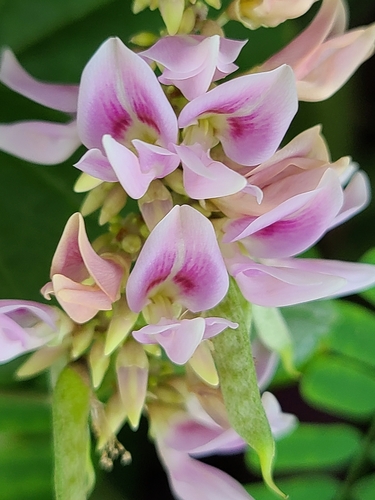
Acacia eburnea
(L. f.) Willd.
Pahari kikar

(c) gunthergore, some rights reserved (CC BY-NC)

(c) gunthergore, some rights reserved (CC BY-NC)

(c) gunthergore, some rights reserved (CC BY-NC)
What to Eat
Edible parts: Fungus gall, Fruit, Pod
V. karroo is used for chemical products, forage, domestic uses, environmental management, fibre, food, drink, and wood. The tough wood is white to slightly yellowish in colour, rarely producing dark brown heartwood. It is widely cultivated in Asia, Australia, the Mediterranean region, India and the Indian Ocean area. The large thorns mean that the tree must be approached, and the branches handled, carefully.
Where to Find It
In India fungus gall grows on this plant. It is Revenella esculenta Nar. It is edible. The tree grows in dry regions.
Afghanistan, Arabia, Asia, Himalayas, India, Indonesia, Middle East, Nepal, Pakistan, SE Asia, Sri Lanka,
How to Identify
A shrub or small tree. It grows 5 m tall. There are prickles along the stem. The leaves are twice divided and there are 8-18 pairs of pinnae. There are up to 50 pairs of pinnules on each pinnae. The flowers are yellow. They are in large clusters at the ends of branches. The pods are flattened.
How to Grow
Plants can be grown by seed.
Medicinal Uses
This species, especially the bark (which can be chewed safely), is also used to treat oral thrush and ulcers. The roots are also used medicinally. They may be chewed for use as an aphrodisiac or powdered and used for dizziness. The gum, bark and leaves have been used as a soothing agent and astringent for colds, conjunctivitis and hemorrhage in other regions of Southern Africa. The bark and leaves have also been used to treat convulsions and stomach problems (including nausea) and as a coagulant. The thorns were used by early naturalists to pin the insects they collected. It is very widespread throughout southern Africa and there are different forms in some places, which can be confusing. Vachellia karroo may be found from the Western Cape through to Zambia and Angola. In tropical Africa it is replaced by Vachellia seyal. The name acacia is derived from Greek "akis" a point or barb. Karroo is one of the old spellings of karoo which cannot be corrected because of the laws governing botanical nomenclature (giving of names).
Notes
There are about 1,350 Acacia species. Over 1,000 occur in Australia. Also as Mimosaceae.
Names & Synonyms
Kal edai, Marmati, Murmata, Murmati, Udai vel
References (5)
- Ambasta S.P. (Ed.), 2000, The Useful Plants of India. CSIR India. p 5
- Gunjatkar, N., & Vartak, V.D., 1982, Enumeration of wild edible legumes from Pune District, Maharashtra State. J.Econ. Tax. Bot. Vol 3 pp 1-9
- Prachi, K., et al, 2012, Underutilized wild fruits of North Maharashtra. Journal of Research in Plant Sciences. (2012) 1:071-076
- Sp. pl. 4(2):1081. 1806
- Sukarya, D. G., (Ed.) 2013, 3,500 Plant Species of the Botanic Gardens of Indonesia. LIPI p 99