Celastrus paniculatus
Willd.
Black-oil tree, Intellect tree
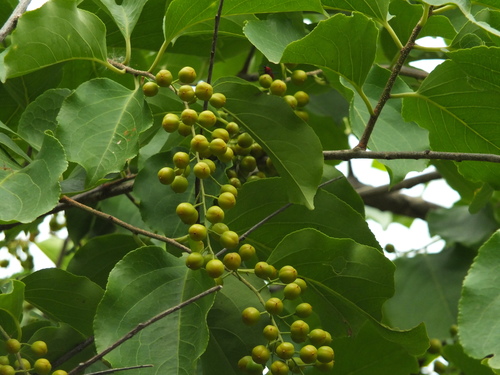
(c) Siddarth Machado, some rights reserved (CC BY), uploaded by Siddarth Machado
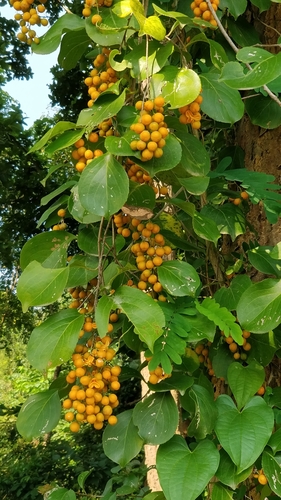
(c) Suhel Quader, some rights reserved (CC BY), uploaded by Suhel Quader
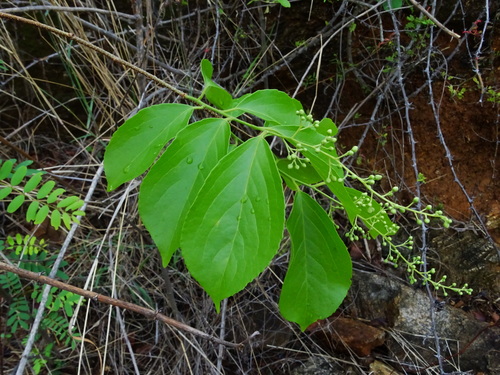
no rights reserved, uploaded by Ajit Ampalakkad
What to Eat
Edible parts: Fruit, Leaves, Flowers
The unripe fruits are boiled and eaten as a vegetable, while ripe fruits are eaten raw. Young leaves are cooked as a vegetable or used in soup. Flowers are boiled (with water changes) and prepared as a cooked vegetable. Leaves and flowers are sold in local markets.
Known Hazards
Where to Find It
A tropical plant. In China it grows on forest slopes between 200-2,000 m above sea level. In Yunnan. It occurs in the Western Ghats in India.
Asia, Australia, Bhutan, Cambodia, China, Christmas Island, Himalayas, India, Indochina, Indonesia, Laos, Malaysia, Myanmar, Nepal, New Caledonia, Pacific, Pakistan, Philippines, SE Asia, Sri Lanka, Taiwan, Thailand, Vietnam,
How to Identify
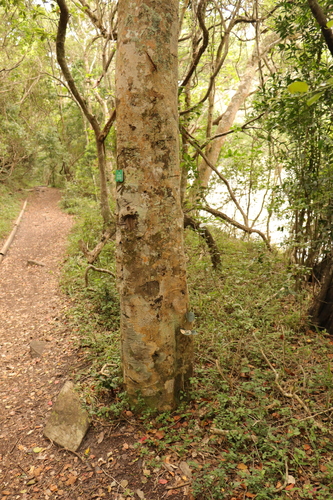
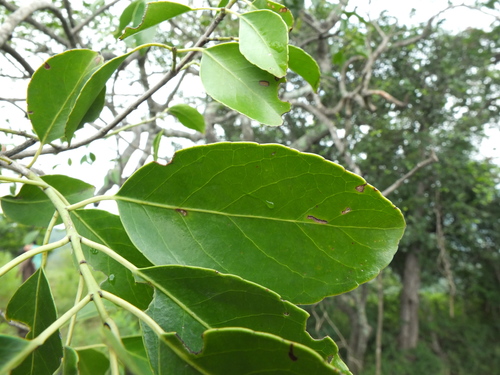
A sprawling shrub or large woody climber. The stems can be 23 cm across. The bark is corky. The leaves vary. They can be oval or round. They are 5-11 cm long by 3-7 cm wide. The base is wedge shaped or rounded. The flowers are in large long drooping groups at the ends of branches. Male and female flowers are separate. The fruit is a capsule 9-12 mm across. It has 3 valves with 3-6 seeds. The seeds are yellowish-brown. They have a red fleshy layer around them.
How to Grow
Plants can be grown from seeds.
Propagation: Seed - gather when ripe, remove the aril since this inhibits germination, and store in dry sand if not sowing immediately. Three months cold stratification leads to a higher germination rate. Germination rates are usually good. When they are large enough to handle, prick the seedlings out into individual pots and grow them on until large enough to plant out. Layering of the current seasons growth. It can take 12 months before a good root system is formed and the new plant can be transplanted. Root cuttings, 6mm thick and 25mm long. Plant horizontally in pots.
Medicinal Uses
Oil from the seeds is used as a traditional medicine in Indian Unani and Ayurvedic medicine.
Other Uses
The seed contains 52% oil, and the fruit 30%. It is used as an illuminant in lamps and also for soap making. This oil is also used medicinally (see notes above).
Wikipedia
Source ↗Celastrus paniculatus is a woody liana commonly known as black oil plant, climbing staff tree, and intellect tree (Sanskrit: jyotishmati ज्योतीष्मती, Hindi: mal-kangni माल-कांगनी, Chinese: deng you teng 灯油藤). This climbing shrub grows throughout India at elevations up to 1,800 m (5,900 ft). C. paniculatus is a deciduous vine with stems up to 10 cm (3.9 in) in diameter and 6 m (20 ft) long with rough, pale brown exfoliating bark covered densely with small, elongated lenticles. The leaves are simple, broad, and oval, obovate or elliptic in shape, with toothed margins.
Production
In India in the Ghats the fruit are available June to December.
Other Information
It is a cultivated plant. Leaves and flowers are sold in local markets.
Notes
The leaves and sap are used in medicine. There are about 30 Celastrus species.
Names & Synonyms
Dhimar-bel, Gangunge, Hinn-hmwe, Hpak-ko-suk, Jyotishmati, Kangli, Kangui, Kangun, Kanjri, Kariganne, Karkanganvel, Katong lai, Kaunya, Kiri, Mak taek, Malkangani, Malkangini, Malkauni, Myin-gaung-nayaung, Myin gondaing, Myin-lauk-yaung, Nwe-ni, Padie, Palulavam, Pimpli cha baar, Piparfal, Sankhir, Sila, Taung-bort-lu-lin, Valulavai, Warandul tonda
References (29)
- Aiguo, C. & Zhiling, D., 2001, Managing Agricultural Resources for Biodiversity Conservation. Case Study Yunnan, Southwest China. Environment Liaison Center International. p 40
- Ambasta S.P. (Ed.), 2000, The Useful Plants of India. CSIR India. p 113
- Aryal, K., Moe, A.T., Hein, P.P., Bay, Y.H.S., Htay, T., Aung, H.W., Shakya, B., Xuefei, Y., Shaoliang, Y. , 2020, Wild and non- cultivated edible plants and their contribution to local livelihoods in Putao, Myanmar. ICIMOD.
- Bhatia, H., et al, 2018, Traditionally used wild edible plants of district Udhampur, J&K, India. Journal of Ethnobiology and Ethnomedicine (2018) 14:73
- Bohra, N., et al, 2017, Ethnobotany of wild edible plants traditionally used by the local people in the Ramnagar regions from Nainital District, Uttarakhand, India. Biolife 5(1): 12-19
- Burkill, I.H., 1966, A Dictionary of the Economic Products of the Malay Peninsula. Ministry of Agriculture and Cooperatives, Kuala Lumpur, Malaysia. Vol 1 (A-H) p 512
- Dey, A. & Mukhererjee, A., 2015, Living and Survival Amidst Hunger: Wild Edible Botanicals as a Prime Forest Productivity in the Rural Purulia District, West Bengal, India from Colonial to Present. Research Journal of Forestry 9(3): 71-86
- Dobriyal, M. J. R. & Dobriyal, R., 2014, Non Wood Forest Produce an Option for Ethnic Food and Nutritional Security in India. Int. J. of Usuf. Mngt. 15(1):17-37
- Ekka, N. S. & Ekka, A., 2016, Wild Edible plants Used by Tribals of North-east Chhattisgarh (Part-I), India. Research Journal of Recent Sciences. Vol. 5(ISC-2015), 127-131 (2016)
- Eiadthong, W., et al, 2010, Management of the Emerald Triangle Protected Forests Complex. Botanical Consultant Technical Report. p 47
- Flora of Pakistan. www.eFlora.org
- Jadhav, R., et al, 2015, Forest Foods of Northern Western Ghats: Mode of Consumption, Nutrition and Availability. Asian Agri-History Vol. 19, No. 4: 293-317
- Jadhav, V. D. et al, 2011, Documentation and ethnobotanical survey of wild edible plants from Kolhapur district. Recent Research in Science and Technology. 3(12): 58-63
- Johnson, N., 2002, Environmental Change in northern Thailand: Impact on Wild Edible Plant Availability. Ecology of Food and Nutrition, 41: 5, 373-399
- Kachenchart, B., et al, 2008, Phenology of Edible Plants at Sakaerat Forest. In Proceedings of the FORTROP II: Tropical Forestry Change in a Changing World. Bangkok, Thailand.
- Khumgratok, S., Edible Plants in Cultural Forests of Northeastern Thailand. Mahasarakham University Thailand.
- Luczaj, L., et al, 2021, Wild food plants and fungi sold in the markets of Luang Prabang, Lao PDR. Journal of Ethnobiology and Ethnomedicine (2021) 17:6
- Pandy, R. K. & Saini, S. K., 2007, Edible plants of tropical forests among tribal communities of Madhya Pradesh. Indian Journal of Traditional Knowledge. 6(1), pp 185-190
- Prafulla, S., 2017, Wild Food Diversity of Nawegaon-Nagzira Tiger Reserve in Gondia-Bhandara district of Maharashtra, India. Int. J. of Life Sciences, 2017, Vol. 5 (4): 620-626
- Prashanth Kumar, G.M. and Shiddamallayya, N., 2015, Ethnobotanical Study of Less Known Wild Edible Plants of Hakki Pikki Tribes of Angadihalli, Hassan District, Karnataka. Journal or Medicinal Plants Studies 3(5):80-85
- Sen, R., et al, 1985, Ethnobotanical Uses of Herbaria - 4 J. Econ. Tax. Bot. Vol 6. No.2 pp 331-335
- Setiya, A. V., et al, 2016, Exploration and documentation of some wild edible plants used by the aboriginals from Gadchiroli District (M.S.) India. International Advanced Research Journal in Science, Engineering and Technology. 3(7)
- Shin, T., et al, 2018, Traditional knowledge of wild edible plants with special emphasis on medicinal uses in Southern Shan State, Myanmar. Journal of Ethnobiology and Ethnomedicine (2018) 14:48
- Sp. pl. 1(2):1125. 1798
- Sukarya, D. G., (Ed.) 2013, 3,500 Plant Species of the Botanic Gardens of Indonesia. LIPI p 911
- Tiwari, J. K., et al, 2010, Some Promising Wild Edible Plants of Srinagar and its Adjacent Area in Alaknanda Valley of Garhwal Himalaya, India. Journal of American Science 6(4) p 167ff
- Wild edible plants of Himachal Pradesh
- World Checklist of Useful Plant Species 2020. Royal Botanic Gardens, Kew
- Xu, You-Kai, et al, 2004, Wild Vegetable Resources and Market Survey in Xishuangbanna, Southwest China. Economic Botany. 58(4): 647-667.