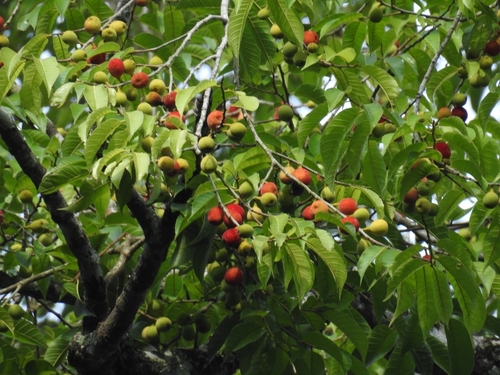
Ficus arnottiana
(Miq.) Miq.
Indian rock fig
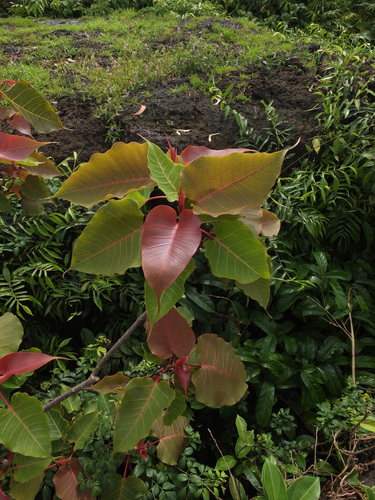
(c) Siddarth Machado, some rights reserved (CC BY), uploaded by Siddarth Machado
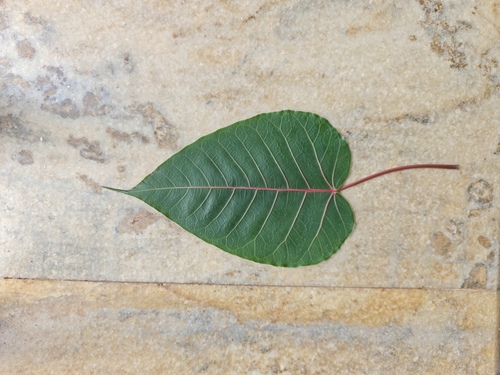
(c) Om Dhuttargaonkar, some rights reserved (CC BY-NC), uploaded by Om Dhuttargaonkar

(c) Dinesh Valke, some rights reserved (CC BY-SA)
What to Eat
Edible parts: Leaves - tea, Fruit
The fruit is eaten fresh. The leaves are boiled, dried, and used as tea.
Where to Find It
A tropical plant. It grows in rock crevices between 1000-1500 m altitude in India.
Asia, India, Northeastern India,
How to Identify
A fig. It is a shrub or small tree. It grows 10 m tall. It loses its leaves during the year. The leaves are simple and alternate or in spirals. The leaf stalk is 3-10 cm long. The leaf blade is 6-20 cm long by 5-13 cm wide. It is oval with a deeply heart shaped base. The fruit are figs that occur in pairs or crowded near the tips. They are yellow-brown when ripe and 5-7 mm across.
Wikipedia
Source ↗Ficus arnottiana, commonly known as the Indian rock fig, rock peepal or wavy-leaved fig tree, is a species of fig tree, native to the Indian subcontinent with a preference to rocky habitats. The species was named in honor of the Scottish botanist George Arnott Walker-Arnott.
Notes
There are about 800-1000 Ficus species. They are mostly in the tropics. There are 120 Ficus species in tropical America.
Names & Synonyms
Amakanniyan, Ban pipal, Bassari, Bettadaarali, Kagoli, Kallaravi, Kallarayal, Khadak payar, Paraspipal, Pilkhan, Pimpli, Pipal, Plaksha, Plokhyo
References (4)
- Ambasta, S.P. (Ed.), 2000, The Useful Plants of India. CSIR India. p 221
- Ann. Mus. Bot. Lugduno-Batavum 3:287. 1867-1868 ("1867")
- Kuvar, S. D. & Shinde, R. D., 2019, Wild Edible Plants used by Kokni Tribe of Nasik District, Maharashtra. Journal of Global Biosciences. Volume 8, Number 2, 2019, pp. 5936-5945
- Malhotra, C.L.., et al, 1985, Additional Notes on the wild edible plants of India J. Econ. Tax. Bot. Vol 6. No.2 pp 481-482