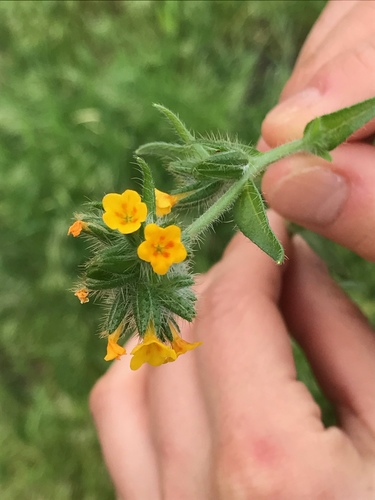
Trichodesma indica
(L.) R. Br.
Indian borage
What to Eat
Edible parts: Seeds, Leaves, Flowers
The black seeds are eaten, particularly by children. The leaves and flowers are also consumed.
Where to Find It
A tropical plant. In Pakistan it grows up to 1,400 m altitude.
Afghanistan, Asia, India, Mauritius, Pakistan, Philippines, SE Asia,
How to Identify
An annual herb. The branches are spreading and very hairy. There are short thin hairs and tiff longer hairs. The leaves are broadly sword shaped and 4-9 cm long by 1-2 cm wide. There are a few flowers in a loose group at the end. The fruit are nutlets. These are 4-5 mm long.
Medicinal Uses
The fruit are chewed for nausea and indigestion.
Other Information
The seeds are especially eaten by children.
Names & Synonyms
Adhomukhi, Andusi, Cchotakulpha, Cchotaphulva, Chotokulpa, Gokhe-kei-kanti, Guvvagutti, Hetamundia, Hetmudia, Kallributi ratmandu, Katte-tumbesoppu, Kaurla, Kawalyache dole, Kazhuthaithumbai, Kula-tirub, Lahanakalpa, Nilakrai, Phopati, Phul-dar, Ratisurkha, Ratmandi, Sal-kanla, Sal-knota, Surasa, Undhaphuli
References (7)
- Ambasta, S.P. (Ed.), 2000, The Useful Plants of India. CSIR India. p 648
- A. Rees, Cycl. 36: Trichodesma no. 1. 1817 (R. Br., Prodr. 149. 1810, nom. inval.; Lehm., Pl. Asperif. nucif. 193. 1818)
- Flora of Pakistan.
- Kiran, K. C., et al, 2019, Diversity and Seasonal Availability of Potential Wild Edible Plants from Vidarbha Region of Maharashtra State, India. Int.J.Curr.Microbiol.App.Sci (2019) 8(2): 1434-1446
- Misra, S., 2020, Survey of edible plants for human consumption in south Odisha, India. Journal of Emerging Technologies and Innovative Research (JETIR) Vol. 7, Issue 12 p 292
- Sadhale, A., et al, 1991, Ethnobotanical studies of sacred grove at Ajiwali, Pune district. J. Econ. Tax. Bot. Vol. 15 No. 1 pp 167-172
- Wild edible plants of Himachal Pradesh