Hypodematium crenatum
(Forssk.)Kuhn.
DryopteridaceaeLeaves
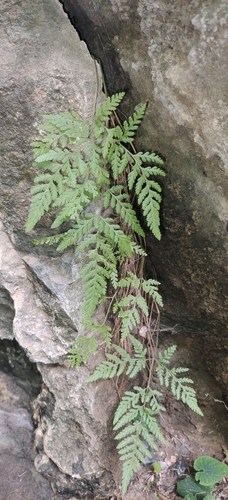
iNaturalist · cc-by-nc
(c) orientalstork, some rights reserved (CC BY-NC)
(c) orientalstork, some rights reserved (CC BY-NC)

iNaturalist · cc-by-nc
(c) Jean-François Olivier, some rights reserved (CC BY-NC)
(c) Jean-François Olivier, some rights reserved (CC BY-NC)

iNaturalist · cc-by-nc
(c) Jean-François Olivier, some rights reserved (CC BY-NC)
(c) Jean-François Olivier, some rights reserved (CC BY-NC)
What to Eat
Edible parts: Fronds, Leaves
The young curled fronds are occasionally eaten, particularly when food is scarce.
Where to Find It
It is a tropical and subtropical plant. It grows between 600-2000 m altitude. It grows on sandy cliffs and cracks in limestone areas. In southern China it grows from sea level to 1,800 m above sea level.
Africa, Asia, Bhutan, China, Himalayas, India, Japan, Malaysia, Myanmar, Philippines, SE Asia, Taiwan,
Countries: United Arab Emirates, Afghanistan, Armenia, Angola, Azerbaijan, Bangladesh, Burkina Faso, Bahrain, Burundi, Benin, Brunei, Bhutan, Botswana, Congo (DRC), Central African Republic, Congo (Republic), Cote d'Ivoire, Cameroon, China, Cape Verde, Djibouti, Algeria, Egypt, Eritrea, Ethiopia, Gabon, Georgia, Ghana, Gambia, Guinea, Equatorial Guinea, Guinea-Bissau, Indonesia, Israel, India, Iraq, Iran, Jordan, Japan, Kenya, Kyrgyzstan, Cambodia, Comoros, North Korea, South Korea, Kuwait, Kazakhstan, Laos, Lebanon, Sri Lanka, Liberia, Lesotho, Libya, Morocco, Madagascar, Mali, Myanmar, Mongolia, Mauritania, Mauritius, Maldives, Malawi, Malaysia, Mozambique, Namibia, Niger, Nigeria, Nepal, Oman, Philippines, Pakistan, Qatar, Rwanda, Saudi Arabia, Seychelles, Sudan, Singapore, Sierra Leone, Senegal, Somalia, South Sudan, Sao Tome & Principe, Syria, Eswatini, Chad, Togo, Thailand, Tajikistan, Timor-Leste, Turkmenistan, Tunisia, Turkey, Taiwan, Tanzania, Uganda, Uzbekistan, Vietnam, Yemen, South Africa, Zambia, Zimbabwe
How to Identify
A fern with a creeping rhizome. It has a dense covering of bright brown scales. These are narrow and pointed. The stipe is 25 cm long. It is grooved and naked except at the base. The blade is delta shaped.
Other Information
They are eaten when food is scarce.
Names & Synonyms
Polypodium crenatum Forsk.Nephrodium crenatum BakerLastrea creanata Bedd.
References (2)
- Dobriyal, M. J. R. & Dobriyal, R., 2014, Non Wood Forest Produce an Option for Ethnic Food and Nutritional Security in India. Int. J. of Usuf. Mngt. 15(1):17-37
- Pande, P.C. & Pangtey, Y.P.S., 1987, Studies on Ethnobotany - 1. on some less known edible and economic ferns of Kumaun Region of Western Himalaya. J. Econ. Tax. Bot. Vol 11 No.1 pp 81-85


