Sorbus foliolosa
(Wallich) Spach
Sale
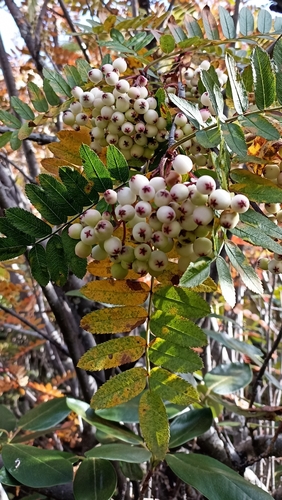
(c) Rajendra Koranga, some rights reserved (CC BY-NC), uploaded by Rajendra Koranga
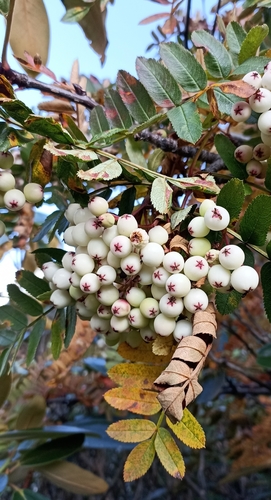
(c) Rajendra Koranga, some rights reserved (CC BY-NC), uploaded by Rajendra Koranga
What to Eat
Edible parts: Fruit
The ripe fruit are eaten.
Where to Find It
It is a subtropical plant. It grows between 2,400-4,000 m altitude in the Himalayas. In Yunnan.
Asia, Bhutan, Canada, China, Himalayas, India, Myanmar, Nepal, North America, Northeastern India, SE Asia, Sikkim, Tibet,
How to Identify
A large shrub or small tree. The bark peels off in strips across the trunk. The twigs are almost without hairs. The leaves are 6-12 cm long and have 9-15 pairs of leaflets. The leaflets are narrow and have sharp teeth along the edge. The leaflets are 2.3-4 cm long. The flowers have long white downy hairs. The flowers are white or greenish-white and in dense flat topped clusters. They have an unpleasant smell. The petals are rounded and 2-3 mm across. The fruit is round or oval and red or bluish-red.
Names & Synonyms
Jungli seo, Ranreg
References (7)
- Ambasta, S.P. (Ed.), 2000, The Useful Plants of India. CSIR India. p 586
- Flora of China @ efloras.org Volume 9
- Hist. nat. veg. 2:96. 1834
- Negi, P. S. & Subramani, S. P., 2015, Wild Edible Plant Genetic Resources for Sustainable Food Security and Livelihood of Kinnaur District, Himachal Pradesh, India, International Journal of Conservation Science. 6 (4): 657-668
- Polunin, O., & Stainton, A., 2006, Flowers of the Himalaya, Oxford India Paperbacks. p 122
- Rawat, G.S., & Pangtey, Y.P.S., 1987, A Contribution to the Ethnobotany of Alpine Regions of Kumaon. J. Econ. Tax. Bot. Vol. 11 No. 1 pp 139-147
- www.Efloras.org Annotated checklist of the Flowering Plants of Nepal.
More from Rosaceae


