Ficus heterophylla
Linn.f.
Creeping fig
(c) shivaprakash, some rights reserved (CC BY-NC)

(c) dechaphaetkrathok, some rights reserved (CC BY-NC)
What to Eat
Edible parts: Fruit
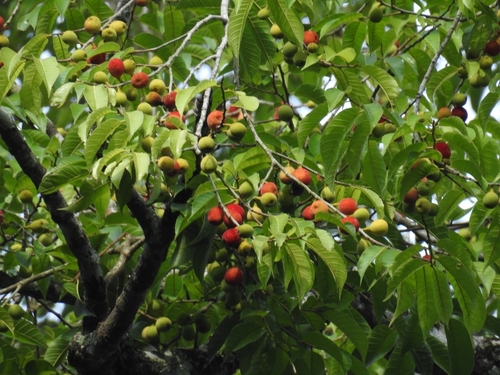
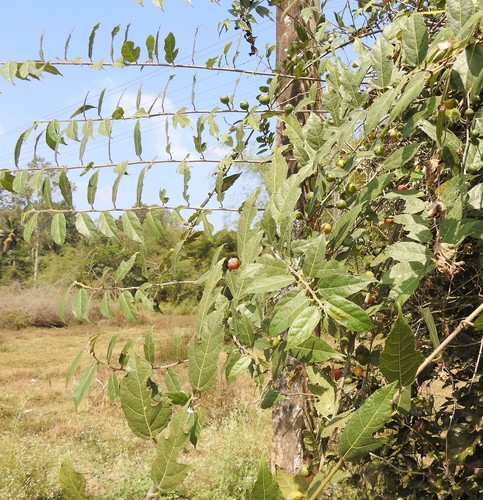
Fruit. Figs axillary on leafy or older leafless branches, solitary, yellowish orange and smooth when mature, globose to pear-shaped, 10 - 20mm in diameter.
Where to Find It
It grows in the tropics. It grows in moist valleys and along streams beween 400-800 m above sea level in southern China.
Asia, Cambodia, Himalayas, India, Indochina, Indonesia, Laos, Malaysia, Myanmar, Northeastern India, SE Asia, Sikkim, Sri Lanka, Thailand, Vietnam,
How to Identify
A fig. It is a shrub. It often lies over. The young branches are reddish-brown. The leaves are broadly sword shaped and 7-10 cm long by 3-4 cm wide. Young leaves have lobes along the stalk. The figs are in the axils of older branches. They occur singly and are yellowish orange when ripe.
How to Grow
Fig trees have a unique form of fertilization, each species relying on a single, highly specialized species of wasp that is itself totaly dependant upon that fig species in order to breed. The trees produce three types of flower; male, a long-styled female and a short-styled female flower, often called the gall flower. All three types of flower are contained within the structure we usually think of as the fruit. The female fig wasp enters a fig and lays its eggs on the short styled female flowers while pollinating the long styled female flowers. Wingless male fig wasps emerge first, inseminate the emerging females and then bore exit tunnels out of the fig for the winged females. Females emerge, collect pollen from the male flowers and fly off in search of figs whose female flowers are receptive. In order to support a population of its pollinator, individuals of a Ficus spp. must flower asynchronously. A population must exceed a critical minimum size to ensure that at any time of the year at least some plants have overlap of emmission and reception of fig wasps. Without this temporal overlap the short-lived pollinator wasps will go locally extinct.
Medicinal Uses
The leaf paste is applied for several days as a poultice on areas affected by rheumatism or on ear infections.
Wikipedia
Source ↗Ficus heterophylla is a fig plant species, in the family Moraceae, which can be found in India, southern China, Indo-China and western Malesia. In Vietnam it may be called vú bò.
Notes
There are about 800-1000 Ficus species. They are mostly in the tropics. There are 120 Ficus species in tropical America.
Names & Synonyms
Bhuidumur, Buroni, Datir, Dhusre, Ganthi sahada, Kanwe-bin, Kodiyatti, Koro, Mamasu, Shan rong, Trayamana, Vallitterakam
References (11)
- Ambasta, S.P. (Ed.), 2000, The Useful Plants of India. CSIR India. p 222
- Hedrick, U.P., 1919, (Ed.), Sturtevant's edible plants of the world. p 308
- Kachenchart, B., et al, 2008, Phenology of Edible Plants at Sakaerat Forest. In Proceedings of the FORTROP II: Tropical Forestry Change in a Changing World. Bangkok, Thailand.
- Krishna, B., & Singh, S., 1987, Ethnobotanical Observations in Sikkim. J. Econ. Tax. Bot. Vol. 9 No. 1 pp 1-7
- Kumar, A., et al, 2011, Assessment of Diversity in the Genus Ficus L. (Moraceae) of Katerniaghat Wildlife Sanctuary, Uttar Pradesh, India. American Journal of Plant Sciences, 2011, 2, 78-92
- Misra S. & Misra M., 2016, Ethnobotanical and Nutritional Evaluation of Some Edible Fruit Plants of Southern Odisha, India. International Journal of Advances in Agricultural Science and Technology, Vol.3 Issue.1, March- 2016, pg. 1-30
- Mozhui, R., et al, 2011, Wild edible fruits used by the tribals of Dimapur district of Nagaland, India. Pleione 5(1): 56 - 64.
- Savita, et al, 2006, Studies on wild edible plants of ethnic people in east Sikkim. Asian J. of Bio Sci. (2006) Vol. 1 No. 2 : 117-125
- Singh, V. B., et al, (Ed.) Horticulture for Sustainable Income and Environmental Protection. Vol. 1 p 216
- Suppl. pl. 442. 1782 ("1781")
- www.eFloras.org Flora of China