Schima wallichii
(DC.) Korth.
Needle wood, Wallichii puspa tree
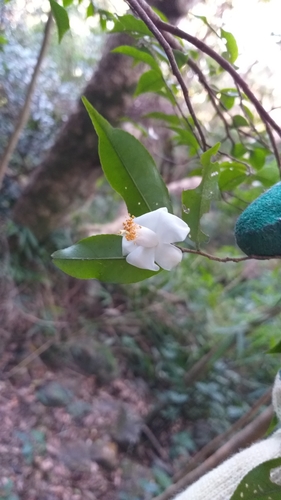
(c) Franz Anthony, some rights reserved (CC BY), uploaded by Franz Anthony
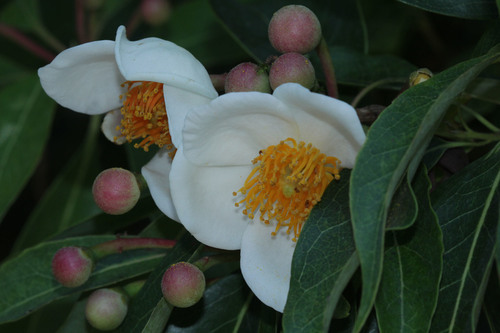
(c) JODY HSIEH, some rights reserved (CC BY-NC)

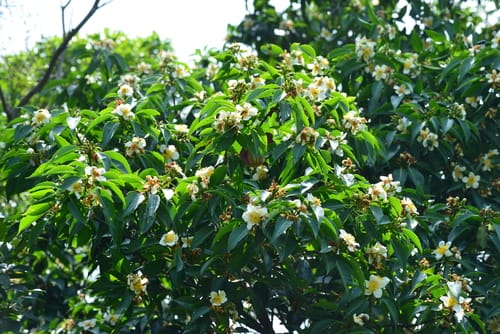
(c) copyboy, some rights reserved (CC BY-NC)
What to Eat
Edible parts: Shoots, Leaves
Young shoots and leaves are eaten raw or cooked, often boiled and served with rice or mixed with other vegetables. Shoots are sold in markets.
Known Hazards
Where to Find It
A tropical and subtropical plant. It needs a humus-rich, acid soil. In India it is usually in the foothills and grows up to about 1,500 m altitude. Hobart Botanical Gardens? It suits hardiness zones 9-11. In Yunnan.
Asia, Australia, Bangladesh, Bhutan, China, Himalayas, India, Indochina, Indonesia, Japan, Laos, Myanmar, Nepal, Northeastern India, SE Asia, Sikkim, Tasmania, Thailand, Tibet, Vietnam,
How to Identify
An evergreen tree. It grows 8 m high and spreads 6 m wide. It can be 20-30 m tall. The crown is dense and bushy. The bark is dark grey with cracks along it. The leaves are glossy. They are large, leathery and green. They are oblong or sword shaped and 9-24 cm long by 3.5-8 cm wide. They are bronze-red when young. They are arranged in spirals. The flowers are white. They have prominent yellow stamens. The flowers have a scent. They occur in the axils of leaves and are 3-5 cm across. The fruit are round and 1.3-1.8 cm across. They are warty. There are 2-6 seeds in each cell. They are surrounded by a paper wing.
How to Grow
Plants can be grown from seed or half hardened cuttings.
Propagation: Seed - germinates freely when sown as soon as it is ripe. Pre-soak stored seed for 12 hours in warm water (about body temperature) before sowing. Germination rates vary considerably - fresh seeds give about 90% germination in 10 - 12 days, but in some seedlots there has been a germination rate of only 15% in 23 - 85 days. Seeds are sown under shade and only lightly covered with soil. Seedling mortality in the nursery is usually about 50%. After 2 - 3 months seedlings are 5 - 8cm tall and can be transplanted from the seedbed to containers; at 6 - 8 months, when they are about 20cm tall, they can be planted out in the field, although stumps may be made of older seedlings. Seed storage behaviour is recalcitrant; seeds cannot be stored and are short-lived in open storage at room temperature. Dried fruits or seeds can be stored for up to 3 months, although 1 record in Nepal shows that they can be stored for a long time without problems. There are 196 000-267 000 dry seeds/kg.
Medicinal Uses
The astringent corollas are used to treat uterine disorders and hysteria. The crude drug is called ‘buah cangkok’ in Indonesia, and ‘changkoh’ in peninsular Malaysia. The bark is used as an antiseptic for wounds. The sap from the stem is used in the treatment of ear infections.
Other Uses
The bark is a source of tannins and is used for dyeing. The leaves also contain tannin but not in quantities large enough for economic. The seed contains 19% oil. The heartwood is pink-brown, red-brown or grey-brown, but is sometimes dark red-brown; it is not clearly differentiated from the pale grey sapwood. The grain is straight or interlocked, frequently irregular; texture moderately fine or fine and even.The wood is medium-weight to heavy, hard, fairly strong, moderately durable and relatively resistant to dry-wood termites. It is easy to work with hand and machine tools and polishes satisfactorily. It is used for medium-heavy construction that is under cover, such as columns and beams, for flooring, interior fitting, panelling, door and window frames, joinery, utility furniture, ship and boat building (ribs, decks), vehicle bodies, agricultural implements, pallets, boxes and crates, poles, toys, turnery and, when treated, for railway sleepers. It has been used for bridge building in mountain areas, and young trees have been used as rafters. Good-quality plywood can be manufactured from the wood, and it is suitable for the production of wood-wool boards. The wood is suitable for paper pulp. The wood is a good firewood. The energy value of the sapwood is about 19 980 kJ/kg. The tree has been used as a shade tree in coffee plantations, and as a cover crop in plantations of Pinus merkusii and Agathis dammara. In the northeastern regions of India, planting cardamom with this tree are some of the ideal agroforestry systems for conserving soil and water. A useful tree for reforestation and planting for water conservation in catchment areas. The tree is planted as a pioneer species in northern Thailand in reforestation projects to restore native woodland - it is planted in degraded woodland and open areas in a mix with various other species that all have the ability to grow fast; produce dense, weed-suppressing crowns; and attract seed-dispersing wildlife, particularly birds and bats.
Wikipedia
Source ↗Schima wallichii, commonly known as the needlewood or Chinese guger tree, is a species of evergreen tree in the tea family, Theaceae. Schima wallichii is native to a wide area of China and tropical Asia. It grows 10–20 metres (33–66 ft) tall.
Other Information
Shoots are sold in markets.
Notes
There is only one Schima species.
Names & Synonyms
Chilaune, Chilauney, Chilauni, Dieng-ngan, Kanak, Khaimasii, Khainsuri, Khai so, Khengthing, Khiang, Khieng, Khuzli gachi, Laukya, Laukya-byu, Mai-song, Makrisal, Masa, Mi, Nkiai, Oosoi, Pohon puspa wali, Thalo, Thit-yar, Thitya-byu, Thitya, Thutya-ni, Usoi, Voi thuoc, Zhokhaikhai
References (24)
- Ambasta S.P. (Ed.), 2000, The Useful Plants of India. CSIR India. p 555 ? (DC.)Korth
- A Rapid Participatory Biodiversity Assessment. 2007, Southern Lao PDR. IUCN p 92
- Burkill, I.H., 1966, A Dictionary of the Economic Products of the Malay Peninsula. Ministry of Agriculture and Cooperatives, Kuala Lumpur, Malaysia. Vol 2 (I-Z) p 2008
- Cundall, P., (ed.), 2004, Gardening Australia: flora: the gardener's bible. ABC Books. p 1322
- Gangte, H. E., et al, 2013, Wild Edible Plants used by the Zou Tribe in Manipur, India. International Journal of Scientific and Research Publications, Volume 3, Issue 5
- Gardner, S., et al, 2000, A Field Guide to Forest Trees of Northern Thailand, Kobfai Publishing Project. p 58
- Guite, C., 2016, Study of wild edible plants associated with the Paite Tribe of Manipur, India. International Journal of Current Research. Vol. 8, Issue 11, pp. 40927-40932
- Hibbert, M., 2002, The Aussie Plant Finder 2002, Florilegium. p 288
- Kar, A., et al, 2013, Wild Edible Plant Resources used by the Mizos of Mizoram, India. Kathmandu University Journal of Science, Engineering and Technology. Vol. 9, No. 1, July, 2013, 106-126
- Maisuthisakul, P., 2012, Phenolic Constituents and Antioxidant Properties of some Thai Plants. Chp. 9 in Book Phytochemicals - A Global Perspective of Their Role in Nutrition and Health
- Medhi, P., Sarma, A and Borthakur, S. K., 2014, Wild edible plants from the Dima Hasao district of Assam, India. Pleione 8(1): 133-148
- Meitei, L. R., et al, 2022, An ethnobotanical study on the wild edible plants used by forest dwellers in Yangoupokpi Lokchao Wildlife Sanctuary, Manipur, India. Ethnobotany Research and Application 23:15
- Pfoze, N. L., et al, 2012, Survey and assessment of floral diversity on wild edible plants from Senapati district of Manipur, Northeast India. Journal or Biodiversity and Environmental Sciences. 1(6):50-52
- Ryan, S., 2008, Dicksonia. Rare Plants Manual. Hyland House. p 50
- Sahni, K.C., 2000, The Book of Indian Trees. Bombay Natural History Society. Oxford. p 31
- Savita, et al, 2006, Studies on wild edible plants of ethnic people in east Sikkim. Asian J. of Bio Sci. (2006) Vol. 1 No. 2 : 117-125
- Sawian, J. T., et al, 2007, Wild edible plants of Meghalaya, North-east India. Natural Product Radiance Vol. 6(5): p 421
- Shin, T., et al, 2018, Traditional knowledge of wild edible plants with special emphasis on medicinal uses in Southern Shan State, Myanmar. Journal of Ethnobiology and Ethnomedicine (2018) 14:48
- Singh, P.K., Singh, N.I., and Singh, L.J., 1988, Ethnobotanical Studies on Wild Edible Plants in the Markets of Manipur - 2. J. Econ. Tax. Bot. Vol. 12 No. 1 pp 113-119
- Slik, F., www.asianplant.net
- Sukarya, D. G., (Ed.) 2013, 3,500 Plant Species of the Botanic Gardens of Indonesia. LIPI p 499
- Sundriyal, M. & Sundriyal, R. C., 2004, Structure, Phenology, Fruit Yield, and Future Prospects of some Prominent Wild Edible Plant Species of the Sikkim Himalaya, India. Journal of Ethnobiology 24(1): 113-138
- Van Sam, H. et al, 2004, Trees of Laos and Vietnam: A Field Guide to 100 Economically or Ecologically Important Species. Blumea 29 (2004) 201-349
- Verh. nat. gesch. Ned. Bezitt., Bot. 143. 1842