Balakata baccata
(Roxb.) Esser
Mousedeer's rubber tree
(c) Arief Hamidi, some rights reserved (CC BY-NC), uploaded by Arief Hamidi
(c) Aparajita Datta, some rights reserved (CC BY-NC), uploaded by Aparajita Datta
(c) Arief Hamidi, some rights reserved (CC BY-NC), uploaded by Arief Hamidi
What to Eat
Edible parts: Fruit
Young fruit are boiled and eaten as a vegetable. Ripe fruit are sweet and eaten, sometimes used as a flavouring.
Where to Find It
A tropical plant. It grows in forests and near streams between 600-700 m above sea level. In Yunnan.
Andamans, Asia, Bangladesh, Cambodia, China, Himalayas, India, Indochina, Indonesia, Laos, Malaysia, Myanmar, Northeastern India, SE Asia, Thailand, Vietnam,
How to Identify
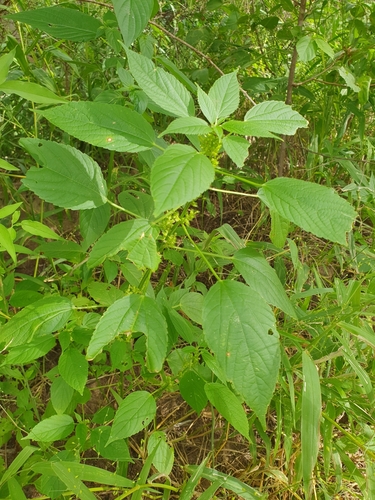
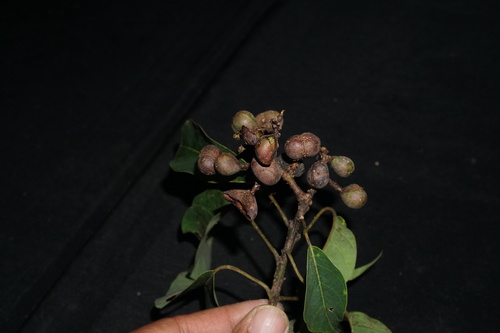
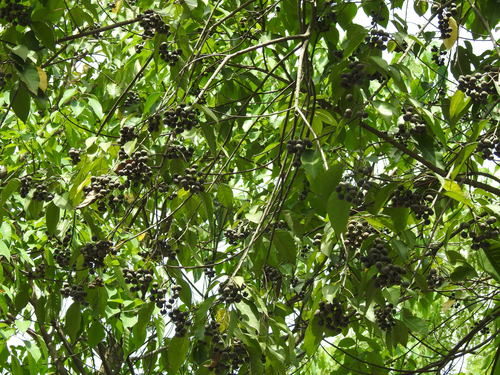
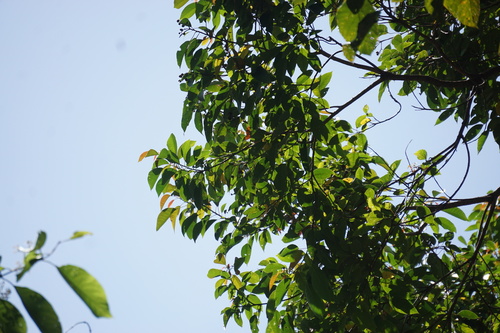
A large evergreen tree. It grows 30 m tall. The trunk is 60 cm across. The young branches are usually in rings. The leaves are oval and 8-22 cm long by 4-11 cm wide. They are pale underneath. The fruit are black. They have 1 or 2 seeds.
How to Grow
Plants can be grown by seeds.
Other Uses
Sapwood cream to white, soft, with a sour to sweet smell. It is not very durable. The wood is used as timber. The tree is planted as a pioneer species in northern Thailand in reforestation projects to restore native woodland - it is planted in degraded woodland and open areas in a mix with various other species that all have the ability to grow fast; produce dense, weed-suppressing crowns; and attract seed-dispersing wildlife, particularly birds and bats.
Production
In Nagaland fruit are available September to November.
Notes
There are about 100 Sapium species. Most are tropical.
Names & Synonyms
Adamsali, Ankrataruwa, Bedi, Billa, Boloch, Budi, Dieng-ja-long-ehr, Kayu rulus, Lal kanijal, Larrna, Lawa, Lelun, Ludahi, Ludai, Mamas-mamas, Mayang, Memaya, Metong, Oohu, Pelandok, Pohon karet kancil, Pudlikat, Puligota, Samperai, Samsim, Seleng, Shigum, Thing-bok-pui, Thing-zawk-pui, Tobu
References (11)
- Ambasta S.P. (Ed.), 2000, The Useful Plants of India. CSIR India. p 548 (As Sapium baccatum)
- Burkill, I.H., 1966, A Dictionary of the Economic Products of the Malay Peninsula. Ministry of Agriculture and Cooperatives, Kuala Lumpur, Malaysia. Vol 2 (I-Z) p 1995 (As Sapium baccatum)
- Kar, A., et al, 2013, Wild Edible Plant Resources used by the Mizos of Mizoram, India. Kathmandu University Journal of Science, Engineering and Technology. Vol. 9, No. 1, July, 2013, 106-126 (As Sapium baccatum)
- Majumdar, K and Datta, N., 2009, Traditional wild edible fruits for the forest dwellers of Tripura, India. Pleione 3(2) 167-178 (As Sapium baccatum)
- Milow, P., et al, 2013, Malaysian species of plants with edible fruits or seeds and their evaluation. International Journal of Fruit Science. 14:1, 1-27 (As Sapium baccatum)
- Pradheep, K., et al, 2016, Wild edible plants used by Konyak tribe in Mon district of Nagaland: Survey and inventorisation. Indian Journal of Natural Products and Resources. Vol 7(1) pp 74-81
- Singh, V. B., et al, (Ed.) Horticulture for Sustainable Income and Environmental Protection. Vol. 1 p 219 (As Sapium baccatum)
- Srivastava, R. C., 2009, Traditional knowledge of Adi tribe of Arunachal Pradesh on plants. Indian Journal of Traditional Knowledge. 8(2): 146-153 (As Sapium baccatum)
- Srivastava, R. C., et al, 2010, Indigenous biodiversity of Apatani plateau: Learning on biolcultural knowledge of Apani tribe of Qrunachal Pradesh for sustainable livelihoods. Indian Journal of Traditional Knowledge 9(3): 432-442 (As Sapium baccatum)
- Sukarya, D. G., (Ed.) 2013, 3,500 Plant Species of the Botanic Gardens of Indonesia. LIPI p 147
- World Checklist of Useful Plant Species 2020. Royal Botanic Gardens, Kew