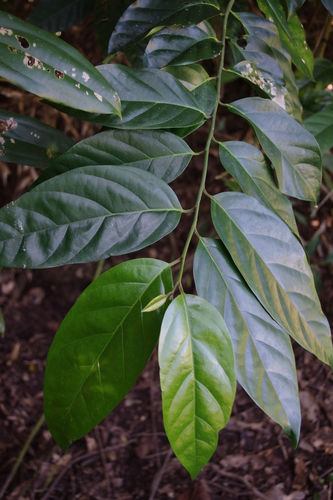
Stemonurus secundiflorus
Blume

iNaturalist · cc-by-nc
(c) Made Vasek Wijaya, some rights reserved (CC BY-NC)
(c) Made Vasek Wijaya, some rights reserved (CC BY-NC)

iNaturalist · cc-by-nc
(c) Made Vasek Wijaya, some rights reserved (CC BY-NC)
(c) Made Vasek Wijaya, some rights reserved (CC BY-NC)

iNaturalist · cc-by-nc
(c) Made Vasek Wijaya, some rights reserved (CC BY-NC)
(c) Made Vasek Wijaya, some rights reserved (CC BY-NC)
What to Eat
Edible parts: Seeds, Fruit
The fruit is eaten after special preparation. The seeds are eaten after repeated cooking.
Where to Find It
A tropical plant. It often grows in swampy places. It grows up to 100 m above sea level.
Asia, Indonesia, Malaysia, SE Asia,
Countries: United Arab Emirates, Afghanistan, Armenia, Azerbaijan, Bangladesh, Bahrain, Brunei, Bhutan, China, Georgia, Indonesia, Israel, India, Iraq, Iran, Jordan, Japan, Kyrgyzstan, Cambodia, North Korea, South Korea, Kuwait, Kazakhstan, Laos, Lebanon, Sri Lanka, Myanmar, Mongolia, Maldives, Malaysia, Nepal, Oman, Philippines, Pakistan, Qatar, Saudi Arabia, Singapore, Syria, Thailand, Tajikistan, Timor-Leste, Turkmenistan, Turkey, Taiwan, Uzbekistan, Vietnam, Yemen
How to Identify
A tall tree. It grows 10-24 m high. The trunk can be 40 cm across. The leaves are alternate and simple. The flowers are 7 mm across. They are green to yellow. The fruit are 4.5 cm along. They are green. They can float.
Notes
Also put in the Olacaceae.
Names & Synonyms
Ensurok, Entaburok, Jerumut, Lada hutan, Lada-lada hutan, Lokan, Pepepat bukit, Sabar bubu, Sebungku, Semanten, Semburok
Croton laurifolius Nor.Lasianthera secundiflora (Blume) Miq.Lasianthera secundiflora var. sumatrana Miq.Stemonurus lanceolatus Becc.Stemonurus pauciflorus Ridl.Stemonurus ridleyanus Sleum.Stemonurus secundiflorus var. valetonii Hochr.Urandra lanceolata (Becc.) O. KtzeUrandra secundiflora (Blume) O. Ktze
References (6)
- Burkill, I.H., 1966, A Dictionary of the Economic Products of the Malay Peninsula. Ministry of Agriculture and Cooperatives, Kuala Lumpur, Malaysia. Vol 2 (I-Z) p 2111
- Heyne, K., 1923, p 987
- Milow, P., et al, 2013, Malaysian species of plants with edible fruits or seeds and their evaluation. International Journal of Fruit Science. 14:1, 1-27
- Sleumer, 1971, Icacinaceae. Flora Malesiana Series 1. Vol 7: 1 p 60
- Slik, F., www.asianplant.net
- World Checklist of Useful Plant Species 2020. Royal Botanic Gardens, Kew