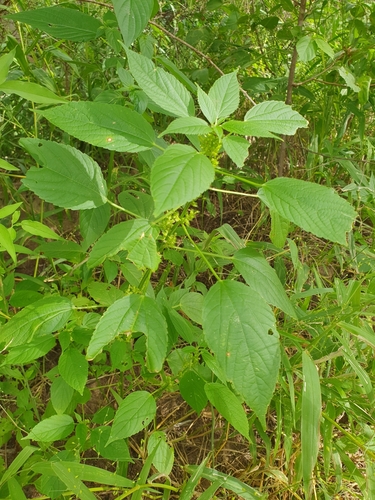
Baliospermum calycinum
Muell.-Arg.
EuphorbiaceaeLeaves

gbif · cc-by
Royal Botanic Gardens, Kew
Royal Botanic Gardens, Kew

gbif · cc0
Royal Botanic Garden Edinburgh
Royal Botanic Garden Edinburgh

gbif · cc0
Royal Botanic Garden Edinburgh
Royal Botanic Garden Edinburgh
What to Eat
Edible parts: Leaves
Leaves and flowers - cooked and used as a vegetable. Some caution should be exercised, the closely related species Baliospermum solanifolium is a drastic purgative, and this species is likely to contain the same or similar compounds.
Where to Find It
It is a subtropical plant. In southern China it grows in dense forest between 500-2,500 m above sea level.
Asia, Bangladesh, Bhutan, China, Himalayas, India, Indochina, Myanmar, Nepal, Northeastern India, SE Asia, Thailand,
Countries: United Arab Emirates, Afghanistan, Armenia, Azerbaijan, Bangladesh, Bahrain, Brunei, Bhutan, China, Georgia, Indonesia, Israel, India, Iraq, Iran, Jordan, Japan, Kyrgyzstan, Cambodia, North Korea, South Korea, Kuwait, Kazakhstan, Laos, Lebanon, Sri Lanka, Myanmar, Mongolia, Maldives, Malaysia, Nepal, Oman, Philippines, Pakistan, Qatar, Saudi Arabia, Singapore, Syria, Thailand, Tajikistan, Timor-Leste, Turkmenistan, Turkey, Taiwan, Uzbekistan, Vietnam, Yemen
How to Identify
A shrub. It grows to 3 m tall. Young branches are hairy. The leaves are oblong and 9-16 cm long by 3-8 cm wide.
How to Grow
A dioecious species, both male and female forms need to be grown if seed is required.
Notes
There are 7 Baliospermum species.
Names & Synonyms
Gilgal
Baliospermum calycinum var. micranthum Muell.-Arg.Baliospermum meeboldii Pax. & K. Hoffm.Baliospermum micranthum Mull.Arg.Baliospermum suffruticosum Pax & K. Hoffm.
References (4)
- Ambasta S.P. (Ed.), 2000, The Useful Plants of India. CSIR India. p 66 (As Baliospermum micranthum)
- Murtem, G. & Chaudhrey, P., 2016, An ethnobotanical note on wild edible plants of Upper Eastern Himalaya, India. Brazilian Journal of Biological Sciences, 2016, v. 3, no. 5, p. 63-81
- Singh, B., et al, 2012, Wild edible plants used by Garo tribes of Nokrek Biosphere Reserve in Meghalaya, India. Indian Journal of Traditional Knowledge. 11(1) pp 166-171 (As Baliospermum micranthum)
- Srivastava, R. C., 2009, Traditional knowledge of Adi tribe of Arunachal Pradesh on plants. Indian Journal of Traditional Knowledge. 8(2): 146-153