Bauhinia acuminata
Linn.
Dwarf white Bauhinia
(c) Chandra sekhar, some rights reserved (CC BY-NC)

(c) Diya laneesh, some rights reserved (CC BY-NC)

(c) Diya laneesh, some rights reserved (CC BY-NC)
What to Eat
Edible parts: Flowers, Leaves, Fruit
The white to pale yellow flowers are eaten raw or fried. Young shoots and fruit are cooked and eaten as a vegetable.
Where to Find It
A tropical plant. It needs regular moisture and humidity. It needs a fertile, humus-rich, well-drained soil. It suits hardiness zones 10-12. In XTBG Yunnan.
Africa, Andaman Is., Asia*, Australia, Bangladesh, Cambodia, China, Dominican Republic, East Africa, East Timor, Himalayas, India, Indochina, Indonesia, Laos, Malaysia, Marquesas, Myanmar, Northeastern India, Pacific, Pakistan, Philippines, SE Asia, Sierra Leone, Solomon Islands, Sri Lanka, Thailand, Timor-Leste, Vietnam, West Indies, Winward Is., Zimbabwe,
How to Identify
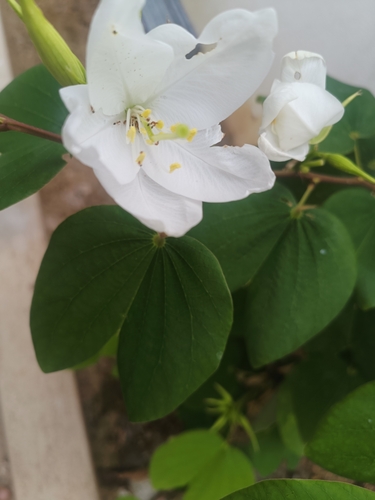
An evergreen shrub. It grows 3 m tall. The leaves have 2 lobes. They are downy and rounded. The leaves are 15 cm long. The flowers are white to pale yellow. There are only a few flowers on a stalk. The flowers are 5 cm wide. The fruit are flattened pods.
How to Grow
It can be grown by seeds or root suckers.
Propagation: Seed - Cuttings of half-ripe wood.
Medicinal Uses
The leaves, roots and flowers are used medicinally.
Other Uses
The plant is grown as a hedge.
Wikipedia
Source ↗Bauhinia acuminata is a species of flowering shrub native to tropical southeastern Asia. Common names include dwarf white bauhinia, white orchid-tree and snowy orchid-tree. The exact native range is obscure due to extensive cultivation, but probably from Malaysia, Indonesia (Java, Borneo, Kalimantan, Lesser Sunda Islands), and the Philippines. It grows two to three meters tall. Like the other Bauhinia species, the leaves are bilobed, shaped like an ox hoof; they are 6 to 15 centimetres (2+1⁄4 to 6 in) long and broad, with the apical cleft up to 5 centimetres (2 in) deep; the petiole is 1.5 to 4 centimetres (1⁄2 to 1+1⁄2 in) long. The flowers are fragrant, 8 to 12 centimetres (3+1⁄4 to 4+3⁄4 in) in diameter, with five white petals, ten yellow-tipped stamens and a green stigma. The fruit is a pod 7.5 to 15 centimetres (3 to 6 in) long and 1.5 to 1.8 centimetres (1⁄2 to 3⁄4 in) broad. The species occurs in deciduous forests and scrub. It is widely cultivated throughout the tropics as an ornamental plant. It may be found as an escape from cultivation in some areas, and has become naturalised on the Cape York Peninsula, Australia. The plant has a number of ethnobotanical uses around the world. The roots are used by the Javanese to treat cough and cold and in India the leaves and bark are used to treat asthma. It is also used in many culinary dishes of Odisha
Notes
There are about 250-350 Bauhinia species. Most are in the tropics. Also as Caesalpinaceae.
Names & Synonyms
Bunga perak, Cheung kou sar, Kaa-long, Kokkumandarai, Kupu kupu, Mahahlega-phyu, Mati kotora, Megong aphal, Mong-bo nhon, Mong-bo trang, Palan, Quach vang, Sivamalli, Swe-daw, Tapak kuda, Vaibe, Vellutthamandarom
References (17)
- Ambasta S.P. (Ed.), 2000, The Useful Plants of India. CSIR India. p 68
- Anderson, E. F., 1993, Plants and people of the Golden Triangle. Dioscorides Press. p 203
- Bircher, A. G. & Bircher, W. H., 2000, Encyclopedia of Fruit Trees and Edible Flowering Plants in Egypt and the Subtropics. AUC Press. p 55
- Bodkin, F., 1991, Encyclopedia Botanica. Cornstalk publishing, p 134
- Engel, D.H., & Phummai, S., 2000, A Field Guide to Tropical Plants of Asia. Timber Press. p 142
- Etherington, K., & Imwold, D., (Eds), 2001, Botanica's Trees & Shrubs. The illustrated A-Z of over 8500 trees and shrubs. Random House, Australia. p 120
- Fu, Yongneng, et al, 2003, Relocating Plants from Swidden Fallows to Gardens in Southwestern China. Economic Botany, 57(3): 389-402
- Heywood, V.H., Brummitt, R.K., Culham, A., and Seberg, O., 2007, Flowering Plant Families of the World. Royal Botanical Gardens, Kew. p 186 (Genus)
- Hibbert, M., 2002, The Aussie Plant Finder 2002, Florilegium. p 39
- Kew Plants of the World Online
- Llamas, K.A., 2003, Tropical Flowering Plants. Timber Press. p 196
- Luo, B., et al, 2019, Wild edible plants collected by Hani from terraced rice paddy agroecosystem in Honghe Prefecture, Yunnan, China. Journal of Ethnobiology and Ethnomedicine 15:56 (As var. candida)
- Medhi, P. & Borthakur, S. K., 2012, Phytoresources from North Cachur Hills of Assam -3: Edible plants sold at Hflong market. Indian Journal or Natural Products and Resources. 3(1) pp 84-109
- Medhi, P., Sarma, A and Borthakur, S. K., 2014, Wild edible plants from the Dima Hasao district of Assam, India. Pleione 8(1): 133-148
- Patiri, B. & Borah, A., 2007, Wild Edible Plants of Assam. Geethaki Publishers. p 42
- Sarma, H., et al, 2010, Updated Estimates of Wild Edible and Threatened Plants of Assam: A Meta-analysis. International Journal of Botany 6(4): 414-423
- Sp. pl. 1:375. 1753