Begonia rex
Putz.
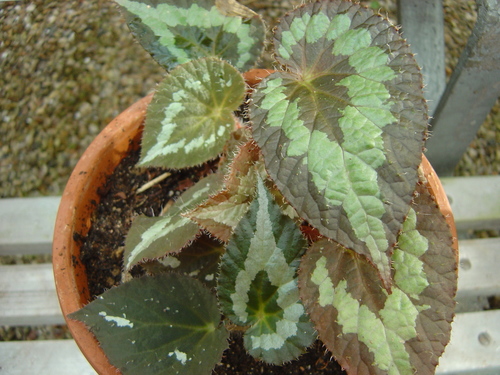
(c) Mininain, some rights reserved (CC BY-SA)

(c) tomten, some rights reserved (CC BY-NC)

Daderot, no known copyright restrictions (public domain)
What to Eat
Edible parts: Leaf stalks, Seeds
The leaf stalks and seeds are edible and the leaf stalks are used as a substitute for rhubarb.
Known Hazards
Where to Find It
It is a subtropical plant. It grows in forests and on rocks and in caves in valleys. It grows between 400-1,100 m above sea level. In Yunnan.
Asia, Australia, Bangladesh, Caucasus, China, Cuba, Dominican Republic, Georgia, Haiti, Himalayas, India, Indochina, Mexico, Myanmar, Northeastern India, SE Asia, Slovenia, Vietnam, West Indies,
How to Identify
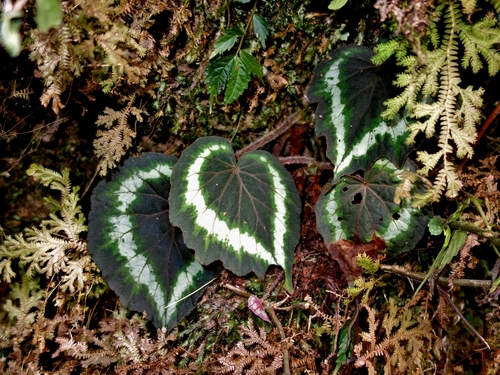
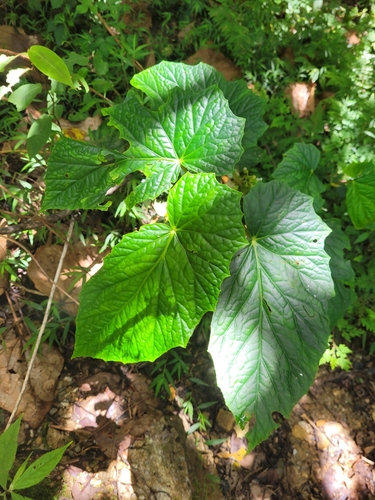
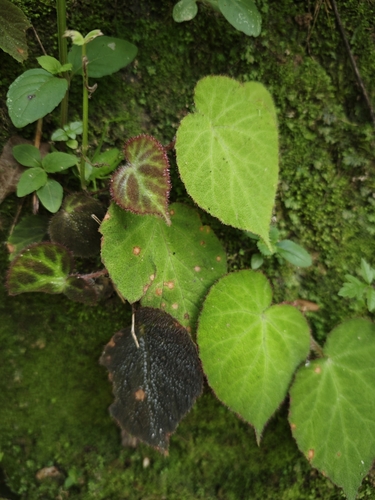
A herb. It grows 40 cm tall. It has a rhizome. The leaves are at the base. The leaf stalks are 35 cm long. The leaves are oval unequal on opposite sides. They are 6-33 cm long by 5-21 cm wide. They are purplish underneath.
Wikipedia
Source ↗Begonia rex, the king begonia, fancy-leaf begonia, or painted-leaf begonia is a species of flowering plant in the family Begoniaceae. It's a rhizomatous begonia first brought to England from Assam, and documented in 1857. It is native to the East Himalayas, found from southern Bhutan to northern Myanmar, and has been introduced to Bangladesh, Cuba, the Dominican Republic, and Haiti. These plants are noted for their dark leaves with prominent silvery grey bands, and are usually grown for their foliage, not flowers. When this species was introduced into cultivation, it became popular as a houseplant. Hybrids began to appear with varying leaf patterns as Rex begonias hybridize quite freely.
Notes
There are 900-1,000-1,500 Begonia species.
Names & Synonyms
Kraljevska begonija, Thuhaiduong vua
References (8)
- Ambasta S.P. (Ed.), 2000, The Useful Plants of India. CSIR India. p 70
- Bussman, R. W., et al, 2021, Unity in diversity—food plants and fungi of Sakartvelo (Republic of Georgia), Caucasus. Journal of Ethnobiology and Ethnomedicine (2021) 17:72 p 7
- Fl. Serres Jard. Eur. 12:141, t. 1255, 1258. 1858
- Heywood, V.H., Brummitt, R.K., Culham, A., and Seberg, O. 2007, Flowering Plant Families of the World. Royal Botanical Gardens, Kew. p 59
- Hibbert, M., 2002, The Aussie Plant Finder 2002, Florilegium. p 41
- Kew Plants of the World Online
- Mapes, C. & Basurto, F., 2016, Biodiversity and Edible Plants of Mexico. Chapter 5 in R. Lira, et al. (eds.), Ethnobotany of Mexico, Ethnobiology, Springer. p 114
- Plants of Haiti Smithsonian Institute http://botany.si.edu