Cotoneaster racemiflorus
(Desf.) J. R. Booth ex Bosse
Black-wood
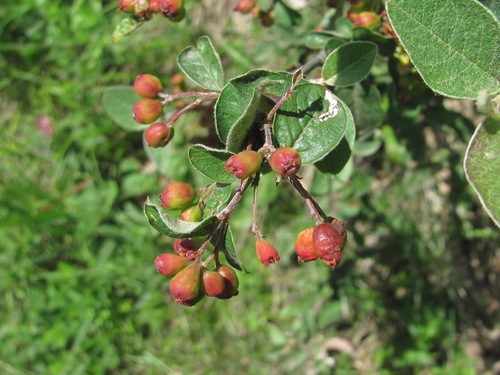
(c) Gennadiy Okatov, some rights reserved (CC BY-NC), uploaded by Gennadiy Okatov
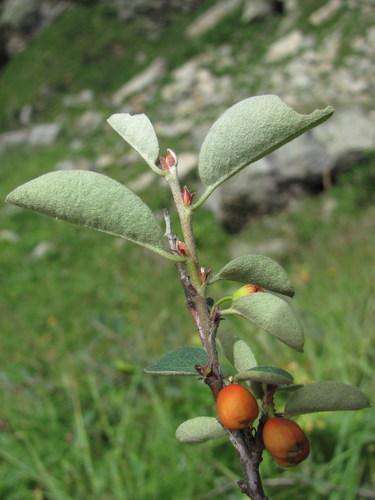
(c) Gennadiy Okatov, some rights reserved (CC BY-NC), uploaded by Gennadiy Okatov

(c) Валерий Тихомиров, some rights reserved (CC BY-NC)
What to Eat
Edible parts: Manna
The plant yields a manna-like substance called shir-khist, which is rich in sugars — containing approximately 13% sucrose and 37.5% dextrose. The exact part of the plant that produces it is unspecified, though the stem is the most likely source.
Where to Find It
It is a temperate plant. It will grow in most soils. It is resistant to frost and drought. It suits hardiness zones 3-9.
Africa, Asia, Australia, Central Asia, Europe*, Himalayas, India, Iran, Middle East, North Africa, Tajikistan,
How to Identify
A deciduous shrub. It grows 1.8 m high and spreads 1.8 m wide. The stem is erect and slender. The branches arch over. The leaves are oval and hairy. They are velvety underneath and have a spiky tip. The flowers are small and white. The fruit are red.
How to Grow
It can be grown from seeds or by cuttings.
Propagation: Seed. Members of this genus hybridize freely, so seed should be obtained from a known wild source or controlled fertilization if true breeding is required. Sow seed as soon as it is ripe in autumn in a cold frame; it will usually germinate in spring. Stored seed germinates faster with 3 months warm stratification at 15°C followed by 3 months cold stratification at 4°C. Germination usually occurs within 1–18 months at 15°C but can take 2 years. Pot seedlings as soon as they are large enough to handle, and plant out into nursery beds or permanent positions when more than 10cm tall. Cuttings of half-ripe wood with a heel can be taken in July or August in a frame. Cuttings of mature wood from the current year's growth, preferably with a heel, can be taken in November in a frame.
Medicinal Uses
The plant is aperient, expectorant, and stomachic.
Other Uses
A rose-tan dye is obtained from the fruit. The wood is used in basket making.
Wikipedia
A deciduous shrub reaching 2.4 m tall with medium growth rate. Hardy to UK zone 3. Flowers May to June with hermaphrodite blooms pollinated by flies and midges. Adapts to light sandy, medium loamy, and heavy clay soils with preference for well-drained conditions; tolerates heavy clay and poor soils. Grows in mildly acid to very alkaline pH ranges. Suitable for semi-shade or full sun, tolerates dry or moist soil. Withstands strong winds and atmospheric pollution but not maritime exposure. Noted for attracting wildlife.
Notes
There are more than 200 Cotoneaster species. The manna is 13% saccharine and 37.5% destrose.
Names & Synonyms
References (7)
- Ambasta, S.P. (Ed.), 2000, The Useful Plants of India. CSIR India. p 144
- Bodkin, F., 1991, Encyclopedia Botanica. Cornstalk publishing, p 291
- Donkin,
- Etherington, K., & Imwold, D., (Eds), 2001, Botanica's Trees & Shrubs. The illustrated A-Z of over 8500 trees and shrubs. Random House, Australia. p 237
- Facciola, S., 1998, Cornucopia 2: a Source Book of Edible Plants. Kampong Publications, p 196 (As Cotoneaster racemiflora)
- Uphof,
- Vollstandiges Handb. der Blumengartnerei 4:177. 1849 "racemiflora"
More from Rosaceae


