Erycibe paniculata
Roxb.
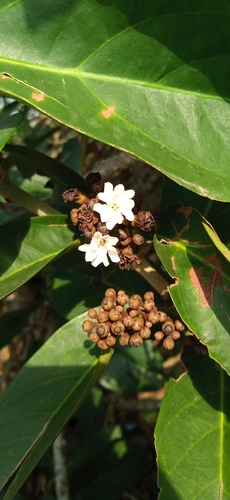
(c) Hani Ristiawan, some rights reserved (CC BY-NC), uploaded by Hani Ristiawan
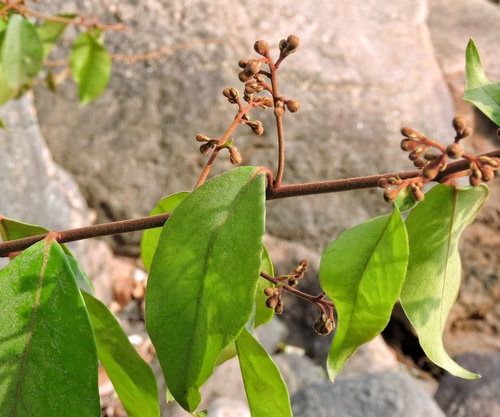
(c) Subhajit Roy, some rights reserved (CC BY-NC-ND), uploaded by Subhajit Roy
What to Eat
Edible parts: Fruit
The sweet berries are eaten.
Where to Find It
It is a subtropical plant. It grows in moist deciduous forests.
Andamans, Asia, Himalayas, India, Myanmar, Northeastern India, SE Asia,
How to Identify
A large woody climber. The leaves and flowers have a rusty coating. The leaves are oval. They are 4-8 cm long by 2-5 cm wide. They taper to a blunt tip. The flowers are yellow and have a scent. They are 6-8 mm across. The fruit is an oval berry. They are 6-8 mm long by 3-4 mm wide. They are small and black when ripe. They have one seed.
Wikipedia
Source ↗Erycibe paniculata is a dicot rainforest liana of the family Convolvulaceae and is native to Indo-China and southern China. It is noteworthy for its very curious petals. Each flower has a five-lobed corolla from each lobe of which project two petal-like extensions at about a 45 degree angle from each other.
Production
In southern India it flowers and fruits November to March.
Notes
There are about 66 Erycibe species. They are mostly in Asia.
Names & Synonyms
Bodolombomano, Irimpi yatali, Kari, Nigoni boal lota, Niguniboallota, Puttapalatige, Unam-kodi
References (6)
- Ambasta, S.P. (Ed.), 2000, The Useful Plants of India. CSIR India. p 203
- Heywood, V.H., Brummitt, R.K., Culham, A., and Seberg, O. 2007, Flowering Plant Families of the World. Royal Botanical Gardens, Kew. p 109
- Patiri, B. & Borah, A., 2007, Wild Edible Plants of Assam. Geethaki Publishers. p 86
- Ramakrishna, N. & Singh, DSR, R., 2020, Ethno-Botanical Studies of Edible Plants Used by Tribal Women in Nirmal District. IJSRSET p 309
- Sarma, H., et al, 2010, Updated Estimates of Wild Edible and Threatened Plants of Assam: A Meta-analysis. International Journal of Botany 6(4): 414-423
- Wild edible plants of Himachal Pradesh


