Ficus pumila
Linn.
Creeping fig, Climbing fig, Ivy-like fig

(c) beingplace, some rights reserved (CC BY-NC), uploaded by beingplace

(c) fu-han-sheng, some rights reserved (CC BY-NC)

(c) Ahmad Fuad Morad, some rights reserved (CC BY-NC-SA)
What to Eat
Edible parts: Fruit
The fruit of Ficus pumila var. awkeotsang is used in cuisine. In Taiwan, its fruit is turned inside out and dried. The seeds are scraped off and a gel is extracted from their surface with water and allowed to set and form a jelly known in Taiwan as aiyu jelly (or aiyuzi 愛玉子) and in Singapore as ice jelly (文頭雪).
Known Hazards
Where to Find It
A subtropical plant. It can grow in sun or shade. It needs moderate moisture. It will grow on most well-drained soils. It cannot tolerate frost. Melbourne Botanical gardens. Hobart Botanical Gardens. It suits hardiness zones 8-11.
Africa, Asia, Australia, Bangladesh, China*, Cuba, Dominican Republic, East Africa, Fiji, Guam, Haiti, India, Indochina, Indonesia, Japan*, Malaysia, Mozambique, Myanmar, Nepal, New Zealand, Niue, North America, Pacific, Pakistan, Puerto Rico, Sao Tome and Principe, SE Asia, Sri Lanka, Tasmania, Thailand, Tibet, USA, Vietnam, West Indies, Zimbabwe,
How to Identify
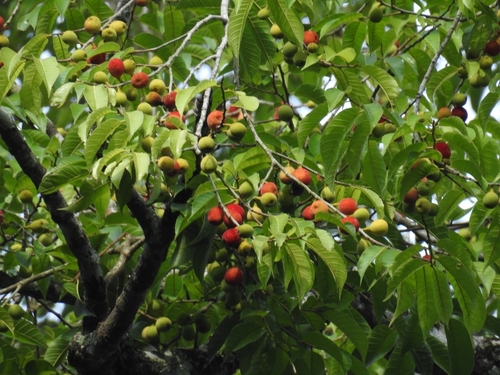
A climbing fig. It clings to other plants. There are climbing aerial roots in the axils of leaves. It can climb 14 m or more. It often climbs up buildings. It can spread very widely. The leaves are of 2 types. The leaves are small, flat and heart shaped. They are 4-5 cm long. With age, new non climbing growth appears. These form thick stem. This growth has larger leaves which are fleshy. The flowers are very small. The occur singly. The fig or fruit are barrel-like and purplish green. They can be 5 cm long by 3 cm wide. The young figs are green but turn purple as they ripen.
How to Grow
It needs a specific pollinator wasp for fruit. Where these occur it can be grown from seed. They can also become selfsown. It can be grown from cuttings and can spread from stem growth. It is often grown covering walls.
Propagation: Seed - germinates best at a temperature around 20°c. Air layering. Tip cuttings around 4 - 12cm long, taken from lateral branches.
Medicinal Uses
Both the aerial parts and the fruits are considered to be galactagogue and tonic, and are seen as a systemic remedy and blood reconstiluent. A decoction or tincture of either is used in treating conditions such as anaemia, chronic dysentery, haemorrhoids, galactophoritis, spermatorrhoea, impotence, menstrual disorders. dysuria, haematuria, constipation, rheumatism, lumbago. osteodynia, boils and impetigo. Externally the leaves are applied to carbuncles. The latex is reported to have anthelmintic properties. In cases of dropsy the plant ash is rubbed on the body.
Other Uses
Planted as a nematode-resistant rootstock for Ficus carica. The plant is traditionally grown in living fences in the northwestern Himalayas, where it helps to exclude livestock and other animals; mark out land boundaries; whilst also providing a range of medicinal and other uses.
Wikipedia
Source ↗Ficus pumila, commonly known as the creeping fig or climbing fig, is a species of flowering plant in the mulberry family, native to East Asia (southern China, southern Japan, Vietnam) and naturalised in parts of the southeastern and south-central United States. It is also found in cultivation as a houseplant. The Latin specific epithet pumila means "dwarf", and refers to the very small leaves of the plant.
Production
It is slow growing.
Notes
There are about 800-1000 Ficus species. They are mostly in the tropics. There are 120 Ficus species in tropical America. It can be invasive.
Names & Synonyms
Ara jalar, Co trau, Dongshili, Hiedra, Hsueh-li, Kyauk-kat-nyaung-nwe, Lata dumur, Lin suea, Mu-lien, Mu-man-tu
References (24)
- Ambasta, S.P. (Ed.), 2000, The Useful Plants of India. CSIR India. p 223
- Cundall, P., (ed.), 2004, Gardening Australia: flora: the gardener's bible. ABC Books. p 604
- Engel, D.H., & Phummai, S., 2000, A Field Guide to Tropical Plants of Asia. Timber Press. p 219
- Etherington, K., & Imwold, D., (Eds), 2001, Botanica's Trees & Shrubs. The illustrated A-Z of over 8500 trees and shrubs. Random House, Australia. p 328
- Facciola, S., 1998, Cornucopia 2: a Source Book of Edible Plants. Kampong Publications, p 155
- Flora of China @ efloras.org Volume 5
- Hibbert, M., 2002, The Aussie Plant Finder 2002, Florilegium. p 102
- Hu, Shiu-ying, 2005, Food Plants of China. The Chinese University Press. p 360
- Ju, Y., et al, 2013, Eating from the wild: diversity of wild edible plants used by Tibetans in Shangri-la region, Yunnan, China, Journal of Ethnobiology and Ethno medicine 9:28
- Levy-Yamamori, R., & Taaffe, G., 2004, Garden Plants of Japan. Timber Press. p 272
- Llamas, K.A., 2003, Tropical Flowering Plants. Timber Press. p 278
- Marinelli, J. (Ed), 2004, Plant. DK. p 455
- Miguel, E., et al, 1989, A checklist of the cultivated plants of Cuba. Kulturpflanze 37. 1989, 211-357
- Pasha, M. K. & Uddin, S. B., 2019, Minor Edible Fruits of Bangladesh. Bangladesh J. Plant Taxon. 26(2): 299–313
- Plants of Haiti Smithsonian Institute http://botany.si.edu/antilles/West Indies
- Smith, A.C., 1981, Flora Vitiensis Nova, Lawaii, Kuai, Hawaii, Volume 2 p 180
- Sp. pl. 2:1060. 1753
- Staples, G.W. and Herbst, D.R., 2005, A tropical Garden Flora. Bishop Museum Press, Honolulu, Hawaii. p 410
- Sukarya, D. G., (Ed.) 2013, 3,500 Plant Species of the Botanic Gardens of Indonesia. LIPI p 928
- Swaminathan, M.S., and Kochnar, S.L., 2007, An Atlas of major Flowering Trees in India. Macmillan. p 258
- Wang, J., et al, 2020, An ethnobotanical survey of wild edible plants used by the Yi people of Liangshan Prefecture, Sichuan Province, China. Journal of Ethnobiology and Ethnomedicine 16:10 p 8
- Wiersema, J. H. & Leon, B., 2013, World Economic Plants. A Standard Reference CRC Press. 2nd Ed. p 305
- World Checklist of Useful Plant Species 2020. Royal Botanic Gardens, Kew
- www.eFloras.org. Flora of China